Aug 26, 2022
WHAT IS AN ADVERB?

What is an Adverb?
An Adverb is one of the parts of speech that expresses to transform or to modify other types of words like another adverb, adjective, clause, verb, or any other word or phrase, clause, preposition, determiner, etc. except certain adjectives that qualify straight nouns.
Describe and define: What is an adverb ?
An adverb is a word that describes how an action is carried out. Adverbs can change or add detail to a verb, adjective, or even a whole clause. When discussing the adverb form, there are several adverb forms. For example, adverb forms that add -ly, -ble, -bly, -ley, -sly. It is often difficult to tell at first whether the word is an adjective or an adverb. The general rule is to look at the other words which it occurs with. If it comes before a noun it is probably an adjective.
What does the Adverb form do?
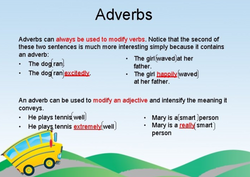
The main function of an adverb is to modify verbs or verb phrases. In other words, they add extra descriptive detail to the verb to help describe how that verb was carried out.
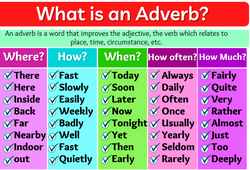
Adverbs are sometimes used to describe manner or time. In other words, they add detail about when, how, where, or why something is being done.
In English, adverbs are often found after the verb, but they can also precede the verb that they are modifying.
Why are Adverbs and adverb forms important?
Adverbs are important because they are the part of the sentence that adds more detail and information to it. They give additional detail about how things happen, and they are arguably what makes a string of words unique and interesting in a sentence.
How do you identify an adverb?
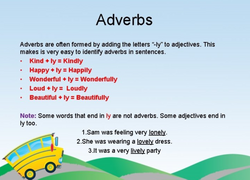
It is often recognized by the suffix -ly at the end of it. Adjectives usually describe an action in terms of how, when, where, and to what extent it occurred.
What are 5 examples of adverbs?
1. James clapped loudly.
2. The child ran happily towards their mother.
3. She quickly agreed to re-type the letter.
4. He asked me to leave the house quietly.
5. He plays the flute beautifully.
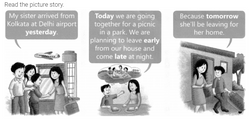
A. Answer the following questions as per the story.
1. When did the sister arrive from Kolkata? ___________
2. When are they planning to leave and come? ___________
3. When will be the sister leaving for her home? ___________
B. Complete the following sentences using appropriate verbs or adverbs.
1. I saw him ___________
a. yesterday
b. tomorrow
2. I ___________ your father tomorrow.
a. see
b. am seeing
3. My plane ___________ tomorrow.
a. leaves
b. left
4. I haven’t seen her ___________ Monday.
a. since
b. for
5. I went there ___________
a. yesterday
b. tomorrow
A. Pick out adverbs from the following sentences. The first one has been done for you.
1. She will come soon. soon
2. The play will begin now. ___________
3. The boy came early. ___________
4. I will see him tomorrow. ___________
5. He has arrived today. ___________
6. The train will reach Delhi tomorrow. ___________
7. Your desire will be fulfilled soon. ___________
8. He also died soon after consuming it. ___________
9. Now let me bake a cake for my son. ___________
10. We should never fall into the hands of the moneylenders. ___________
B. Write whether the underlined adverb is describing when, where, or how an action happens.
1. Rohit quickly ate his lunch. ___________
2. Neil often reads books about vampires. ___________
3. Oliver immediately came to the rescue. ___________
4. When will you come here to visit us? ___________
5. Molly slowly walked to the barber shop. ___________
6. Sometimes Varun goes to the museum. ___________
7. Please speak clearly. ___________
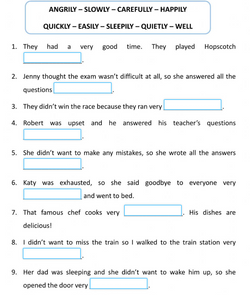
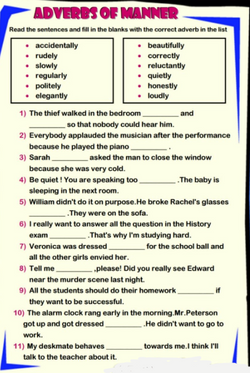
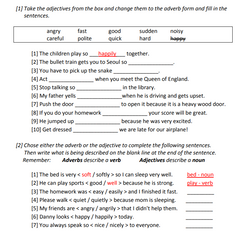
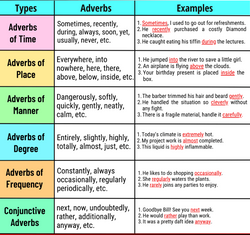
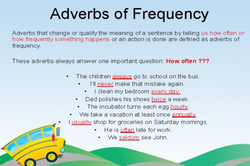
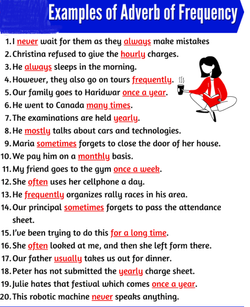
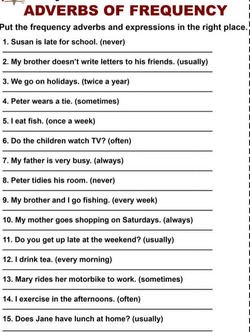
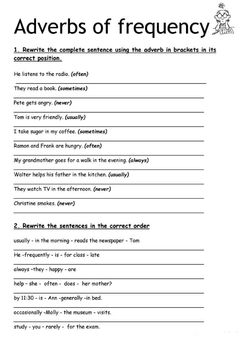
Adverbs of frequency
We can use adverbs of frequency to say how often we do something.
1. I always go to the cinema at the weekend.
2. She usually has cereal for breakfast.
3. They sometimes watch TV in the evenings.
4. We never go to museums.
How to use them
Always means every time. Usually means most times. Sometimes means a small number of times. Never means no times.
1. She always practises the piano in the evenings. Every day!
2. We usually go to the park on Sundays. Most Sundays!
3. They sometimes make a cake. Just for special days!
4. He never forgets his homework. No times!
We usually put the adverb before the verb.
1. She always does her homework after school.
2. I usually have cereal for breakfast.
If the verb is to be, we put the adverb after the verb.
1. They are usually on holiday in July.
2. He is sometimes late for school.
To ask a question, use often or how often.
1. Does she play football often?
2. How often do you play computer games?
Adverbs of Evaluation
Adverbs of evaluation also called commenting adverbs, offer commentary or judgment. These words are subjective and can relate opinions or degrees of certainty.
Here are some examples of adverbs of evaluation:
Actually
Apparently
Clearly
Frankly
Fortunately
Hopefully
Luckily
Sadly
Thankfully
Unbelievably
Unfortunately
Adverb Examples in Sentences
Now, let’s use some of our examples of adverbs in sentences.
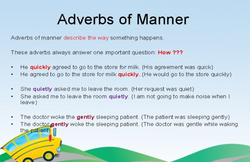
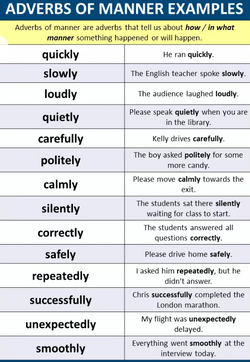
First, let’s start with some adverbs of manner.
1. The new hire accidentally deleted everything off the shared drive.
2. The seventh-grade boy leaned in awkwardly for a kiss from his crush.
3. I cannot believe how beautifully she painted the backdrop for the play.
4. Briefly describe your work experience in your cover letter.
5. After getting glasses, he could see clearly for the first time ever.
6. I love you dearly even after twenty years together.
7. He reached his hands eagerly into the cookie jar.
8.The writer foolishly did not back up her manuscript, and the power went out.
9.. She snarled jealously at the woman hitting on her spouse.
10. The girl entered the stage nervously and began to sing.
11. If you’re not going to fold the towels properly, don’t do it at all.
12. The man, who answered the phone rudely, said my RV was too old to stay there then hung up on me.
13. . The new member timidly took a seat near the back of the group.
14. After the race, we voraciously ate a huge brunch.
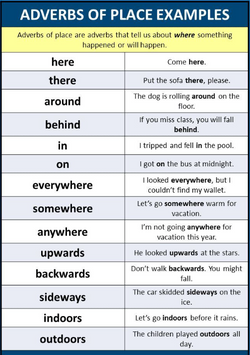
Now, here are some examples of adverbs of place:
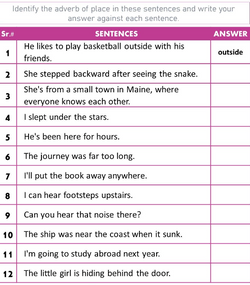
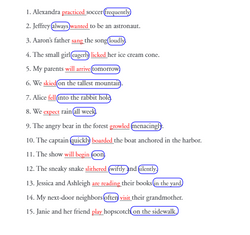
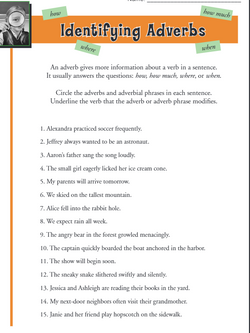
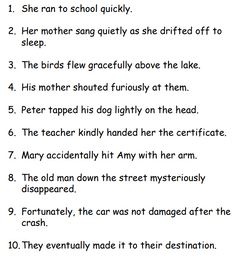
Identify the adverb in the sentence.
By undefined
39 notes ・ 98 views
English
Beginner