Sep 20, 2022
TYPES OF VERBS: TRANSITIVE AND TRANSITIVE VERBS

A verb is the action word of a sentence but can also describe a state of being.
erbs are as essential to a sentence as bread is to a sandwich. Without verbs, sentences wouldn’t be, well, sentences!
What Is a Verb?
A verb is one of the eight parts of speech (a category which words fall under, depending on their function within a sentence). Verbs are one of the most important parts of speech because every sentence requires at least one verb. A few examples of verbs are:
sing, explore, dance, walk, say, change, will, can, be
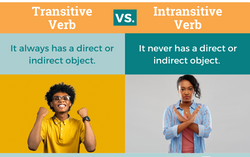
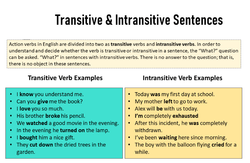
TWO TYPES OF THE VERBS
How Do You Identify the Intransitive Verb in a Sentence?
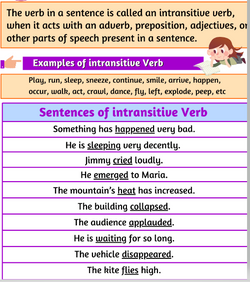
Identifying the intransitive verb in a sentence requires you to look for what isn’t there.
First, find the action verb in the sentence.
Then look at what comes after the verb. Is there a noun close by that is receiving the action?
That noun is the direct object. It usually immediately follows the verb, although it can have a determiner or adjective in front.
If there’s no direct object, the verb you found is an intransitive verb.
What is a transitive verb in English?
Transitive verb definition: a transitive verb is a main verb that has an object: a person or a thing. The object receives the action (transitive verb) and comes right after it. Without its object, it looks incomplete. So, always try to mention the object of a transitive verb.
Study the following examples using transitive verbs:
I love my friends. (object = my friends)
I will burn the papers in some time. (object = the papers)
He studied Botany for 3 years. (object = Botany)
Jon and I bought a house last week. (object = a house)
How to find a transitive verb?
To find out the transitive verb in a sentence is easy. Ask ‘what‘ or ‘whom‘ to the verb to find out the object of the verb. The answer to the question ‘what’ is always an object (non-living), and the answer to the question ‘whom’ is always a person.
If the verb answers any of the two questions, it is a transitive verb. But if it does not, it is not a transitive verb. Let’s take some examples and try this.
She is cooking pasta for dinner.
Cooking ‘what’ = pasta
Cooking ‘whom’ = no answer (she won’t a person)
Asking what to the verb gets us the object of the verb ‘cook’ and tells us that it is a transitive verb.
I did not invite Rashmi to the wedding.
Asking whom to the verb gets us its object: Rashmi. Whom did I not invite to the wedding? It is Rashmi (the object of the verb).
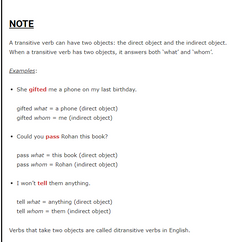
Notice the transitive verbs in the above examples take an object after them. Now, imagine these sentences not having the object of these verbs.
I love.
I will burn in some time.
He studied for 3 years.
Jon and I bought last week.
KNOWLEDGE TEST
Identify if the sentences are Transitive and Intransitive Sentences
1. I go to the movies with my girlfriend every week.
The verb in the example sentence given above is intransitive because it has no object and the verb concerns only the subject.
2. I saw him on the beach last night.
The verb in the example sentence given above is transitive because it answers the question “who”.
3. The doctor examined the old patient.
The verb in the example sentence given above is transitive because it answers the question “who”.
4. I gave one of my favorite books to my girlfriend’s cousin.
The verb in the example sentence given above is transitive because it answers the question “what”.
5. I am reading books from Russian literature.
The verb in the example sentence given above is transitive because it answers the question “what”.
6. Karen doesn’t love you, so I don’t think you should try so hard to meet her.
The verb “does not like” in the example sentence given above is transitive because it answers the question “who”.
6. My sweet daughter spoke for the first time.
The verb in the example sentence given above is intransitive because it has no object and the verb concerns only the subject.
7. My little pet dog ran for the first time yesterday.
The verb in the example sentence given above is intransitive because it has no object and the verb concerns only the subject.
7. My best friend, Brandon, walks 8 miles almost every day.
The verb in the example sentence given above is intransitive because it has no object and the verb concerns only the subject.
8. I think I remember you.
The verb in the example sentence given above is intransitive because it has no object and the verb concerns only the subject.
9. I think I remember you.
The verb in the example sentence given above is intransitive because it has no object and the verb concerns only the subject.
10. Mike saw me last night around half-past eight.
The verb in the example sentence given above is intransitive because it has no object and the verb concerns only the subject.
INSPIRING QOUTES OF THE DAY
“Always do your best. What you plant now, you will harvest later.”
By undefined
20 notes ・ 62 views
English
Beginner