Jul 10, 2026
Let them think
INTRODUCTION — My Story
Part 1: The Situation
1. At the age of 41, I found myself $800,000 in debt, unemployed, and watching my husband's restaurant business crumble. It felt like we had failed at life with no hope of ever escaping the debt.
2. I enviously watched as my friends found success after success in their careers while we struggled to get groceries on the table. I had just been laid off and had no idea what to do with my life: I'd already tried being a public defender for the Legal Aid Society in New York City, being a lawyer in a large firm in Boston, working for a few start-ups, doing business development at an advertising agency, becoming a life coach, hosting a call-in radio show, and even opening a small paint-your-own-pottery-studio. I felt completely lost, like nothing I did would ever be enough to dig us out of the hole we were in.
Vocabulary & Pronunciation:
| Word | Meaning | Pronunciation |
|---|---|---|
| crumble | to slowly fall apart or fail | KRUM-bul |
| enviously | feeling envy; wishing you had what someone else has | EN-vee-us-lee |
| unemployed | without a job | un-em-PLOYD |
| laid off | lost a job (company decision, not your fault) | — |
| legal aid | free legal help for people who can't afford a lawyer | — |
| business development | finding new clients/partners for a company | — |
| life coach | someone paid to help guide personal/career decisions | — |
| pottery | clay objects, often handmade | PAH-tuh-ree |
Part 2: The Avoidance
1. To deal with the anxiety and self-doubt, my main strategy became avoidance. Avoid getting up by hitting the snooze button. Avoid the pain with alcohol. Avoid responsibility by blaming my husband. Avoid looking for a job by procrastinating however I could.
Vocabulary & Pronunciation:
| Word | Meaning | Pronunciation |
|---|---|---|
| anxiety | a strong feeling of worry or fear | ang-ZY-uh-tee |
| self-doubt | lack of confidence in oneself | — |
| avoidance | staying away from something on purpose | uh-VOY-dunts |
| snooze button | button on an alarm clock to delay waking up | SNOOZ |
| procrastinating | delaying or putting off tasks | proh-KRAS-tuh-nay-ting |
Part 3: Stuck Despite Knowing
1. If you've ever been in this situation, you understand how monumental even the simplest tasks seem: getting out of bed, opening your bills, being fully present with your family, cooking a nice meal, applying for a job, going for a walk, canceling that subscription, or even just being honest about the extent to which you're struggling... Everything feels impossible.
2. Every morning when I woke up, the anxiety was coursing through my veins, and I thought, Is this really what it's going to look like for the rest of my life?
3. But you want to know the funny thing about being stuck? I knew exactly what I needed to do: get up, tackle the dreaded pile of bills, get the kids ready for school, make myself go on walks, reach out to my friends for support, make a budget, find a job. And yet, I couldn't seem to do any of it.
Vocabulary & Pronunciation:
| Word | Meaning | Pronunciation |
|---|---|---|
| monumental | very large or difficult | mahn-yoo-MEN-tul |
| fully present | giving complete attention, not distracted | — |
| subscription | a recurring paid service | sub-SKRIP-shun |
| coursing through my veins | flowing quickly through the body (used for strong feeling) | KOR-sing |
| dreaded | feared or disliked in advance | DRED-id |
| tackle | to deal with a problem directly | TAK-ul |
Author's Message
The author shares her personal low point — deep in debt, jobless, and watching her marriage's business fail — to show how anxiety can trap people in avoidance, even when they know exactly what needs to be done. Her honesty sets up the book's core theme: knowing the right action isn't the same as being able to take it.
How I Changed My Life
Part 1: The Morning Everything Changed
1. I'll never forget the morning when everything changed for me. The alarm went off, and there I was, lying in bed, completely overwhelmed by our problems. Like so many of us, I was paralyzed by my own thoughts, and the last thing I wanted to do was get up and face another day.
2. But then, something strange happened. A thought popped into my head that would ultimately change my life. It was so simple, almost silly. I remembered watching a rocket launch and the way NASA counted down to blast off: 5-4-3-2-1. I thought, What if I just counted backward like that and launched myself out of bed?
3. It seemed ridiculous, but I was desperate, so I gave it a shot. I counted backward: 5-4-3-2-1—and I got out of bed. Just like that. I didn't think about how tired I was or how much I didn't want to face my problems. I simply moved before my brain had the chance to talk me out of it. It's like launching a rocket: Once you start the countdown, 5-4-3-2-1, there's no turning back.
4. At that point in my life, I was so used to letting my thoughts paralyze me and fear and stress consume me that the concept felt completely foreign. I remember what a revelation it was when I thought to myself, Wait a minute, I can feel horrible and still do what I need to do? Yes, Mel, you can. And it worked.
Vocabulary & Pronunciation:
| Word | Meaning | Pronunciation |
|---|---|---|
| overwhelmed | feeling like a problem is too big to handle | OH-ver-welmd |
| paralyzed | unable to move or act | PAIR-uh-lyzd |
| blast off | the moment a rocket launches | BLAST OF |
| desperate | willing to try anything out of great need | DES-per-it |
| foreign | unfamiliar, strange | FOR-in |
| revelation | a surprising realization | rev-uh-LAY-shun |
Part 2: The 5 Second Rule Is Born
1. In those five seconds, I had interrupted the cycle of overthinking. It felt like a small victory, but it was also a revelation. If I could push through those five seconds of fear, maybe I could push through anything.
2. So, I started using this countdown everywhere in my life.
3. 5-4-3-2-1 Get up when the alarm rings.
4. 5-4-3-2-1 Pick up the phone and start networking to find a job.
5. 5-4-3-2-1 Open the bills that had been piling up on the counter for months.
6. I started calling this the "5 Second Rule." One 5-second move at a time, I forced myself to put one foot in front of the other and slowly step back into my life. I won't lie to you. It wasn't easy. The next couple of years were among the hardest of my life.
Vocabulary & Pronunciation:
| Word | Meaning | Pronunciation |
|---|---|---|
| interrupted | stopped something in the middle | in-tuh-RUP-tid |
| overthinking | thinking too much about something, often anxiously | OH-ver-think-ing |
| networking | building professional contacts/relationships | NET-wur-king |
| piling up | accumulating, growing in a stack | PY-ling up |
Part 3: The Hard Years
1. It's not easy to claw your way out of debt or face the painful issues in your marriage. It's not easy to quiet the anxiety or push through the self-doubt. It's hard to update your résumé and look for a job when you question the value you bring. It's a grind to force yourself to get back in shape and create healthier habits after you've let yourself go.
2. And it's definitely not glamorous to work all day, then come home, take care of three kids, spend a few minutes with my husband, and then stay up late every night, trying to figure out ways I can make more money.
3. But that's what I did.
4. The 5 Second Rule taught me that action is the answer. Thinking about your problems will never solve them. Waiting around to feel like doing something means you'll never do it. It taught me that no one is coming to save you. You must save yourself from yourself. You have to force yourself to make little moves forward, all day, every day, especially when you don't feel like it.
Vocabulary & Pronunciation:
| Word | Meaning | Pronunciation |
|---|---|---|
| claw your way out | escape a difficult situation with great effort | KLAW your way out |
| grind | continuous hard, tiring work | GRYND |
| let yourself go | stopped taking care of your appearance/health | let yourself GO |
| glamorous | attractive, exciting, impressive-looking | GLAM-er-us |
Part 4: The TEDx Talk
1. Using 5-4-3-2-1, I pushed through the excuses, the anxiety, the overwhelm, and the fear. And step by step, day by day, week by week, I slowly took the actions that put my life and career back on track. My husband started using it to push himself to face the issues in his business head-on, and it worked for him too. But it would be another three years before I told anyone else about the 5 Second Rule. I had been reluctant to share it with anyone because, first, I didn't know why it worked. And second, I didn't feel like I was in a position to give anybody advice.
2. But that all changed one fateful day when an old roommate recommended me as the "perfect person" to give advice on career change at a small event. I suppose she thought of me because I had changed my career so many times, even I had lost count. The event offered to fly me and my husband to San Francisco and put us up in a hotel. When you're struggling financially, that sounds like a free vacation, so I said yes. This was the first time I had ever given a speech on a stage at an event. The only public-speaking class I had ever taken was in high school, and as soon as I boarded the plane, that's when the panic started to sink in: What on earth have I gotten myself into?
3. When I walked on stage and saw 700 people in the audience staring back at me, my mind went blank, and I could feel my chest and neck turning red. I then proceeded to have a 21-minute-long anxiety attack onstage. About 19 minutes in, I forgot how to end my talk on career change, so I blurted out the 5 Second Rule and how I use it, because I couldn't think of anything else to say. I must have blacked out, because I also don't remember the part where I gave everyone in the audience my email address. And as I walked off that stage, I thought that was the worst experience of my life. Thank God it's over.
4. It turns out that small event was one of the first TEDx conferences ever held. They filmed it, and a year later, posted the video online. Not only did it go viral—it's become one of the most watched TEDx talks of all time. The 5 Second Rule and its 5-4-3-2-1 countdown spread by word of mouth around the world.
Vocabulary & Pronunciation:
| Word | Meaning | Pronunciation |
|---|---|---|
| reluctant | unwilling, hesitant | ree-LUK-tunt |
| fateful | having important, often unexpected consequences | FAYT-ful |
| head-on | directly, facing something without avoiding it | HED-ON |
| blurted out | said something suddenly, without thinking | BLUR-tid out |
| blacked out | temporarily lost memory or consciousness | BLAKT out |
| viral | spread rapidly online to many people | VY-rul |
| word of mouth | information spread by people talking to each other | WURD of MOWTH |
Part 5: The Rule Spreads Worldwide
1. As it spread, people started to write to me at that email address, sharing stories about how the Rule was changing their lives. I was so moved by people's stories that I would sit up late at night, after I had put our three kids to bed, answering their emails one by one.
2. When I had been drowning in my problems, I felt like I was the only one who had trouble doing the things I needed to do. It's not true. We all struggle with motivation. It's a universal problem, and the 5 Second Rule seems to be a solution that not only works for me but also works for people all over the world.
3. The stories were amazing: People had used 5-4-3-2-1 to push through fear, procrastination, and excuses to change jobs; lose 100 pounds; get sober; launch and sell businesses; improve their health and marriages. The medical and clinical uses blew me away. Doctors and psychologists were using it to treat PTSD, OCD, and depression. Even as I'm writing this Introduction, we have heard from over a thousand people who have used the 5 Second Rule to stop themselves from attempting suicide and to ask for help.
Vocabulary & Pronunciation:
| Word | Meaning | Pronunciation |
|---|---|---|
| drowning in problems | overwhelmed, unable to cope (used figuratively) | DROW-ning |
| universal | applying to everyone, everywhere | yoo-nih-VER-sul |
| get sober | stop drinking alcohol/using drugs | get SOH-ber |
| blew me away | impressed or surprised greatly | bloo me uh-WAY |
| PTSD | Post-Traumatic Stress Disorder | P-T-S-D |
| OCD | Obsessive-Compulsive Disorder | O-C-D |
Note: This part discusses suicide prevention. If this topic feels heavy for anyone in the group, it's okay to pause — support is available if needed.
Part 6: Understanding Why It Works
1. As that TEDx talk became more and more popular online, I started getting invited to speak at other small events. I remember being asked to talk to a group of Realtors at a bar. It was embarrassing standing there with a beer in my hand, trying to talk over the music and people gabbing in the next room. But I survived. I spoke in church basements, a high school classroom, then a friend's brown-bag lunch at work, and it just grew from there.
2. I would break out in hives as I held the microphone, and I wasn't getting paid. But the more I talked about the Rule and saw how powerful it was for everyone who tried it, the more I became obsessed with understanding why such a simple hack could lead to such profound results.
3. So, I put my lawyer hat on and started researching habits, human behavior, and the science of motivation. I needed to make a case: Why does counting 5-4-3-2-1 work? I gathered evidence from the experiences of ordinary people who had been using it. I found compelling precedent from the accounts of therapists, addiction specialists, and medical doctors who had begun recommending it to their patients, and all the evidence pointed to a simple explanation:
Vocabulary & Pronunciation:
| Word | Meaning | Pronunciation |
|---|---|---|
| Realtors | real estate agents | REE-ul-ters |
| gabbing | talking casually, chatting | GAB-ing |
| break out in hives | develop a skin reaction from stress/anxiety | brayk owt in HYVZ |
| obsessed | unable to stop thinking about something | ub-SEST |
| precedent | an earlier example used as support/evidence | PRESS-ih-dent |
| addiction specialists | professionals who treat addiction | uh-DIK-shun SPESH-uh-lists |
Small, Consistent Action Changes Everything
Part 1: Hiding the Struggle, Facing Depression
1. Meanwhile, my friends and extended family had no idea what I was doing because I was too scared to tell them. Mel? Giving advice? Give me a break. She nearly destroyed her own life.
2. At this point in my story, my husband had left the restaurant business and was struggling with depression. We were still drowning in debt, so I was working a full-time job trying to keep our family of five afloat while dedicating nights and weekends to speaking at small events and basically writing a dissertation on the science of motivation on the side.
Vocabulary & Pronunciation:
| Word | Meaning | Pronunciation |
|---|---|---|
| extended family | relatives beyond parents/siblings (aunts, cousins, etc.) | ik-STEN-did FAM-uh-lee |
| afloat | staying financially stable, not sinking into debt | uh-FLOHT |
| dissertation | a long, detailed research paper | dih-ser-TAY-shun |
Part 2: Waiting for Permission
1. I knew I wanted to teach the 5 Second Rule full-time and somehow make this my career, but I didn't know how. Looking back, I can see how paralyzed I was with imposter syndrome. What right did I have to call myself an expert in anything? I suppose I was just waiting for some kind of permission to put myself out there.
2. Maybe you're doing that right now. Waiting for the right time. Waiting to feel ready or a little less afraid. Waiting for someone to come along and tell you that today is the day to start. The problem with waiting is no one is coming. The only permission you need is your own.
Vocabulary & Pronunciation:
| Word | Meaning | Pronunciation |
|---|---|---|
| imposter syndrome | feeling like a fraud despite real success/skill | im-POS-ter SIN-drohm |
| put myself out there | take a risk by being visible/vulnerable publicly | put my-SELF owt THAIR |
| permission | official or personal approval to do something | per-MISH-un |
Part 3: The Speaking Career Takes Off
1. Deciding to get serious about trying to make money as a motivational speaker was one of the best decisions I have made in my life. I'll share more with you about what led to this breakthrough in the pages of this book. Once I started getting paid, I put every dollar toward chipping away at our debt. That first year I gave 17 paid speeches. The next year, it was 47, and I was able to quit my day job. I couldn't believe what was happening. By the third year, it was 99 speeches plus a 24-city tour with JPMorganChase. I had become the most-booked female speaker in the world. I was being hired by companies I admired.
2. How did this happen? By forcing myself out of bed on those mornings I didn't feel like it. Learning how to push yourself to take action when you are afraid or full of self-doubt or overwhelmed with excuses is a life skill you can learn. Once you master it, you'll understand that you can achieve anything through small, consistent moves forward.
Vocabulary & Pronunciation:
| Word | Meaning | Pronunciation |
|---|---|---|
| breakthrough | an important discovery or turning point | BRAYK-throo |
| chipping away | reducing something gradually, bit by bit | CHIP-ing uh-WAY |
| most-booked | hired the most often | most BOOKT |
Part 4: Growing Recognition
1. I found myself on the road 150 days a year, standing on stages teaching the 5 Second Rule and the science of motivation while my husband stayed home and took care of our three kids. Word about the Rule and my skill onstage grew and grew. One event had 27,000 people in the audience. CEOs from the world's top brands, professional athletes, medical doctors, neuroscientists, and bestselling authors had begun recommending my work to others. I started a newsletter because I no longer had time to respond to people's emails personally. I eventually wrote to the team at TEDx and asked if they could remove my email from the video online.
2. When people would ask if I had a Ph.D. or if I was a therapist, I would say, "No, I learned everything the hard way—by screwing up my own life and then having to fix it."
Vocabulary & Pronunciation:
| Word | Meaning | Pronunciation |
|---|---|---|
| neuroscientists | scientists who study the brain and nervous system | NOOR-oh-sy-en-tists |
| newsletter | a regular email/publication sent to subscribers | NOOZ-let-ter |
| Ph.D. | Doctor of Philosophy, an advanced academic degree | PEE-AYCH-DEE |
| screwing up | making a serious mistake (informal) | SKROO-ing up |
Part 5: Becoming an Author
1. Armed with years of experience, evidence, testimony, and research, I was finally ready to make my case in the form of a book. In 2017, I self-published The 5 Second Rule.
2. The 5 Second Rule went on to become the most successful self-published audiobook in history, and the sixth most read book of the year on Amazon. That book has now been read by millions of people and translated into 41 languages.
Vocabulary & Pronunciation:
| Word | Meaning | Pronunciation |
|---|---|---|
| armed with | equipped or prepared with (used figuratively) | ARMD with |
| testimony | a statement or account, often based on experience | TES-tih-moh-nee |
| self-published | published a book independently, without a publisher | SELF-PUB-lisht |
| translated | converted into another language | trans-LAY-tid |
Part 6: What She Learned Along the Way
1. Over the years of traveling across the country speaking on stages, I learned three important things: First, most of us are just trying to do our best to get ahead, pay our bills, raise a family, fall in love, have more fun, and reach the potential of our lives. We're just looking for simple ways to be a little happier and make our lives a little better. And we're not only looking for those resources for ourselves—we are looking for the people in our lives who need them too.
2. Second, I've been told over and over again that I have this amazing ability to distill complex ideas and scientific research into simple, actionable advice that anyone can use to improve their life.
3. And third, nothing brings me more joy than sharing what I am learning with people like you.
Vocabulary & Pronunciation:
| Word | Meaning | Pronunciation |
|---|---|---|
| reach the potential | fully develop one's abilities or possibilities | reech the poh-TEN-shul |
| distill | to reduce something complex into its essential, simple form | dih-STIL |
| actionable | able to be acted on practically | AK-shun-uh-bul |
Part 7: Building a Mission and a Company
1. So I have made it my mission to find and share many simple tools to help anyone create a better life. And the "simple" part is key, because if you remember it, you'll use it. For example, did you know that high-fiving yourself in the mirror is one of the fastest ways to rewire your mindset for self-confidence? Me either, and once I learned about it, I dug into the research and it became the topic of my New York Times bestselling book The High 5 Habit.
2. The more results people achieved using the 5 Second Rule and the High 5 Habit, the more organizations, media companies, and corporate brands asked me to create programming for their teams and audiences.
3. So I launched 143 Studios, a Boston-based production company that produces award-winning content, events, audio series, online courses, journals, books, and professional development education for partners like Starbucks, Audible, Ulta Beauty, JPMorganChase, LinkedIn, and Headspace.
Vocabulary & Pronunciation:
| Word | Meaning | Pronunciation |
|---|---|---|
| mission | a strong sense of purpose or goal | MISH-un |
| rewire your mindset | change deep mental habits or thought patterns | ree-WY-er your MYND-set |
| bestselling | a book that sells in very high numbers | BEST-sel-ing |
| programming | organized content or activities (media/education context) | PROH-gram-ing |
Part 8: Expanding Reach
1. In 2022, we launched and started producing The Mel Robbins Podcast, which airs in 194 countries and is one of the top-ranked podcasts in the entire world. We've created free online courses that more than a million students have completed. And that little newsletter I created way back when is now read twice a week by a million and a half people.
2. For everything I have accomplished, I had no prior experience or the "proper" credentials to pursue. I just made myself do it.
Vocabulary & Pronunciation:
| Word | Meaning | Pronunciation |
|---|---|---|
| airs | is broadcast (used for TV/radio/podcasts) | AIRZ |
| top-ranked | rated among the highest in quality or popularity | TOP-RANKT |
| credentials | qualifications, certificates, or proof of expertise | krih-DEN-shulz |
Part 9: The Real Reason for the Change
1. I was 41 when I had that anxiety attack on the TEDx stage. I was 46 when I got my first speaking paycheck. I was 49 when I self-published my first book. I was 50 when I started my production company. And I was 54 when I launched one of the fastest-growing podcasts in the world.
2. My life didn't change because of one thing that I did; it changed because of the thousands of mornings where I woke up and didn't feel like getting out of bed, but I 5-4-3-2-1 made myself do it.
Vocabulary & Pronunciation:
| Word | Meaning | Pronunciation |
|---|---|---|
| paycheck | payment received for work | PAY-chek |
| fastest-growing | increasing in size/popularity at a rapid rate | FASS-tist-GROH-ing |
Changing My Life Wasn't Glamorous; It Was Grueling.
Part 1: The Real Reason for Success
1. I didn't achieve success or financial freedom because of some secret. I did it because I was willing to do what most people won't: I woke up every day, and regardless of how I felt, I kept slowly chipping away at my goals for over a decade, a painstakingly slow process.
2. Some days, all I focused on was just trying to be a little better than I was the day before. Often that's all you need to do. I am not special, or different, or gifted, or lucky; I just found the tools that worked for me and I used them. Today, my entire career and life's purpose is sharing those tools with you.
3. I don't say any of this to brag. I say this to tell you that you have no idea what you're capable of, and neither did I. Through action, I have achieved some extraordinary things, and so can you.
Vocabulary & Pronunciation:
| Word | Meaning | Pronunciation |
|---|---|---|
| grueling | extremely tiring and demanding | GROO-uh-ling |
| financial freedom | having enough money to live without money-stress | fy-NAN-shul FREE-dum |
| painstakingly | done with great care and effort, slowly | PAYNZ-tay-king-lee |
| gifted | naturally talented | GIF-tid |
| extraordinary | remarkable, beyond what's usual | ik-STROR-din-air-ee |
Part 2: You'll Never Feel Ready
1. You'll never feel ready to change your life. One day, you just get tired of your own excuses and force yourself to do it. You're never going to feel like going to the gym. One day you just make yourself go. You're never going to feel like having that hard conversation. One day you just get sick of avoiding it, and you force yourself to start it. You'll never feel like looking for a better job. One day you just push yourself to start looking.
2. 5-4-3-2-1 will help you push through your own internal obstacles and take action when you don't feel motivated to do so. And if you use it for long enough, you'll be shocked by what you can achieve.
Vocabulary & Pronunciation:
| Word | Meaning | Pronunciation |
|---|---|---|
| internal obstacles | barriers inside your own mind (fear, doubt, etc.) | in-TER-nul OB-stuh-kulz |
| motivated | having a strong reason or drive to act | MOH-tih-vay-tid |
Part 3: What the 5 Second Rule Can't Fix
1. The 5 Second Rule works because it helps you win the internal battle you have with yourself. But here's what it can't do: It can't remove the external battles you have to fight every day. No matter how many times you count 5-4-3-2-1, it won't stop the traffic jams, or inconsiderate strangers, or a micromanaging boss, or your family's endless judgment, guilt trips, passive comments, and demands. And one thing I know for sure, the more you say 5-4-3-2-1 and push yourself to change, the more you'll wish other people would change too.
Vocabulary & Pronunciation:
| Word | Meaning | Pronunciation |
|---|---|---|
| external battles | struggles caused by outside people/situations | ik-STER-nul BAT-ulz |
| inconsiderate | not thinking about other people's feelings | in-kun-SID-er-it |
| micromanaging | controlling every small detail of someone's work | MY-kroh-MAN-uh-jing |
| guilt trips | making someone feel guilty to influence them | GILT trips |
| passive comments | indirect remarks meant to criticize without being direct | PASS-iv KOM-ments |
Part 4: Introducing the Let Them Theory
1. That brings us to this book.
2. For the past decade, I've been so focused on discovering, creating, teaching, and sharing simple ways you and I can improve ourselves. But in all this time, I have never tackled the number one factor (based on research) that determines whether you and I live a healthy and happy life: relationships. That's where the Let Them Theory comes into play. It's time we talk about how to effectively deal with other people and the surprising secret to creating better relationships with everyone in your life.
3. Two years ago, I stumbled upon these two words: Let Them, and it was like flipping a switch in my life.
4. The 5 Second Rule changed my relationship with myself.
5. The Let Them Theory changed my relationship with other people.
6. Let me explain.
Vocabulary & Pronunciation:
| Word | Meaning | Pronunciation |
|---|---|---|
| tackled | dealt with directly | TAK-uld |
| stumbled upon | discovered something by chance | STUM-buld uh-PON |
| flipping a switch | causing a sudden, complete change (used figuratively) | FLIP-ing a SWICH |
Part 5: How the 5 Second Rule Works on Yourself
1. The 5 Second Rule is about SELF-improvement. It will help you get YOURSELF out of bed on tough days, get to the gym, sit down and start writing, open your mountain of bills, take the risk, sign up for the class, finally look at your bank statement, do the last two weeks of laundry, or take the AI coding class you know you need to take.
2. Every time you count 5-4-3-2-1, you will push YOURSELF through hesitation, procrastination, overthinking, and doubt. You'll teach YOURSELF how to take action no matter how you feel. That's why it works.
Vocabulary & Pronunciation:
| Word | Meaning | Pronunciation |
|---|---|---|
| self-improvement | working to better yourself | SELF-im-PROOV-ment |
| bank statement | a document showing account transactions/balance | BANK STAYT-ment |
| hesitation | pausing due to uncertainty or doubt | hez-ih-TAY-shun |
Part 6: The Deeper Questions
1. But over the years I have wondered, Why do I need to constantly force myself to move forward? Why am I so afraid of failing? Why am I so nervous about taking a risk? Why do I have a hard time asking for what I need? What exactly is in my way?
2. Have you ever truly stopped and considered these questions for yourself: Why do you hesitate? What is it that is causing you to procrastinate? Or feel so tired? Or overthink every decision? What's underneath all that doubt? What is stopping you from doing what you need to do or living your life the way you want to live it? What are you afraid of?
Vocabulary & Pronunciation:
| Word | Meaning | Pronunciation |
|---|---|---|
| constantly | happening all the time, without stopping | KON-stunt-lee |
| underneath | beneath, at the hidden root of something | un-der-NEETH |
Part 7: The Discovery — It Was Other People
1. I was shocked when I discovered the answer for myself: It was other people. Or rather, how I was letting other people impact me. I was spending too much time and energy managing or worrying about other people. What they do, what they say, what they think, how they feel, and what they expect from me. The reality is, no matter how hard you try or what you do, you cannot control other people. And yet, you live your life as if you can.
2. You live as though, if you say the right things, people will like you. If you keep taking on more work, your boss will respect you. If you act in the right way, and cater to what your mom wants, and also keep your friends happy, somehow you'll find peace. You won't.
Vocabulary & Pronunciation:
| Word | Meaning | Pronunciation |
|---|---|---|
| impact | to have an effect or influence on something | IM-pakt |
| cater to | to try to please or satisfy someone's wants | KAY-ter too |
Part 8: Freedom Through "Let Them"
1. In this book, you'll learn how two words—Let Them—can set you free. Free from the opinions, drama, and judgment of others. Free from the exhausting cycle of trying to manage everything and everyone around you. There is a better way to live.
2. The Let Them Theory is a proven method that teaches you how to protect your time and energy, and focus on what matters to you. You've spent too long chasing approval, managing other people's happiness, and letting their opinions hold you back. Learn how to stop giving your power away and start creating a life where you come first—your dreams, your goals, your happiness. But the best part? The Let Them Theory doesn't just change your life for the better—it transforms the lives of everyone around you too.
Vocabulary & Pronunciation:
| Word | Meaning | Pronunciation |
|---|---|---|
| exhausting | extremely tiring | ig-ZAWS-ting |
| chasing approval | constantly seeking others' acceptance or praise | CHAY-sing uh-PROO-vul |
| giving your power away | letting others control your emotions/decisions | GIV-ing your POW-er uh-WAY |
| transforms | completely changes something | trans-FORMZ |
How This Book Will Benefit You
Part 1: What This Book Covers
1. This book covers the Let Them Theory, what it is, why it works, and how to use it in eight key areas of your life where you've been trying to control things that you simply cannot control. It is packed with research, evidence, and stories of how you can apply the Let Them Theory—and you'll learn that this approach is supported by ancient philosophies, therapeutic modalities, and the core teachings of the world's major religions, Stoicism, and spiritual practices.
Vocabulary & Pronunciation:
| Word | Meaning | Pronunciation |
|---|---|---|
| philosophies | systems of ideas about life, knowledge, or values | fih-LOS-uh-feez |
| therapeutic modalities | different methods used in therapy/healing | ther-uh-PYOO-tik moh-DAL-ih-teez |
| Stoicism | an ancient Greek philosophy focused on calm acceptance | STOH-ih-siz-um |
| spiritual practices | activities related to personal faith or inner growth | SPEER-ih-choo-ul PRAK-tih-sez |
Part 2: How the Book Is Written
1. While much of what you're about to learn is supported by scientific research, this is not a textbook or an academic paper. This book is meant to be a guide to applying the Let Them Theory and these principles in the most important areas of your life. That's why it is written in a way that's easy to understand, fun to read, and filled with relatable stories and specific takeaways. Plus, you'll find summaries at the end of each section so the key takeaways are at your fingertips, and you can immediately put to use what you're learning.
Vocabulary & Pronunciation:
| Word | Meaning | Pronunciation |
|---|---|---|
| academic paper | formal, scholarly written research | ak-uh-DEM-ik PAY-per |
| principles | basic rules or truths that guide behavior | PRIN-sih-pulz |
| relatable | easy to understand or connect with personally | ree-LAY-tuh-bul |
| takeaways | key lessons or points to remember | TAYK-uh-wayz |
| at your fingertips | easily and quickly available | at your FIN-ger-tips |
Part 3: The Promise of This Book
1. I cannot wait for you to read this book and apply everything you learn. You'll quickly see how you've tied your happiness to other people's behavior, opinions, and feelings. The result? You've unknowingly sabotaged your ability to be happier, healthier, and get what you want. That ends with this book.
2. If you can promise yourself that you'll stick with me through this book, read, absorb, and immediately start implementing what you learn, I guarantee you: Your life will get a little easier and your relationships will get so much better.
3. This will be one of the most liberating and empowering things you will ever experience. And it all begins with two simple words: Let Them.
Vocabulary & Pronunciation:
| Word | Meaning | Pronunciation |
|---|---|---|
| tied your happiness to | made your happiness dependent on something/someone | TYD your HAP-ee-ness too |
| sabotaged | damaged or ruined something, often unintentionally | SAB-uh-tahjd |
| absorb | to take in and understand information fully | ab-ZORB |
| implementing | putting a plan or idea into action | IM-pluh-men-ting |
| liberating | freeing, giving a sense of release | LIB-er-ay-ting |
| empowering | giving someone confidence or control | em-POW-er-ing |
The Let Them Theory
Let Them + Let Me
CHAPTER 1: Stop Wasting Your Life on Things You Can't Control
Part 1: The Real Problem
1. If you're struggling to change your life, achieve your goals, or feel happier, I want you to hear this: The problem isn't you. The problem is the power you unknowingly give to other people.
2. We all do it, often without realizing it. You make the mistake of thinking that if you say the right thing, everyone will be satisfied. If you bend over backward, maybe your partner won't be disappointed. If you're friendly enough, maybe your co-workers will like you more. If you keep the peace, maybe your family will stop judging your choices.
3. I know this because I've lived it. I spent years trying to be everything for everyone else, thinking that if I could just do enough, say the right things, and keep everyone happy, I'd finally feel good about myself.
4. But what happens instead? You work harder, bend further, and shrink yourself smaller, and still, someone is disappointed. Still, someone criticizes. Still, you're left feeling like no matter how hard you try, it's never enough.
5. It doesn't have to be this way. This book is here to help you take your power back. To stop wasting your time, energy, and happiness trying to control things you can't control—like other people's opinions, moods, or actions—and, instead, focus on the one thing you can control: you.
6. And here's the remarkable thing: When you stop managing everyone else, you'll realize you have a lot more power than you thought—you've just unknowingly been giving it away.
7. Let me introduce you to the simplest, most life-changing idea I've ever discovered: the Let Them Theory.
Vocabulary & Pronunciation:
| Word | Meaning | Pronunciation |
|---|---|---|
| bend over backward | try extremely hard to please someone | bend OH-ver BAK-werd |
| keep the peace | avoid conflict, maintain calm | keep the PEES |
| shrink yourself smaller | make yourself less visible/assertive | SHRINK your-SELF SMAWL-er |
| remarkable | notably surprising or impressive | rih-MAR-kuh-bul |
Part 2: What Is the Let Them Theory?
1. The Let Them Theory is about freedom. Two simple words—Let Them—will free you from the burden of trying to manage other people. When you stop obsessing over what other people think, say, or do, you finally have the energy to focus on your own life. You stop reacting and start living. Instead of driving yourself crazy trying to manage or please other people, you'll learn to Let Them.
2. So, what does this look like? Imagine you're at work, and your colleague is in a bad mood. Instead of letting their negativity affect you, just say Let Them. Let them be grumpy. It's not your problem. Focus on your work and how you feel.
3. Or maybe your dad makes another comment about your life choices, and it hits you like a brick. Instead of letting it ruin your day, just say Let Him. Let him have his opinions. They don't change who you are or what you've accomplished or your right to make decisions that make you happy.
4. The truth is, other people hold no real power over you unless you give it to them.
5. Here's why this works: When you stop trying to control things that aren't yours to control, you stop wasting your energy. You reclaim your time, your peace of mind, and your focus. You realize that your happiness is tied to your actions, not someone else's behavior, opinions, or mood.
6. It sounds simple—and it is. But I'm telling you, this shift will change everything. And, even though it's called Let Them, this book is about YOU—your time and your energy—because these are the most precious resources you have.
7. The Let Them Theory will teach you that the more you let other people live their lives, the better your life gets. And, the more you let people be who they are, or feel what they feel, or think what they think, the better your relationships will be.
8. Learning how to let adults be adults has changed my life. And it will change yours too, because when you finally stop giving your power to other people, you'll see how much power you truly have.
9. But perhaps the most surprising thing about the Let Them Theory is how I discovered it in the first place.
Vocabulary & Pronunciation:
| Word | Meaning | Pronunciation |
|---|---|---|
| burden | a heavy load or responsibility | BER-din |
| obsessing | thinking about something excessively | ub-SES-ing |
| grumpy | irritable, bad-tempered | GRUM-pee |
| reclaim | take back something that was lost or given away | ree-KLAYM |
| precious | very valuable, treasured | PRESH-us |
Part 3: The Prom That Changed My Life — Setting the Scene
1. I'm almost embarrassed to tell you the story. I discovered something that changed my entire approach to life at... a high school prom. (Now there's a sentence I never thought I'd write).
2. I don't know what it is about proms, but boy are they stressful. I went through four of them with our two daughters, so I figured our son Oakley's would be a breeze. I was wrong.
3. Our daughters had obsessed about every detail for months: dresses, dates, promposals, hairstyles, spray tans, makeup, corsages, bus rentals, post-prom parties. It was never-ending, and I was so glad when their proms were finally over.
4. Our son, on the other hand, wasn't sure he and his friends were even going to go. Despite my prodding, he communicated zero details or plans with us. (I know everyone with a son, a brother, or a boyfriend is nodding along with me right now.)
5. And then, of course, the week of the prom, Oakley decided he wanted to go. Everything was a last-minute scramble—the tuxedo, the specific sneakers he wanted to wear, the logistics. Even finding his date, something our daughters agonized over for months, was left for 48 hours before the big event.
6. When prom finally arrived, miraculously, we had the tux, the tennis shoes, the date, and the location of the pre-prom photos figured out. Somehow we had also been talked into hosting the post-prom party. Whew!
Vocabulary & Pronunciation:
| Word | Meaning | Pronunciation |
|---|---|---|
| a breeze | something easy | a BREEZ |
| promposal | an elaborate invitation to prom (slang) | PROM-poh-zul |
| corsage | a small flower arrangement worn by a woman | kor-SAHZH |
| prodding | repeated encouragement or pushing | PROD-ing |
| last-minute scramble | rushed, disorganized effort right before a deadline | LAST-MIN-it SKRAM-bul |
| agonized | worried intensely over something | AG-uh-nyzd |
Part 4: A Moment of Reflection in the Kitchen
1. Right before we were racing out the door, my husband, Chris, fixed Oak's bowtie one last time. Our daughter Kendall, who was home from college, looked at her brother and said, "You look SO good, Oakley."
2. I stood there and took in the moment. What a handsome young man he had grown into. I couldn't believe how fast 18 years had flown by. I also couldn't believe that Kendall was almost done with college, and our daughter Sawyer had already graduated and was now working at a large technology firm in Boston.
3. As I stood there in the kitchen, I allowed this fact to wash over me: Time was passing, and I wished it would slow down. That's the cruel fact about time. It's going to keep passing, whether you slow down or not. The time that you have with the people that you love is like a melting ice cube. One minute, it's there... The next, it's gone.
4. And here's the sad truth: You and I, we can't stop the ice cube from melting. The only thing we can do is make the most of the time that we have with the people that we love while we have it. In moments like this, when I really stop and pause, I always feel a little sad.
5. I don't know about you, but I feel like I am racing through life and not allowing myself to truly enjoy it. And I get so worked up about things that don't matter that I ruin the brief moments I have with those I love.
6. Did I really have to get so stressed out about the last-minute scramble and take it out on Oakley? No.
7. I'm sure you can relate, even if you don't have a child going to the prom. Maybe you've let comments from your family ruin an entire holiday together, or been so consumed with work or school that you cancel yet another plan with your friends. You can waste years of your life being distracted by meaningless things or late nights at work. It's easy to get yourself so stressed out about life that you forget the entire point is to live it.
8. As I stood there in the kitchen watching Chris fix Oakley's bowtie, I just tried to take it all in. I took a deep breath, walked up to Oak, and gave him a hug. I looked at him and said, "You look so handsome."
9. "Thanks, Mom." And then he saw what time it was and said, "Dude, we gotta go!"
10. And just like that, the moment was gone, and time was moving again. Life is funny like that. One minute you are tearing up about the passing of time and how old the kids have gotten, the next minute you're racing around trying to find your keys and getting annoyed that someone left their dishes in the sink, AGAIN.
Vocabulary & Pronunciation:
| Word | Meaning | Pronunciation |
|---|---|---|
| bowtie | a knotted necktie tied in a bow shape | BOH-ty |
| wash over me | to be strongly felt or experienced suddenly | WOSH OH-ver mee |
| cruel | harsh, causing pain (used figuratively about time) | KROOL |
| worked up | agitated, upset | WERKT up |
| tearing up | starting to cry slightly | TAIR-ing up |
Part 5: The Corsage Disagreement
1. On the way out the door, I opened the fridge and grabbed the beautiful corsage I had made from the local flower shop for Oakley's date. He took one look at it and said, "Mom, she doesn't want a corsage. DON'T bring that."
2. I stared at him. "But it's so beautiful," I said. "Are you sure?"
3. "I already told you, she said she doesn't want one."
4. "Well, how about I just bring it with us, and if she wants to wear it she can... and if she doesn't, she doesn't have to?"
5. He snapped at me, "Mom, please. I don't want you to bring it."
6. I rolled my eyes at our daughter Kendall, looking for some backup. She shook her head at me and said, "Mom, drop it. He's nervous. He doesn't really know the girl he asked. Don't push it."
7. I'll admit that I was annoyed and maybe even a little hurt. I had spent time scrolling online researching flower trends for prom, and I had ordered his date something really killer AND taken the time to drive down, get it, and pay for it. Here I was trying to do something nice for him, and instead of being grateful, he's barking at me. Plus, it was his first prom—what did he know?
8. So I stuck the corsage in my purse, and we headed out the door to the place where everyone was taking pre-prom photos.
Vocabulary & Pronunciation:
| Word | Meaning | Pronunciation |
|---|---|---|
| snapped | spoke suddenly and sharply, irritably | SNAPT |
| backup | support or agreement from someone | BAK-up |
| drop it | stop discussing or pursuing a topic | DROP it |
| barking at me | speaking to someone harshly or aggressively | BAR-king at mee |
Part 6: The Corsage Incident at Photos
1. Once we got there, Oakley introduced us to his date, who pulled out a boutonniere for his lapel and asked Chris if he could help her pin it in place. I, of course, couldn't help myself.
2. I reached into my purse, pulled out that corsage like it was a winning lottery ticket, and said to her: "Oakley said you didn't want something, but I had this made up for you just in case."
3. Oakley shot me a look, and I immediately wished I had kept my mouth shut. He turned to his date apologetically. "You don't have to wear it."
4. She looked back and said, "It's okay... I'll wear it."
5. And that's when I noticed she had made her own corsage, which she was already wearing on one of her wrists. Kendall rolled her eyes. Chris shifted. If I could have evaporated in that moment, I would have. Oakley grabbed the plastic container from me and slid the corsage on the free wrist she had graciously extended. And then Chris pinned the boutonniere on Oakley's tux. We took a couple of photos, and then, out of nowhere, it started to rain. And by rain, I mean... downpour. Rain hadn't been in the forecast, so not one of the 20 kids dressed in black tie, or their parents, had a rain jacket OR an umbrella.
Vocabulary & Pronunciation:
| Word | Meaning | Pronunciation |
|---|---|---|
| boutonniere | a small flower worn on a man's jacket lapel | boo-tuh-NEER |
| lapel | the folded flap on the front of a jacket | luh-PEL |
| apologetically | in a manner expressing regret | uh-pol-uh-JET-ik-lee |
| evaporated | disappeared completely (used figuratively here) | ih-VAP-uh-ray-tid |
| graciously | in a polite, kind manner | GRAY-shus-lee |
| downpour | a very heavy rainfall | DOWN-por |
Part 7: The Dinner Plan Panic
1. These kids are going to get SOAKED, I thought. But it didn't seem to faze the kids at all. They just kept talking in a group, and that's when I overheard them say, "So, what do you guys want to do for dinner?"
2. I leaned toward Oakley and whispered, "Oak, you guys don't have a reservation for dinner before the prom?"
3. "Nope."
4. I looked at my husband and said, "They don't have a reservation for dinner?!"
5. He shook his head. "I guess not." This didn't seem to bother my husband or my son. Boy, did it bother me. How the hell do 20 kids have no reservation or plans to eat before the prom? Our daughters had this handled months in advance.
6. Oak and his friends kept discussing their options as a group. I looked at them and said, "So what are you guys going to do for dinner?"
7. Oakley turned toward me and said, in that way that only a teenage boy can, "I think we're going to head out and go to Amigos."
8. Now, the Amigos Taqueria is this great little taco place in the center of town... but it's got maybe four tables. The entire place is the size of a shed. All the moms froze, and even the dads were now questioning this plan. Twenty kids in black tie were planning to head out into this rainstorm with no umbrellas or rain jackets to a fast-food joint that maybe ten of them can squeeze inside of... before prom?! I couldn't help myself.
9. You know that feeling when your body is two steps ahead of you, and you just can't stop yourself from saying something or doing something irrational? In my defense, I wasn't the only parent who intervened. Dozens of parents were now swarming their kids trying to take control of the situation. I broke out my phone and started searching for restaurants that might have a sit-down reservation available for twenty.
10. Nothing... There was nothing. I could feel Kendall watching me. She just stood there as I yelled out to the other parents, "I can't find a reservation anywhere. I'll look for a pizza place that delivers here."
Vocabulary & Pronunciation:
| Word | Meaning | Pronunciation |
|---|---|---|
| faze | to disturb or bother someone | FAYZ |
| taqueria | a taco restaurant (Spanish-origin term) | tah-keh-REE-ah |
| black tie | formal dress code (tuxedos, gowns) | BLAK TY |
| irrational | not logical, not based on reason | ih-RASH-uh-nul |
| intervened | got involved to change a situation | in-ter-VEEND |
| swarming | crowding around in large numbers | SWOR-ming |
Part 8: Kendall's Intervention — "Let Them"
1. And that's when she reached out and grabbed my arm, pulled me toward her, and looked me in the eyes.
2. "Mom, if Oakley and his friends want to go to a taco bar for pre-prom, LET THEM."
3. "But it's too small for all of them to fit in; they're going to get soaked," I said.
4. "Mom, LET THEM get soaked."
5. "But his new sneakers are going to get ruined."
6. "LET THEM get ruined."
7. "Kendall, they're brand new!"
8. "MOM! You're being annoying. LET THEM show up to prom in wet tuxedos and dresses. LET THEM go eat where they want. It's their prom. Not yours. Just drop it."
9. LET. THEM.
10. The effect was immediate. Something inside of me softened. I could feel the tension disappearing, my mind stopped racing, and the stress of trying to control what was happening evaporated. Why did I need to get involved? Why did I have to manage this situation? Why not worry about what I was going to do for dinner tonight, rather than what they were? Why was I stressing about them at all?
11. Let. Them. It's their prom, not yours. Stop controlling it or judging it, or managing it, and LET THEM.
Vocabulary & Pronunciation:
| Word | Meaning | Pronunciation |
|---|---|---|
| immediate | happening right away | ih-MEE-dee-it |
| softened | became gentler or less tense | SOF-tund |
| tension | mental or emotional strain | TEN-shun |
| evaporated | disappeared (used figuratively) | ih-VAP-uh-ray-tid |
Part 9: Letting Go and the Aftermath
1. So that's what I did. As the other parents kept trying to micromanage their kids, I walked up to Oakley and smiled. "What now?" he said. "Here's forty dollars for Amigos," I told him. "Have an awesome prom."
2. He smiled wide, gave me a huge hug, and said, "Thanks, Mom. We will."
3. Then I watched as Oak and his date stepped out the door, into the pouring rain. I watched them run through the storm and splash mud up onto her gown and ruin his new sneakers. And I didn't care. In fact, it was kind of cute.
4. Little did I know, that one moment would fundamentally change my entire approach to life.
Vocabulary & Pronunciation:
| Word | Meaning | Pronunciation |
|---|---|---|
| micromanage | to control every small detail of a situation | MY-kroh-MAN-ij |
| gown | a formal, long dress | GOWN |
| fundamentally | in a basic, essential way | fun-duh-MEN-tuh-lee |
Let Them . . . What an Amazing Idea
Part 1: A Week of Saying "Let Them"
1. Within a week, I could not believe how different I felt. I started saying Let Them anytime I felt stressed, tense, or frustrated... and funny, I realized it was almost always regarding other people.
2. Let them be sold out of bagels at the bakery.
3. Let Oakley be mad that I'm not letting him stay out late tonight.
4. Let Grandma read the news out loud: "Did you hear about this...?"
5. Let them do construction during the Monday-morning commute.
6. Let them leave dishes in the sink.
7. Let the neighbor's dog bark all day.
8. Let my family be late to absolutely everything we go to.
9. Let my relatives be judgmental of my career.
10. Let people hate the photo I just posted online.
11. Let my mother-in-law disagree with my parenting.
Vocabulary & Pronunciation:
| Word | Meaning | Pronunciation |
|---|---|---|
| tense | feeling stressed or anxious | TENS |
| frustrated | annoyed or upset by inability to change something | FRUS-tray-tid |
| commute | the regular trip to and from work | kuh-MYOOT |
| judgmental | quick to criticize or form negative opinions | juj-MEN-tul |
Part 2: The Shift Inside Her
1. Two simple words: Let Them, changed everything. It was as if I didn't care and was weirdly above it all. The things that used to bother me just... didn't. The people who used to annoy me... just didn't. The tight grip that I had on life started to loosen up. Situations at work that would stress me out or cause me to go home and complain to my family just rolled off my back. Brain space that was once overflowing with dumb worries, annoyances, and drama was now available for more important things.
2. The more I said Let Them the more I realized that a lot of what I worried about wasn't worth my time, nor did it deserve my attention. And not everyone was worth my energy. It was liberating.
3. The more I said Let Them, the more time I had for myself. Time to think. Time to breathe. Time to have fun. Time to spend on what mattered to me. Time to take care of myself.
4. I felt at ease, happy, and centered. The impact was undeniable. Even Chris noticed: "You seem different." And the fact is, I felt different.
Vocabulary & Pronunciation:
| Word | Meaning | Pronunciation |
|---|---|---|
| tight grip | strong, controlling hold (used figuratively) | TYT GRIP |
| rolled off my back | didn't affect or bother me | ROHLD of my BAK |
| overflowing | filled beyond capacity | OH-ver-floh-ing |
| liberating | freeing, giving a sense of release | LIB-er-ay-ting |
| centered | calm, balanced, grounded | SEN-terd |
| undeniable | impossible to deny or argue against | un-dih-NY-uh-bul |
Part 3: Posting It Online
1. I felt so good, I just had to share Let Them online. So I posted a 60-second video explaining the Let Them Theory on social media. Here is what I said:
2. If your friends are not inviting you out to brunch this weekend, Let Them. If the person that you're really attracted to is not interested in a commitment, Let Them. If your kids do not want to get up and go to that thing with you this week, Let Them. So much time and energy is wasted on forcing other people to match our expectations. And the truth is, if somebody else—a person you're dating, a business partner, a family member—if they're not showing up how you need them to show up, do not try to force them to change. Let Them be themselves because they are revealing who they are to you. Just Let Them and then you get to choose what you do next.
Vocabulary & Pronunciation:
| Word | Meaning | Pronunciation |
|---|---|---|
| brunch | a late-morning meal combining breakfast and lunch | BRUNCH |
| commitment | a serious promise or dedication, often in relationships | kuh-MIT-ment |
| expectations | beliefs about how someone/something should be | ek-spek-TAY-shunz |
| revealing | showing or making known | ree-VEE-ling |
Part 4: The Video Goes Viral
1. Within 24 hours, more than 15 million people had seen it. Within a week, 60 million, and there were tens of thousands of comments on the video. News outlets started writing articles about the theory and how effective it is. People around the world started flooding my DMs and inbox with questions, stories, and examples of how they were using it. Psychologists and therapists were writing blog posts about it.
2. I was so blown away by the immediate response, I recorded a podcast episode about the theory and my experience using it. That episode took on a life of its own. It was shared so many times Apple named it the sixth most shared podcast episode of the year, globally.
3. That was just the beginning, because then the Let Them tattoos started rolling in!
A lot of Let Them tattoos…
Vocabulary & Pronunciation:
| Word | Meaning | Pronunciation |
|---|---|---|
| news outlets | media organizations that report news (TV, papers, etc.) | NOOZ OWT-lets |
| flooding | arriving in overwhelming numbers | FLUD-ing |
| DMs | direct messages (private social media messages) | DEE-EMZ |
| blown away | greatly impressed or surprised | BLOHN uh-WAY |
| took on a life of its own | grew or spread beyond original expectations | TOOK on a LYF of its OHN |
| tattoos | permanent designs inked on skin | ta-TOOZ |

Researching the Theory
Part 1: What Inspired the Book
1. Let Them is by far the most powerful thing I've ever discovered. The fact that people around the world were getting Let Them permanently inked on their bodies is honestly what inspired me to write this book. I had to understand why these two words had such an immediate, profound, and universal impact on so many people.
Vocabulary & Pronunciation:
| Word | Meaning | Pronunciation |
|---|---|---|
| inked | tattooed | INKT |
| profound | very deep or significant | proh-FOWND |
| universal | applying to everyone, everywhere | yoo-nih-VER-sul |
Part 2: The Research Behind It
1. I've spent the last two years researching the Let Them Theory: why it works, and how you can use it to transform your life and improve your relationships with other people.
2. In writing this book, I've spoken to many of the world's leading experts in psychology, neuroscience, behavioral science, relationships, stress, and happiness. You'll meet them as you read the book, and their research will help you apply the theory in countless situations in your life. As you'll soon see, the science is clear: This thing works. And it works really well.
Vocabulary & Pronunciation:
| Word | Meaning | Pronunciation |
|---|---|---|
| neuroscience | the scientific study of the brain and nervous system | NOOR-oh-sy-ens |
| behavioral science | the study of human/animal behavior | bih-HAYV-yer-ul SY-ens |
| countless | too many to count | KOWNT-lis |
Part 3: The Hardwired Need for Control
1. But this book isn't just about introducing you to the Let Them Theory. It's about a fundamental law of human nature: All human beings have a hardwired need for control.
2. We all have an innate desire to control everything about our lives: our time, our thoughts, our actions, our environment, our plans, our future, our decisions, and our surroundings. Feeling in control makes you feel comfortable and safe, so naturally you try to control everyone and everything around you—oftentimes, without even realizing it.
3. But the fact is, there is one thing you will never be able to control. No matter how hard you try, you will never be able to control or change another person. The only person you are in control of is you. Your thoughts, your actions, your feelings.
Vocabulary & Pronunciation:
| Word | Meaning | Pronunciation |
|---|---|---|
| fundamental | basic, essential, core | fun-duh-MEN-tul |
| hardwired | built-in, instinctive, deeply rooted | HARD-wyrd |
| innate | natural, present from birth | ih-NAYT |
| surroundings | the environment or things around you | suh-ROWND-ingz |
Part 4: Fighting Against Human Nature
1. For too long you've been working against this fundamental law of human nature. You've been fighting to change people, battling to control situations, worrying about what people say, think, or do; and in doing so, you've created unnecessary stress, tension, and friction for yourself and in your relationships. I did too.
2. The Let Them Theory has transformed my entire approach to life and how I deal with other people. Instead of resisting the natural flow of human nature, I learned to embrace it. Instead of wasting my energy on something I can't control—what others say, think, and do—I poured my energy into what I can control: me.
Vocabulary & Pronunciation:
| Word | Meaning | Pronunciation |
|---|---|---|
| battling | fighting or struggling against something | BAT-ling |
| friction | conflict or tension between people | FRIK-shun |
| resisting | fighting against, refusing to accept | rih-ZIS-ting |
| embrace | to accept willingly | em-BRAYS |
| poured (energy into) | directed fully, invested completely | PORD |
Part 5: The Result of Letting Go
1. The result? I gained more control over my own life than I have ever had before. It was freeing. I stopped making other people the problem, and in doing so, my relationships improved in ways I never thought possible. It was like unlocking a door that had been sealed shut for years. And behind it? A life where I'm no longer weighed down by the need to manage other people.
Vocabulary & Pronunciation:
| Word | Meaning | Pronunciation |
|---|---|---|
| freeing | giving a sense of liberation | FREE-ing |
| sealed shut | tightly closed, blocked | SEELD SHUT |
| weighed down | burdened, held back | WAYD DOWN |
Part 6: The Second Half — Let Me
1. In the coming pages, you'll learn all about the theory, the easiest way to start using it, and how awesome it feels when you do. You'll also learn about a surprising discovery I made early in our research. The Let Them Theory isn't just... Let Them. Yes, it begins with these two words, but that's not the whole story. Let Them is just the first half of the equation. There is a second, even more crucial step to this theory: Let Me.
Vocabulary & Pronunciation:
| Word | Meaning | Pronunciation |
|---|---|---|
| equation | here, a balanced combination of two parts | ih-KWAY-zhun |
| crucial | extremely important | KROO-shul |
Part 7: What's Coming Next
1. In the next chapter, we'll unpack both Let Them and Let Me and explore the science and psychology behind each one of the two steps. Then, you'll learn about the eight core areas of your life where the theory will have the biggest positive impact. We'll talk about your relationships, career, emotions, opinions, stress, love life, struggles, chronic comparison, friendship, and most importantly, your relationship with yourself.
2. Over and over, you'll learn how you've been trying to control the wrong things and unknowingly made other people a problem. The truth is, other people should be one of the greatest sources of happiness, support, and love in your life. But they can't be if you keep trying to control what they feel, say, and do. That ends with this book.
Vocabulary & Pronunciation:
| Word | Meaning | Pronunciation |
|---|---|---|
| unpack | to explain or examine something in detail | un-PAK |
| chronic comparison | constantly comparing yourself to others | KRON-ik kum-PAIR-ih-sun |
| sources | origins, where something comes from | SOR-siz |
Part 8: Closing Call to Action
1. Master the Let Them Theory, and you'll stop exhausting yourself trying to control the uncontrollable. This isn't just about feeling better. It's about redesigning how you live your entire life. I can't wait for you to discover the space and freedom to experience your life the way you've always wanted—on your terms.
2. Let's begin.
Vocabulary & Pronunciation:
| Word | Meaning | Pronunciation |
|---|---|---|
| exhausting | draining, extremely tiring | ig-ZAWS-ting |
| uncontrollable | not able to be controlled | un-kun-TROH-luh-bul |
| redesigning | rebuilding or reshaping something | ree-dih-ZY-ning |
| on your terms | according to your own conditions/wishes | on your TERMZ |
CHAPTER 2:
Getting Started: Let Them + Let Me
Part 1: The Photo That Started It
1. Not too long after I discovered the Let Them Theory, I was sitting on my couch, scrolling through social media, when I saw a photo of an old friend of mine. She looked fantastic. I glanced down to read the caption, where she was describing an amazing weekend she'd just had with her friends. And I could tell she meant it.
2. As I stared at the photo, I admired how tan, happy, relaxed, and refreshed she looked. And I found myself thinking, Wow. I could really use a weekend like that. Hell, I could just use a spray tan. I started swiping through the carousel of photos and realized I was seeing photo after photo that showed an epic girls' weekend away.
3. Brunch. Dancing. Shopping. Laughter. Swimming. Cocktails.
4. Then I took my thumb and my pointer finger and pinched so I could zoom in for a closer look at the group shot, only to realize that I knew every single one of the women smiling back at me on my screen. My heart sank. My friends had all gone away together.
Vocabulary & Pronunciation:
| Word | Meaning | Pronunciation |
|---|---|---|
| carousel (of photos) | a rotating series of images, like a photo slideshow | kair-uh-SEL |
| epic | impressively large or remarkable (informal) | EP-ik |
| pinched (to zoom) | pinched fingers together/apart on a screen to resize | PINCHT |
| my heart sank | felt a sudden wave of sadness or disappointment | my HART SANK |
Part 2: The Sting of Being Left Out
1. You know that awful feeling in your stomach, the one that hits you when you realize you've been left out. It's like a punch. You try to brush it off, telling yourself it's not a big deal, but the hurt is real. I should have put my phone down, but I didn't.
2. I looked through those photos one by one—seeing a girls' trip through the eyes of the very same women who I had raised my kids with in our small suburban town—I tried not to let it bother me. But it did.
3. My mind started filling in all the details. I imagined how much fun they were having and how close they had become. I had known these women for years. We bonded over barbecues, carpools, soccer games, date nights with our spouses, and hard conversations about parenthood. So, naturally, I started to spiral.
Vocabulary & Pronunciation:
| Word | Meaning | Pronunciation |
|---|---|---|
| brush it off | to try to ignore or dismiss something | BRUSH it OF |
| suburban | relating to a residential area outside a city | suh-BER-bun |
| bonded | formed a close emotional connection | BON-did |
| spiral | to fall into a worsening emotional or mental state | SPY-rul |
Part 3: Full Stalker Mode
1. I'm talking: Full. Stalker. Mode. I sat there, on that same spot on the couch, and felt it meld to my back as I poured over each and every one of their accounts. Five minutes before, I had been perfectly fine. But now? Well now, I found myself feeling the familiar swirl of emotions take over: rejection, insecurity, confusion. When did they plan this? Why wasn't I included? Why am I never invited anywhere? When was the last time I went away with friends?
Vocabulary & Pronunciation:
| Word | Meaning | Pronunciation |
|---|---|---|
| meld | to blend or merge into something | MELD |
| poured over | examined closely and carefully (also spelled "pored over") | PORD OH-ver |
| rejection | the feeling of being excluded or unwanted | rih-JEK-shun |
| insecurity | lack of confidence, feeling unsure of oneself | in-sih-KYOOR-ih-tee |
Part 4: Chris Steps In
1. As I kept on scrolling through their photos, turning those questions over and over in my head, Chris walked into the room, took one look at me, and asked, "What's wrong?"
2. I sighed, and told him the truth: "I just found out a bunch of my girlfriends went away for the weekend on a really fun trip. I obviously wasn't invited."
3. "That sucks," he said.
4. "Maybe I did something wrong," I said. "Maybe they're mad at me."
5. He crossed his arms and asked me, "Why do you care so much?"
6. I looked at him.
7. "It's not like you're close friends with them anymore, Mel."
8. He was right. I knew he was. But I still felt this urge to reach out and smooth things over. I'm sure you've experienced this before. You find out that you weren't included in something, and all you want is some kind of reassurance that there wasn't something you had done wrong.
Vocabulary & Pronunciation:
| Word | Meaning | Pronunciation |
|---|---|---|
| sighed | let out a deep breath, often from sadness or tiredness | SYD |
| smooth things over | to fix or ease a tense/awkward situation | SMOOTH things OH-ver |
| reassurance | comfort given to remove doubt or fear | ree-uh-SHOOR-ens |
Part 5: Searching for What Went Wrong
1. Because honestly I didn't know. And if you are anything like me, when it happens you immediately assume that you have done something wrong. As I sat there on the couch wracking my brain for any evidence as to why I wasn't included, I couldn't think of anything. And that made me even more nervous.
2. I mean, sure, we had known each other for years. We had gone through early motherhood together, we had lived a lot of life together, and I really liked everyone who was on that trip. But, at the same time, I hadn't really spent time with them as a group in a long, long time. I had seen them around town at large gatherings, but I hadn't invested in those individual friendships; and I hadn't planned anything fun or reached out to them recently either. Intellectually, I knew this, but emotionally I was devastated. I felt like I was back in middle school again: the one left out of the sleepover, the one who didn't make the team, or who wasn't part of the inside joke.
Vocabulary & Pronunciation:
| Word | Meaning | Pronunciation |
|---|---|---|
| wracking my brain | thinking very hard to remember or figure something out | RAK-ing my BRAYN |
| gatherings | social events where people meet | GA-ther-ingz |
| invested (in friendships) | dedicated time/effort into something | in-VES-tid |
| devastated | extremely upset or shocked | DEV-uh-stay-tid |
| inside joke | a joke understood only by a specific group of people | IN-syd JOHK |
Putting the Theory into Practice
Part 6: The Urge to Fix It
1. I felt myself wanting to reach out to them and fix it. Call, text. Anything to make the anxiety go away. That's when those two words came in and saved me from myself. Let Them.
Vocabulary & Pronunciation:
| Word | Meaning | Pronunciation |
|---|---|---|
| anxiety | a strong feeling of worry or unease | ang-ZY-uh-tee |
| saved me from myself | stopped me from making things worse through my own actions | SAYVD mee from my-SELF |
Part 7: What the Old Her Would Have Done
1. The old me would have obsessed over this for days. For weeks, really. My emotions would have gotten the best of me. I would have tried to pretend it didn't bother me. I would have tried to convince myself that I didn't care. I would have tried to rationalize it over and over in my mind. I would have turned my friends into villains to make me feel better. All of which would have made me feel worse and withdraw even more from these women who I genuinely liked.
Vocabulary & Pronunciation:
| Word | Meaning | Pronunciation |
|---|---|---|
| obsessed | thought about something excessively | ub-SEST |
| rationalize | to make excuses or justify a feeling with logic | RASH-uh-nuh-lyz |
| villains | people portrayed as the "bad guys" | VIL-inz |
| withdraw | pull back or distance oneself from others | with-DRAW |
| genuinely | truly, sincerely | JEN-yoo-in-lee |
Part 8: What Actually Happened
1. But that didn't happen. It bothered me for about 10 minutes. As soon as I said Let Them, I felt a little better. The second time I said it, I felt a little better. The third, fourth, fifth, sixteenth time, thirtieth time I said it... I felt a little better.
2. I will be honest with you: In these types of painful situations, you're going to have to keep saying Let Them over and over, because when something hurts, the hurt doesn't just disappear. It rises up again and again. So don't be surprised when you find yourself having to repeat Let Them again and again.
3. Let Them go on the trip. Let Them take the weekend together. Let Them have their fun without you.
Vocabulary & Pronunciation:
| Word | Meaning | Pronunciation |
|---|---|---|
| rises up | comes back or resurfaces (used about emotion) | RY-ziz up |
| repeat | to say or do again | rih-PEET |
Part 9: Not Giving In — Releasing Control
1. At first, those words felt like a rejection. Like I was giving in. But then I realized something important: Let Them wasn't about giving in. It was about releasing myself from the control I never had in the first place. Because here's the truth—no matter how much I tried to analyze the situation or how many ways I could try to control or fix it, nothing I did would change what had happened. Their choice to go away didn't have to make me feel bad, but my attempts to control the situation were making me feel horrible.
2. Let Them.
Vocabulary & Pronunciation:
| Word | Meaning | Pronunciation |
|---|---|---|
| rejection | the feeling of being excluded or unwanted | rih-JEK-shun |
| giving in | surrendering or yielding to something | GIV-ing IN |
| releasing | letting go of, freeing oneself from | rih-LEE-sing |
| analyze | to examine something carefully in detail | AN-uh-lyz |
Part 10: The Realization
1. And just like that, the knot in my chest began to loosen. The pressure to "fix" the situation faded, and I realized something that changed everything: Their weekend away had nothing to do with me.
2. It wasn't personal. They weren't plotting against me. They weren't making a statement about my worth. And even if they were? Let Them.
Vocabulary & Pronunciation:
| Word | Meaning | Pronunciation |
|---|---|---|
| knot in my chest | a tight, uncomfortable feeling caused by stress or anxiety | NOT in my CHEST |
| faded | gradually became weaker or disappeared | FAY-did |
| plotting | secretly planning something, often harmful | PLOT-ing |
| worth | value, importance | WERTH |
What We're Really Trying to Control
Part 11: The Exhausting Urge to Manage Everything
1. We all have moments where we try to control the world around us—especially when we feel hurt, left out, annoyed, or afraid. Maybe you've found yourself trying to manage every detail of a group plan to make sure everyone is included; or maybe you've stressed about whether people are upset with you when they don't respond to your messages right away. It's exhausting, isn't it?
2. I'm a fixer by nature. I've spent most of my life believing that if I didn't step in, if I didn't manage the situation, things would fall apart. I had to be the one who kept everything together—relationships, work, friendships, even the emotions of the people I love. And when something didn't go the way I expected, it felt like a reflection on me. If someone was upset, if something didn't work out, if I wasn't included, I automatically thought I had to fix it, change it, control it.
Vocabulary & Pronunciation:
| Word | Meaning | Pronunciation |
|---|---|---|
| fixer | a person who habitually tries to solve/manage problems | FIX-er |
| fall apart | to break down, stop working or functioning | FALL uh-PART |
| reflection (on me) | something that shows or implies a judgment about oneself | rih-FLEK-shun |
Part 12: The Root of Control — Fear
1. In talking to so many psychologists while researching this book, I learned that the urge to control things comes from a very primal place: fear. Fear of being excluded, of not being liked, of things falling apart if we're not steering the ship. And it shows up in all kinds of ways. We hover over our kids, making sure they make the "right" decisions. We try to influence our partner's habits, worrying that if we don't step in, they'll somehow get it wrong. We even impose our opinions on friends, believing we know better than they do about how their lives should unfold.
2. I've felt that fear a lot in my life. Fear that if I didn't make things happen, I'd be forgotten. Fear that I wouldn't be liked or accepted. Fear that without me at the helm, things would unravel. And let's be real—control gives us the illusion of safety. When we're in control, we believe we can protect ourselves from pain, disappointment, rejection.
Vocabulary & Pronunciation:
| Word | Meaning | Pronunciation |
|---|---|---|
| primal | basic, instinctive, related to core survival instincts | PRY-mul |
| steering the ship | being in control or guiding a situation (figurative) | STEER-ing the SHIP |
| hover | to watch closely and anxiously, often over-managing | HUV-er |
| impose | to force one's views or will onto someone else | im-POHZ |
| at the helm | in charge, in control (originally a ship-steering term) | at the HELM |
| unravel | fall apart, come undone | un-RAV-ul |
| illusion | a false or misleading appearance of something | ih-LOO-zhun |
Part 13: The Truth About Control
1. But it's just that—an illusion of safety. Because no matter how much we try to control people or situations, the truth is, we can't. People will do what they want to do. They'll make their own choices, live their own lives.
2. The fact is, none of that "control" actually makes you feel better. In fact, it has the opposite effect. Trying to control people and situations doesn't calm your fears. It amplifies them. Any psychologist will tell you, the more you try to control something you can't, the more anxious and stressed out you become.
Vocabulary & Pronunciation:
| Word | Meaning | Pronunciation |
|---|---|---|
| amplifies | makes something stronger or more intense | AM-pluh-fyz |
| anxious | feeling worried or nervous | ANGK-shus |
Part 14: The Deeper Realization
1. Sitting on that couch, staring at my phone, I realized I wasn't just trying to control what my friends might think of me—I was trying to control my own discomfort. I hated feeling rejected, so my immediate reaction was to fix the situation before I had to feel anything at all.
2. That's when the Let Them Theory started to click at a much deeper level for me.
Vocabulary & Pronunciation:
| Word | Meaning | Pronunciation |
|---|---|---|
| discomfort | a feeling of unease or mild distress | dis-KUM-fert |
| rejected | excluded, not accepted or wanted | rih-JEK-tid |
| click (figuratively) | to suddenly make sense or become clear | KLIK |
Let Them: A Tool to Implement Wisdom
Part 15: Rooted in Ancient Wisdom
1. The Let Them Theory isn't just a mindset hack—it's rooted in ancient philosophies and psychological concepts that have guided people for centuries. If you're familiar with Stoicism, Buddhism, Detachment Theory, or Radical Acceptance, you'll recognize that Let Them and Let Me applies these teachings and turns them into a practical, everyday tool for improving your relationships and reclaiming your personal power.
Vocabulary & Pronunciation:
| Word | Meaning | Pronunciation |
|---|---|---|
| mindset hack | a quick trick to change one's way of thinking | MYND-set HAK |
| philosophies | systems of ideas about life, knowledge, or values | fih-LOS-uh-feez |
| Detachment Theory | a psychological concept about emotional distancing | dih-TACH-ment THEE-uh-ree |
| Radical Acceptance | a concept about fully accepting reality as it is | RAD-ih-kul ak-SEP-tans |
| reclaiming | taking back something that was lost or given away | ree-KLAY-ming |
Part 16: The Stoic Connection
1. In Stoicism, the focus is on controlling your own thoughts and actions—not the thoughts or actions of others. This philosophy aligns perfectly with Let Them, which is about consciously allowing others to make their own choices and live their lives, without feeling the need to manage or influence their behavior. By practicing Let Them and Let Me, you're applying the core principle of Stoicism: Focus on yourself, because that's where your true power lies.
Vocabulary & Pronunciation:
| Word | Meaning | Pronunciation |
|---|---|---|
| Stoicism | an ancient Greek philosophy focused on calm acceptance | STOH-ih-siz-um |
| aligns | matches up or agrees with | uh-LYNZ |
| consciously | done with full awareness, deliberately | KON-shus-lee |
| core principle | the central, most fundamental rule or idea | KOR PRIN-sih-pul |
Part 17: Buddhism and Radical Acceptance
1. Buddhism and Radical Acceptance teach that suffering comes from resisting reality. The pain we feel often stems from wishing things were different than they are. The Let Them Theory helps you not only accept reality but also separate yourself from the need to change it. You acknowledge that others' actions and choices are not yours to control, and in doing so, you reclaim your emotional freedom. This is Radical Acceptance in its most empowering form.
Vocabulary & Pronunciation:
| Word | Meaning | Pronunciation |
|---|---|---|
| resisting reality | refusing to accept things as they truly are | rih-ZIST-ing ree-AL-ih-tee |
| stems from | originates or comes from | STEMZ from |
| acknowledge | to accept or admit the truth of something | ak-NOL-ij |
| empowering | giving strength or confidence | em-POW-er-ing |
Part 18: Detachment Theory in Action
1. Detachment Theory teaches us how to emotionally distance ourselves from situations that trigger us. When you say Let Them, you're practicing emotional detachment. You create a mental gap between your emotions and the situation at hand, allowing yourself to observe what's happening without being consumed by it. The result? You remain calm, clearheaded, and in control of your actions.
Vocabulary & Pronunciation:
| Word | Meaning | Pronunciation |
|---|---|---|
| trigger | to cause a strong emotional reaction | TRIG-er |
| detachment | emotional distance or separation from something | dih-TACH-ment |
| consumed by (it) | completely overwhelmed or absorbed by something | kun-SOOMD by |
| clearheaded | thinking clearly, not confused | KLEER-hed-id |
Part 19: Not the Same as "Letting It Go"
1. To me, this theory is not the same as "letting it go." Personally, I've never been able to let anything go—because it never feels resolved. It feels like you've walked away from something that's bothering you, and just swallowed your feelings and moved on. Let Them is different. When you say Let Them, you're not giving up or walking away. You're freeing yourself. You're releasing that grip you have on how things should go and allowing them to unfold the way they will go.
Vocabulary & Pronunciation:
| Word | Meaning | Pronunciation |
|---|---|---|
| resolved | settled, dealt with completely | rih-ZOLVD |
| swallowed (your feelings) | suppressed or held back emotions instead of expressing them | SWOL-ohd |
| grip | a tight hold or controlling influence (used figuratively) | GRIP |
| unfold | to develop or happen gradually over time | un-FOHLD |
Part 20: An Active, Empowered Choice
1. When you let others be who they are, you're making an active, empowered choice to release control you never truly had. You're freeing yourself from the endless cycle of stress, frustration, and emotional upheaval that comes with trying to manage everything and everyone. The beauty of Let Them and Let Me is that it helps you master these practices, so you can stop being ruled by emotions and start living a more peaceful, intentional life.
Vocabulary & Pronunciation:
| Word | Meaning | Pronunciation |
|---|---|---|
| empowered | given strength, confidence, or control | em-POW-erd |
| endless cycle | a repeating pattern that seems to have no end | END-lis SY-kul |
| upheaval | major disruption or disturbance, often emotional | up-HEE-vul |
| intentional | done deliberately and with purpose | in-TEN-shuh-nul |
How This Works in Real Life
Part 1: The Work Meeting Scenario
1. Think about how this applies to different areas of your life. Let's say you're in a meeting at work and you've come up with an idea you're excited about. You've put thought into it, you know it has potential—but when you pitch it, the room goes quiet. People nod politely, but they move on, and before you know it, someone else's idea is getting all the attention. You feel invisible. You start second-guessing yourself, wondering if maybe you should've said it differently or tried harder to be heard.
2. In that moment, you can either let this dismissal crush you, or you can pause and say Let Them. Let them dismiss it. Let them go with a different idea. Their response doesn't change the value of your idea. It doesn't change your worth as a contributor. They might have gone with a different strategy, but that doesn't mean yours wasn't a great idea. You're still the same person with the same talents and ability to succeed, and the fact that you had an idea to pitch proves it!
Vocabulary & Pronunciation:
| Word | Meaning | Pronunciation |
|---|---|---|
| pitch (an idea) | to present or propose something for consideration | PICH |
| second-guessing | doubting a decision after already making it | SEK-und-GES-ing |
| dismissal | rejection, refusal to consider something | dis-MIS-ul |
| contributor | someone who adds value or input to a group | kun-TRIB-yoo-ter |
Part 2: The Dating Scenario — Being Ghosted
1. The same goes for dating. Maybe you've been texting someone and things felt like they were going somewhere. But then, out of nowhere, they ghost you. No response, no explanation. It stings, doesn't it? You wonder what you did wrong, replaying every conversation, trying to figure out where it went off the rails. The temptation to text them again, to find some way to get closure, is almost overwhelming. Been there.
2. But here's where Let Them comes in. Let Them show you who they are. Their disrespect doesn't say anything about you. How you respond does. Stop asking why they are doing this. The question is, why do you want to be with someone who does this to you? You don't. Don't waste your energy chasing someone who's already left. Focus on what you can control: Processing your emotions and reminding yourself that you deserve someone who treats you with respect.
Vocabulary & Pronunciation:
| Word | Meaning | Pronunciation |
|---|---|---|
| ghost (verb) | to suddenly stop all communication with someone | GOHST |
| stings | causes emotional pain (used figuratively) | STINGZ |
| off the rails | going wrong, out of control | of the RAYLZ |
| closure | a sense of resolution or ending to a situation | KLOH-zher |
| disrespect | a lack of respect or consideration | dis-rih-SPEKT |
Part 3: Recognizing What's in Your Control
1. In both of these situations—whether it's work, dating, or anything else—when you say Let Them, you are recognizing what's in your control and what isn't. Instead of spiraling, you're choosing to steady yourself and detach. As I said earlier, other people hold no real power over you, unless you give them that power. And every time you say Let Them, you choose to take it back.
Vocabulary & Pronunciation:
| Word | Meaning | Pronunciation |
|---|---|---|
| spiraling | falling into a worsening emotional state | SPY-ruh-ling |
| steady (verb) | to calm or stabilize oneself | STED-ee |
| detach | to separate emotionally from a situation | dih-TACH |
Part 4: Back to the Couch — Owning the Reaction
1. Or take me and the situation on my couch. I wasn't even aware that my friends had gone away together. The second I saw the photos from their trip, though, I reacted. My emotions took over. I felt insecure. I felt left out. I felt less than. And then I took it a step further and told myself that I had done something wrong. Which only made me feel worse.
2. The truth is, I did this to MYSELF. My friends didn't do anything TO me. They were just living their lives. They are allowed to go away. They are allowed to plan a weekend with whomever they want. The way I reacted to their trip is what hurt me.
Vocabulary & Pronunciation:
| Word | Meaning | Pronunciation |
|---|---|---|
| insecure | lacking confidence, feeling unsure of oneself | in-sih-KYOOR |
| felt less than | felt inferior or not good enough (informal phrase) | felt LES than |
Part 5: The Seesaw Visual
1. This is so important to understand that I want to truly unpack this with you in detail. Let's use the visual of a seesaw on a playground to explain how the power dynamic between you and other people goes up and down, and how to use the Let Them Theory when it happens.
2. When someone does something (like planning something and not including you) you will react in an either positive or negative way. If you react negatively—and have self-destructive thoughts or heavy emotions—it will weigh you down. Your reaction is what tips the scales and changes the dynamic between you and someone else.
3. This graphic illustrates exactly how I felt when I saw that photo online.
Vocabulary & Pronunciation:
| Word | Meaning | Pronunciation |
|---|---|---|
| seesaw | a playground plank that tips up and down between two ends | SEE-saw |
| power dynamic | the balance of influence/control between people | POW-er dy-NAM-ik |
| self-destructive | harmful to oneself | self-dih-STRUK-tiv |
| tips the scales | shifts the balance of a situation | TIPS the SKAYLZ |
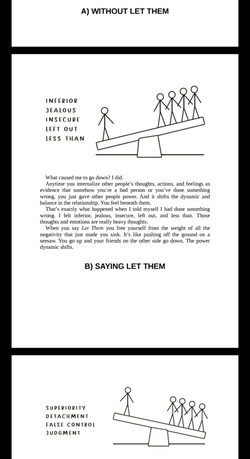
The Danger of Only Saying Let Them / Let Me Is the Power Move
Part 1: The False Sense of Superiority
1. It feels so good to rise above other people and the situations that bother you. That's why people love saying Let Them, because when you're up, you now feel this false sense of superiority and confidence. You push through those heavy emotions and rise up. This will automatically make you feel better than someone else. You will feel wiser and weirdly above it all, which is why it is easy to detach from the situation.
2. And a little superiority can go a long way when you're in an emotional spiral. That temporary feeling of power over other people can help you move through the situation, accept what's happening, and process the frustrating or painful experiences in life.
3. It helps to feel better than the friend who doesn't call you back, or the lazy roommate who doesn't do their dishes, or the rude customer you have to deal with at work.
Vocabulary & Pronunciation:
| Word | Meaning | Pronunciation |
|---|---|---|
| superiority | the feeling of being better than others | soo-peer-ee-OR-ih-tee |
| emotional spiral | a worsening cycle of negative feelings | ih-MOH-shuh-nul SPY-rul |
| temporary | lasting only for a short time | TEM-puh-rair-ee |
| process (an experience) | to mentally work through and make sense of something | PROS-ess |
Part 2: The Moment Passes — Now What?
1. But then, that moment of Let Them is over.
2. Then you will think... now what? You'll be sitting up there looking down on other people, and you'll start to feel a little stranded in your superiority. And, after I initially started saying Let Them, I didn't really know what to do either. Saying it and getting that jolt of superiority felt good, and detaching from the emotion felt great. That was the easy part. But I didn't know what to do next.
Vocabulary & Pronunciation:
| Word | Meaning | Pronunciation |
|---|---|---|
| stranded | left alone, isolated, without a way forward | STRAN-did |
| jolt | a sudden, brief burst of feeling | JOHLT |
Part 3: The Danger of Stopping at "Let Them"
1. And here is the danger of only saying Let Them: If all you ever do is say Let Them, Let Them, Let Them, it will lead you to feel more isolated. It will make you want to withdraw or shut down.
2. And that is exactly what the old me would have done with the situation on the couch. If I had just stopped at the Let Them part—I can imagine it now—I would have sat there in my superiority. I wouldn't have reached out. I would have gossiped about them behind their backs, sought out reassurance from other friends, and felt very awkward every time I saw them. And these are women that I actually like and want to be friends with!
Vocabulary & Pronunciation:
| Word | Meaning | Pronunciation |
|---|---|---|
| isolated | alone, separated from others | EYE-suh-lay-tid |
| withdraw | to pull back or distance oneself | with-DRAW |
| shut down | to stop engaging emotionally or socially | SHUT DOWN |
| gossiped | talked about others' private matters, often unkindly | GOS-ipt |
Part 4: What You Actually Want
1. I want you to stop and really think about a situation where you see friends of yours going out and doing things without you. When it happens, it hurts. It always hurts to be excluded. You want to be included on that golf trip. You want to be invited over to watch the game. You want to go away for the weekend. You would love to go out for drinks with your cool co-workers. You want to have great, fun friendships.
2. And I want that for you too. So let me ask you a question: How exactly is feeling morally superior going to help you create those great friendships?
3. It's not.
Vocabulary & Pronunciation:
| Word | Meaning | Pronunciation |
|---|---|---|
| excluded | left out, not included | ik-SKLOO-did |
| morally superior | believing oneself to be more virtuous or "right" than others | MOR-uh-lee soo-PEER-ee-er |
Part 5: A Warning from a Friend
1. Saying Let Them simply relieves you of the hurt and pain you feel... but only momentarily. It feels so good to blame other people and feel better than others.
2. But as your friend, I feel obligated to warn you that if all you do is say Let Them you're going to find yourself without a lot of friends, without a lot of social plans, and confused as to why the theory "isn't working" in your favor.
Vocabulary & Pronunciation:
| Word | Meaning | Pronunciation |
|---|---|---|
| relieves | reduces or removes a burden, pain, or discomfort | rih-LEEVZ |
| momentarily | for a brief moment, temporarily | moh-men-TAIR-uh-lee |
| obligated | feeling a sense of duty to do something | OB-lih-gay-tid |
Part 6: Introducing "Let Me"
1. And that brings me to the major discovery that I made when I first started researching the theory. Let Them is just the first half of the equation. You cannot stop there. There is a second, critical part to the theory—Let Me.
2. The source of your power is not in managing other people; it's in your response. When you say Let Me, you're tapping into that power by taking responsibility for what you do, think, or say next. Let Me makes you realize that you are in control of what happens next and that life is more fun and fulfilling when you're not sitting alone in your superiority.
Vocabulary & Pronunciation:
| Word | Meaning | Pronunciation |
|---|---|---|
| equation | here, a balanced combination of two parts | ih-KWAY-zhun |
| tapping into | accessing or making use of something | TAP-ing IN-too |
| responsibility | the duty to deal with or take ownership of something | ree-spon-suh-BIL-ih-tee |
| fulfilling | satisfying, giving a sense of meaning or purpose | ful-FIL-ing |
Part 7: Let Me Is the Power Move
1. That's why the theory only works if you say both parts. When you say Let Them, you make a conscious decision not to allow other people's behavior to bother you. When you say Let Me, you take responsibility for what YOU do next.
2. What I love about Let Me is that it immediately shows you what you can control. And there's so much you can control: Your attitude... your behavior... your values, your needs, your desires, and what YOU want to do in response to what just happened.
3. It's the opposite of judgment. Let Me is all about self-awareness, compassion, empowerment, and personal responsibility.
Vocabulary & Pronunciation:
| Word | Meaning | Pronunciation |
|---|---|---|
| conscious decision | a choice made deliberately, with full awareness | KON-shus dih-SIZH-un |
| desires | strong wants or wishes | dih-ZY-erz |
| self-awareness | understanding of one's own emotions and behavior | self-uh-WAIR-nes |
| compassion | sympathy and concern for oneself or others | kum-PASH-un |
Part 8: Balance, Not Superiority
1. Your friends who went away aren't better than you. And you aren't better than them.
2. This is the crux of the Let Them Theory: Let Them and Let Me.
3. The more you allow people to live their lives, the better your life will get. The more control you give up, the more you gain.
4. The Let Them Theory is not about superiority at all. It's about balance. It's about making room for both you and someone else. It's about giving other people the space and the grace to live their lives—and then giving yourself the same.
Vocabulary & Pronunciation:
| Word | Meaning | Pronunciation |
|---|---|---|
| crux | the central or most important point | KRUKS |
| balance | a state of equal or fair distribution | BAL-uns |
| grace | kindness, leniency, or understanding toward someone | GRAYS |
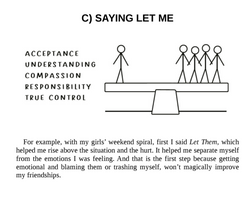
## Looking in the Mirror / Let Me Reach Out
### Part 1: Using the Space to Reflect
**1.** The superiority gave me the mental space to really look at the situation from above. The more I said Let Them, the more space I had to consider MY role in this situation, and what I wanted to do about it.
**2.** And when I stopped to look in the mirror, I saw a lot.
**Vocabulary & Pronunciation:**
| Word | Meaning | Pronunciation |
|---|---|---|
| mental space | room to think clearly, free from emotional pressure | MEN-tul SPAYS |
| look in the mirror | to honestly examine oneself (figurative) | look in the MIR-er |
---
### Part 2: Honest Self-Reflection
**1.** I had been so busy working the past few years, I had barely seen my friends. I hadn't invited anyone to do anything in a long time. Maybe I wasn't excluded. Maybe they didn't think of me at all. And if I'm not making an effort, reaching out, or bumping into them around the neighborhood, why would they think of me? Plus, if I'm being perfectly honest, I've been so busy with my own life, work, and kids, unless I saw my old friends post online, I didn't think about them much either.
**2.** No one owes me an invite. No one owes me a call. Yes, these things feel good; and yes, you deserve friends who reach out. But whose responsibility is it to create those friendships? And more importantly, Let Me be honest with myself: Have I been doing my part? When I stopped to ask myself that question, the answer was no.
**Vocabulary & Pronunciation:**
| Word | Meaning | Pronunciation |
|---|---|---|
| barely | almost not at all | BAIR-lee |
| bumping into | meeting someone unexpectedly | BUM-ping IN-too |
| owes | has a duty or obligation to give something | OHZ |
| responsibility | the duty to deal with or take ownership of something | ree-spon-suh-BIL-ih-tee |
---
### Part 3: Taking Ownership of Her Social Life
**1.** When you are an adult, your social life is your responsibility. If you want more fun, you should get your butt off the couch and create a great social life (talking to myself here too).
**2.** Let Me stop expecting other people to always include me. Let Me take responsibility for what I want in life. Let Me figure out the deeper issue that I need to look at. Let Me be more proactive about reaching out to people. Let Me invite people to do something this weekend. Let Me throw a party for once. Let Me develop better boundaries with work so I have time for friendship. Let Me prioritize my social life, because clearly it matters to me, and it is my responsibility to create one.
**Vocabulary & Pronunciation:**
| Word | Meaning | Pronunciation |
|---|---|---|
| proactive | taking action in advance rather than reacting | proh-AK-tiv |
| boundaries | limits set to protect one's time, energy, or wellbeing | BOWN-duh-reez |
| prioritize | to treat something as more important than other things | pry-OR-ih-tyz |
---
### Part 4: The Deeper Truth
**1.** Let Me reach out to a few of these women to reconnect. Not in a passive way. Not to smooth things over. And not to get an invite to their next getaway. But because once I said Let Them and Let Me and rise above my emotion, I connect with the deeper truth that I actually really miss a few of these women, and seeing that post online made me realize that I work way too much and I want to make an effort to rekindle my friendship with them... and a few other people now that I am thinking about it.
**Vocabulary & Pronunciation:**
| Word | Meaning | Pronunciation |
|---|---|---|
| reconnect | to reestablish contact or a relationship | ree-kuh-NEKT |
| passive | not acting directly, indirect | PAS-iv |
| getaway | a short trip or vacation | GET-uh-way |
| rekindle | to revive or bring back to life (a relationship, feeling) | ree-KIN-dul |
---
### Part 5: Warning One — Does It Apply to Children?
**1.** As I researched this book, two important questions came up repeatedly from people who were applying the Let Them Theory, and I want to address them now before we dive deeper into the rest of the book.
**2.** First: Does the Let Them Theory apply to children?
**3.** Yes, you can absolutely use the Let Them Theory with kids, (with some very important caveats), but this book is specifically focused on how you apply the theory with adults. Throughout the book, I make clear distinctions between adults and children to avoid any confusion. And for those looking for guidance on how to use this approach with children, teens, and young adults, I've included a special guide in the Appendix at the end of the book that breaks this down in detail.
**Vocabulary & Pronunciation:**
| Word | Meaning | Pronunciation |
|---|---|---|
| repeatedly | happening again and again | rih-PEE-tid-lee |
| caveats | warnings or conditions attached to something | KAV-ee-ats |
| distinctions | clear differences | dis-TINK-shunz |
| Appendix | a section of extra material at the end of a book | uh-PEN-diks |
---
### Part 6: Warning Two — What If Let Them Makes You Lonely?
**1.** Second: What if using Let Them makes you feel lonely?
**2.** This is a critical point. Some people have shared that they feel lonely after using the Let Them Theory. If you're feeling this way, it's a sign you're applying the theory incorrectly. The Let Them Theory has two essential steps: Let Them and Let Me. These steps must go hand in hand. You cannot simply say Let Them and stop there. Many people forget the second step, Let Me—and this is a major mistake because Let Me is where your real power lies. It's in Let Me that you take responsibility for your next move, for creating the life, relationships, and connection you want. Without this step, you'll find yourself disconnected rather than empowered.
**Vocabulary & Pronunciation:**
| Word | Meaning | Pronunciation |
|---|---|---|
| critical (point) | extremely important | KRIT-ih-kul |
| essential | absolutely necessary | ih-SEN-shul |
| hand in hand | closely connected, working together | HAND in HAND |
| disconnected | lacking a sense of connection to others | dis-kuh-NEK-tid |
---
### Part 7: What Let Them Is NOT
**1.** As your friend, I feel obligated to warn you that if all you do is say Let Them you're going to find yourself without a lot of friends, without a lot of social plans, and confused as to why the theory "isn't working" in your favor. It feels good to say Let Them because we like to blame other people. And as we've discussed, a jolt of superiority can help when you feel down. However, that's not the purpose of the theory.
**2.** Let Them is not an excuse to stop answering your phone, to shrug your shoulders, to refuse to talk it out with a friend or family member who is hurt, to stay in a situation that hurts you, or to ignore discrimination or dangerous behavior. It's not a license to give someone the silent treatment, ghost people, avoid hard conversations, or withdraw from your relationships. It's not supposed to leave you feeling alone and invisible, but rather more connected and more fulfilled in every single one of your relationships.
**3.** If you find that you're using the theory and it's making you lonelier please hear this: You are using it wrong. The theory is here to make your life better, not worse. So I am reminding you to ALWAYS remember to say Let Me. Because that is the part that will change your life.
**Vocabulary & Pronunciation:**
| Word | Meaning | Pronunciation |
|---|---|---|
| shrug your shoulders | to show indifference or dismissal (figurative) | SHRUG your SHOHL-derz |
| discrimination | unfair treatment based on group identity | dis-krim-ih-NAY-shun |
| license (figurative) | permission or justification to do something | LY-suns |
| silent treatment | deliberately ignoring someone as a form of punishment | SY-lunt TREET-ment |
*Note: This part mentions discrimination and dangerous behavior. If it feels heavy for anyone, feel free to pause.*
---
### Part 8: Taking Full Responsibility
**1.** Using the Let Them Theory, I saw how often I blamed someone else for the fact that I was alone sitting on my couch. Or not making the money I wanted to make. Or how often I said yes due to guilt. Or the decisions I made because I didn't want to disappoint someone else. Or how often I used the excuse of being too tired to make my health or fun a priority.
**2.** When you're an adult, your life, happiness, health, healing, social life, friendships, boundaries, needs, and success are all your responsibility. If you've been secretly hoping someone else would come and rescue you, fix your problems, pay your bills, create a social life, heal your wounds, change into your dream partner, and motivate you to be your best... it's not going to happen. No one is coming. And any time you spend blaming other people, or waiting for permission or an invitation, is wasted. Those days are over.
**Vocabulary & Pronunciation:**
| Word | Meaning | Pronunciation |
|---|---|---|
| guilt | a feeling of having done something wrong | GILT |
| rescue | to save someone from a difficult situation | RES-kyoo |
| wounds (figurative) | emotional pain or hurt | WOONDZ |
| wasted (time) | used without value or benefit | WAYS-tid |
---
### Part 9: Your Let Me Era
**1.** Your Let Me era is here.
**2.** You are capable of creating anything that you want if you are willing to put the time and energy into working for it. And that means you must stop wasting your time and energy on petty, shallow, and insignificant things. And it also means that you have to stop trying to control the one thing you can't: other people.
**3.** In the next section of the book, we're diving into four core areas of your life where the Let Them Theory will create the biggest and most immediate positive impact. You'll learn how to stop allowing other people's behaviors, opinions, reactions, and success to affect your happiness and stand in the way of what you want. And there's no faster way to get started and to feel the power of Let Them than using it to manage stress and protect your peace.
**4.** So let's jump in.
**Vocabulary & Pronunciation:**
| Word | Meaning | Pronunciation |
|---|---|---|
| era | a distinct period of time (used figuratively here) | EER-uh |
| petty | small and unimportant, often trivial | PET-ee |
| shallow | lacking depth or substance | SHAL-oh |
| insignificant | not important or meaningful | in-sig-NIF-ih-kunt |
| immediate | happening right away | ih-MEE-dee-it |
## CHAPTER 3: Managing Stress — Shocker: Life Is Stressful
### Part 1: The Small Stressors of Daily Life
**1.** The fastest and most effective way to start using the Let Them Theory is to rise above the countless tiny stressors you face every day.
**2.** You know the ones I'm talking about: the never-ending notifications on your phone, the slow Internet connections, the unexpected changes in plans, the endless meetings at work, the inconsiderate behavior of other people, the long lines, the slow walkers. These small annoyances may seem insignificant, but they aren't.
**3.** I get that people can be annoying, and, yes, you have a lot on your plate. Modern life can feel like death by a thousand cuts—one thing after another that slowly drains your energy and stresses you out. It's not only easy to let it get to you, it's dumb.
**4.** You can't control how other adults behave, and stressing about it diminishes your power. You'll never reach the full potential of your life if you continue to allow stupid things or rude people to drain your life force.
**5.** Your time and energy are your most valuable resources, and in the next few chapters, you'll learn how to use the Let Them Theory to protect yourself from the unnecessary stress other people are currently causing in your life.
**Vocabulary & Pronunciation:**
| Word | Meaning | Pronunciation |
|---|---|---|
| stressors | things that cause stress | STRES-erz |
| death by a thousand cuts | gradual harm from many small negative things | DETH by a THOW-zund KUTS |
| diminishes | reduces or weakens something | dih-MIN-ish-iz |
| life force | one's energy or vitality (used figuratively) | LYF FORS |
---
### Part 2: Questioning Why Small Things Bother Us
**1.** Just stop and ask yourself: Why do you have to let a long line at the coffee shop ruin your day? Why is traffic putting you in a bad mood? Why do you feel overwhelmed when someone interrupts you during an important task? Why does the person talking loudly on their phone in public irritate you? Why does a family member's unsolicited advice feel like a personal attack? Why does someone else's slow pace in a busy walkway make you feel rushed?
**Vocabulary & Pronunciation:**
| Word | Meaning | Pronunciation |
|---|---|---|
| overwhelmed | feeling like something is too much to handle | OH-ver-welmd |
| irritate | to annoy or bother | IR-ih-tayt |
| unsolicited | not asked for | un-suh-LIS-ih-tid |
| personal attack | criticism aimed directly and hurtfully at someone | PER-suh-nul uh-TAK |
---
### Part 3: The Garden Center Line
**1.** It happens to me too. Just the other day, I went to my favorite garden center to pick up some plants. There, the cashier was moving so slowly. There were only two lanes open and about five people waiting in each.
**2.** Beep. Beep. Beep.
**3.** I felt myself starting to get agitated. I had a meeting I had to get to back home. I wanted to turn to the person behind me, shake my head, and say, "Can you believe this?"
**4.** But I hesitated. I said Let Them to myself instead. The effect was immediate. I softened. Did it speed up the cashier? Nope.
**5.** It did something better. It protected me from this habit of letting little things become big stressors in my day-to-day life. The 10 extra minutes that this line was going to take wouldn't negatively impact the rest of my day, but allowing myself to get agitated and annoyed about something I couldn't control absolutely would. Why get stressed out about things beyond your control or that don't really matter? How does something so small have such a large impact on you?
**Vocabulary & Pronunciation:**
| Word | Meaning | Pronunciation |
|---|---|---|
| agitated | feeling nervous, upset, or troubled | AJ-ih-tay-tid |
| hesitated | paused before acting, due to uncertainty | HEZ-ih-tay-tid |
| softened | became calmer or less tense | SOF-tund |
---
### Part 4: The Cost of Giving Away Power
**1.** When you let the world around you impact your emotional state and peace of mind, you become a prisoner to these external forces. You're letting trivial nonsense dictate your mood, drain your motivation, and steal your focus. There's this famous quote about life from Greek philosopher Epictetus, "It's not what happens to you, but how you react to it that matters." What does that mean? It means that your personal power is in how you react.
**2.** Learning how to respond differently to the annoying and stressful situations every day will change your life. Right now, you're giving away all your power because you're wasting your time and energy on things that don't matter; or you're burning up over things that are beyond your control. You have no idea how big of a problem this is. I didn't either.
**Vocabulary & Pronunciation:**
| Word | Meaning | Pronunciation |
|---|---|---|
| external forces | outside influences or pressures | ik-STER-nul FOR-siz |
| trivial | unimportant, minor | TRIV-ee-ul |
| dictate | to control or determine | DIK-tayt |
| Epictetus | an ancient Greek Stoic philosopher | ep-ik-TEE-tus |
---
### Part 5: Automatic Reactions
**1.** The reason it's hard to manage your stress is that your reaction to what is happening around you is automatic and you feel your entire body go on edge. It's like you get swept up in the emotion, and the next thing you know, you send the text you regret. Or you say things in the heat of the moment that you don't really mean. Or you stand there in a really long line of people, and the anger and annoyance just build and build even though you wish they wouldn't.
**2.** These are all examples of how your reaction to stressful and irritating situations can become a big problem in your day-to-day life. You can't control what is happening around you, but you can control how you respond to it. Nowhere is this more evident than at an airport. In fact, if you want to feel stressed, just go to one.
**Vocabulary & Pronunciation:**
| Word | Meaning | Pronunciation |
|---|---|---|
| on edge | tense, nervous, easily irritated | on EJ |
| swept up in | fully caught up in, overwhelmed by | SWEPT up in |
| in the heat of the moment | acting impulsively during intense emotion | in the HEET of the MOH-ment |
| evident | clearly seen or understood | EV-ih-dent |
---
### Part 6: The Airport Stress Test
**1.** From the check-in to security lines to people losing their minds over weather delays, missing baggage, people crowding the gates before they even start the boarding process, tight connections, getting rerouted, all the overhead space taken by the time you board, long lines at the rental car counter... the number of things that could stress you out are endless.
**2.** But let's use this fact as an example to help you understand what you can control and what you can't control. Remember the fundamental law of human nature: You can't control what other people say, think, or do. Anytime you try to, you lose your power. You must learn to focus on what you say, think, or do. That's how you remain in control.
**3.** Because no matter what is happening on the plane or at the airport, you still hold the power.
**Vocabulary & Pronunciation:**
| Word | Meaning | Pronunciation |
|---|---|---|
| rerouted | sent on a different route or path | ree-ROO-tid |
| overhead space | storage compartments above airplane seats | OH-ver-hed SPAYS |
| fundamental law | a basic, core rule or principle | fun-duh-MEN-tul LAW |
---
### Part 7: The Coughing Passenger
**1.** A few months ago, I was on a plane and the guy right behind me was coughing as if it were his last day on earth. You know that deep, chest hack that is bound to get everyone around them sick?
**2.** I didn't think anything of it for the first few minutes, but when it continued on and on, and then he started clearing his throat, and then he kept coughing, I started to get annoyed.
**3.** I was flying to an event where I had to give a speech, and over the next couple of weeks, I was speaking at a number of big events. I could not afford to get sick and lose my voice.
**4.** I turned around to look through the crack between the seats and saw him just open-mouth coughing into the air, as if no one else was on this plane. I thought: Is this guy really going to get me sick? It's so selfish and rude of him. I can't get sick. I considered my options.
**Vocabulary & Pronunciation:**
| Word | Meaning | Pronunciation |
|---|---|---|
| chest hack | a deep, rough cough (informal) | CHEST HAK |
| bound to | very likely to | BOWND too |
| selfish | caring only about oneself, without regard for others | SEL-fish |
---
### Part 8: Handling the Situation
**1.** Being passive-aggressive wasn't going to solve anything. As much as I kept huffing and puffing in my seat and glaring at him between the cracks trying to make evil-eye contact, he was either not picking up on my clues or he didn't care.
**2.** I considered flagging over the flight attendant and complaining, but he was sitting right there, so he'd hear me, which would feel really weird. So I decided to turn around like a mature adult and ask him politely, "Sir, could you please cover your mouth?"
**3.** There was an awkward pause.
**4.** He nodded and then he proceeded to cough openly for the rest of the plane ride. I know this, because I kept turning around and looking through the crack between the seats. Obviously, you feel bad for the guy. It's not like he wants to be sick. When you have to cough, you have to cough.
**5.** But in the heat of the moment, I was getting more and more annoyed. I was not only stressed out, but it was now ruining my mood and making it impossible to try to get some work done.
**6.** This is just one example of how something happening around you can easily stress you out and negatively impact your body and hijack your brain.
**Vocabulary & Pronunciation:**
| Word | Meaning | Pronunciation |
|---|---|---|
| passive-aggressive | expressing anger indirectly rather than directly | PAS-iv-uh-GRES-iv |
| huffing and puffing | breathing heavily out of frustration or anger | HUF-ing and PUF-ing |
| glaring | staring angrily at someone | GLAIR-ing |
| flagging over | signaling to get someone's attention | FLAG-ing OH-ver |
| hijack (figurative) | to take over control of something forcefully | HY-jak |
---
### Part 9: Your Brain on Stress
**1.** One of the experts that I interviewed while researching this book is Dr. Aditi Neurukar, a physician at Harvard Medical School and author of *The 5 Resets: Rewire Your Brain and Body for Less Stress and More Resilience*.
**2.** Dr. Aditi was the medical director of Harvard's Beth Israel Deaconess Hospital's integrative medicine program, where she developed an enormous clinical practice in stress management using evidence-based, integrative approaches to help her patients feel better.
**3.** Dr. Aditi says, "Stress is a much bigger problem in your life than you realize."
**4.** According to Dr. Aditi, stress causes you to doubt yourself, procrastinate, burn out, doom scroll, and struggle with comparison. If you're having trouble focusing, feeling happy, or taking care of yourself, the reason is stress.
**5.** She also told me that if your inner critic is louder than ever, you're struggling with procrastination, you're constantly tired, you can't stop scrolling on your phone, or you have trouble disconnecting from work, it's all due to stress.
**Vocabulary & Pronunciation:**
| Word | Meaning | Pronunciation |
|---|---|---|
| physician | a medical doctor | fih-ZISH-un |
| resilience | the ability to recover from difficulty | rih-ZIL-yens |
| integrative medicine | a healthcare approach combining conventional and complementary methods | IN-tih-gray-tiv MED-ih-sin |
| evidence-based | supported by scientific research/data | EV-ih-dens-BAYST |
| burn out | become exhausted from prolonged stress | BERN owt |
| doom scroll | to compulsively scroll through negative news online | DOOM SKROHL |
| inner critic | a mental voice that judges or criticizes oneself | IN-er KRIT-ik |
---
### Part 10: The Prefrontal Cortex vs. the Amygdala
**1.** Dr. Aditi explained to me that stress is way bigger than just the tension you feel in your body. Stress is a physiological state in your brain. This is important to understand because stress actively hijacks the functioning of your brain. As Dr. Aditi explained it, normally your prefrontal cortex is in control. This part of your brain helps you run your day-to-day life. It helps you plan, organize, remember things, and guide your decision-making. To become the best version of yourself, you need to leverage this part of your brain.
**2.** The problem is that the second you "feel stressed" by the guy coughing on the plane, the line that is taking too long, or the test results you are waiting on, your brain goes into a stress response and that prefrontal cortex that is so important is no longer in control (and neither are you).
**3.** Your stress response is located in another part of your brain called the amygdala. Dr. Aditi described the amygdala as a "small, almond-shaped structure deep in your brain, located between your ears. It's one of the oldest structures of the human brain and many refer to it as our 'reptilian brain.' And it houses your stress response."
**Vocabulary & Pronunciation:**
| Word | Meaning | Pronunciation |
|---|---|---|
| physiological | relating to the body's physical functions | fiz-ee-uh-LOJ-ih-kul |
| prefrontal cortex | the brain region responsible for planning and decisions | pree-FRUN-tul KOR-teks |
| leverage | to use something to maximum advantage | LEV-er-ij |
| amygdala | a brain structure involved in emotional/stress responses | uh-MIG-duh-luh |
| reptilian brain | an informal term for the brain's oldest, instinct-driven part | rep-TIL-ee-un BRAYN |
---
### Part 11: Fight, Flight, or Freeze
**1.** If you've ever heard someone refer to the "fight, flight, or freeze response," that's the exact same thing as your "stress response"—meaning that when you are stressed, your amygdala is in control. This can cause rash decision-making and more impulsive behaviors.
**2.** When life is normal and you're feeling good, your prefrontal cortex is the one driving most of your actions. This means that you can logically think through the pros and cons of situations and make well-thought-out decisions. In other words, you can choose how you are going to respond.
**3.** But, whenever something happens that makes you feel stressed, this is where you and I get in trouble because the response in our bodies and brains is automatic. Your amygdala takes over automatically. And, this part of your brain has one job: survival and self-preservation.
**4.** Your brain and body kick into fight or flight, and are only designed to work in this stressed-out state for short periods of time. You are supposed to reset back to normal functioning, where your prefrontal cortex is in control and you feel calm and confident again. But what happens when you don't reset?
**Vocabulary & Pronunciation:**
| Word | Meaning | Pronunciation |
|---|---|---|
| fight, flight, or freeze | the body's automatic responses to perceived danger | FYT, FLYT, or FREEZ |
| rash (decision-making) | hasty, without careful thought | RASH |
| impulsive | acting suddenly without thinking things through | im-PUL-siv |
| self-preservation | the instinct to protect oneself from harm | self-prez-er-VAY-shun |
| reset | to return to a normal or balanced state | ree-SET |
## The Real Reason You Are Exhausted All the Time
### Part 1: Living in Chronic Stress
**1.** According to Dr. Aditi, 7 out of 10 people are currently living in a chronic state of stress. I used to be one of them. When you live in a state of chronic stress, you are locked in a constant state of fight or flight. Your amygdala is humming in the background, always on.
**2.** Dr. Aditi told me that when you're stressed, you not only feel like you're in survival mode, but from a neurological standpoint, your brain actually is in survival mode. Your goals... your dreams... your best self... your ability to be patient and nonreactive... it all goes right out the window.
**3.** Which is why you must solve this problem and stop allowing other people to create unnecessary stress in your life. There's too much at stake. You deserve to live a good life, but you'll never be able to if you are always in survival mode.
**Vocabulary & Pronunciation:**
| Word | Meaning | Pronunciation |
|---|---|---|
| chronic | ongoing, long-lasting | KRON-ik |
| humming (figurative) | continuously, quietly active | HUM-ing |
| neurological | relating to the brain and nervous system | noor-uh-LOJ-ih-kul |
| nonreactive | not responding impulsively to stimuli | non-ree-AK-tiv |
| at stake | at risk of being lost or damaged | at STAYK |
---
### Part 2: What Stress Steals From You
**1.** You'll never get that project done this weekend if you keep procrastinating because of stress.
**2.** You need to have more fun, but you won't allow yourself to have it if you can't disconnect from work.
**3.** You should be more present and connected to your spouse, but you never will be if you're constantly stressed.
**4.** The life you've always wanted is right in front of you, but you will never reach for it if your inner critic is constantly telling you not to. Stress is a major problem and it's time you deal with it.
**Vocabulary & Pronunciation:**
| Word | Meaning | Pronunciation |
|---|---|---|
| disconnect (from work) | to mentally step away from work obligations | dis-kuh-NEKT |
| present (adjective) | fully engaged in the current moment | PREZ-ent |
| inner critic | a mental voice that judges or criticizes oneself | IN-er KRIT-ik |
---
### Part 3: Hacking Your Stress Response
**1.** So I asked Dr. Aditi how we reset our brain back to normal functioning. She said the first step is to understand what stress actually is so that you know you have power in these situations.
**2.** For me, it was a revelation to learn that stress is your body and brain switching between two functions. It's empowering to know that I can switch back to normal functioning and that it's not hard to do, using the Let Them Theory.
**3.** How cool is it that you don't have to live your life feeling like everything happening around you has to stress you out? How amazing is it that other people's behavior doesn't have to be a huge problem in your life?
**4.** Next, you're going to use the Let Them Theory to reset your stress response. Think of it as an on-off switch—a little lever you can pull inside your brain whenever something happens that stresses you out.
**5.** The moment you say Let Them, you are signaling to your brain that it's okay: This isn't worth stressing about. You are telling your amygdala to turn off. You are resetting that stress response by detaching from the negative emotion you feel.
**Vocabulary & Pronunciation:**
| Word | Meaning | Pronunciation |
|---|---|---|
| revelation | a surprising realization | rev-uh-LAY-shun |
| lever | a tool or mechanism used to activate/control something | LEV-er |
| signaling | sending a message or indication | SIG-nuh-ling |
| detaching | separating oneself emotionally from something | dih-TACH-ing |
---
### Part 4: The Let Them + Let Me Reset
**1.** Here's how you do it: The moment anything happens that stresses you out, say Let Them. Put yourself in pause. Then say Let Me and take a breath. Let Me take another breath. Slow your stress response. Calm your body and brain down. Take control and regain your power.
**2.** This seems so insignificant, but this one change will turn you into a different person. Catching your stress response using Let Them and Let Me empowers you to choose what you say, think, or do instead of allowing your emotions to hijack your response. No more rage texts, or snapping at your loved ones, or wasting hours crafting an email at work.
**3.** The fact is, not every email warrants a response and not every conversation needs your participation—and you do not always have to have the last word.
**4.** You'll start to see that a lot of what used to set you off isn't worth your time and energy; and the less you react to the things around you using Let Me, the more in control you feel.
**Vocabulary & Pronunciation:**
| Word | Meaning | Pronunciation |
|---|---|---|
| rage texts | angry messages sent impulsively | RAYJ TEKSTS |
| snapping (at someone) | speaking suddenly and sharply | SNAP-ing |
| warrants | justifies, deserves | WOR-runts |
| set you off | triggered a strong emotional reaction | set you OF |
---
### Part 5: The Science of Breathing
**1.** Dr. Aditi said that taking deep breaths has been scientifically proven to help lower your stress response. Breathing in fully, feeling the air expand your belly, stimulates the vagus nerve, which sends a message directly to your brain that says, "We can calm down."
**2.** By saying Let Me and resetting your stress response—you are now back in control and can choose how to intentionally respond.
**Vocabulary & Pronunciation:**
| Word | Meaning | Pronunciation |
|---|---|---|
| scientifically proven | confirmed through scientific study | sy-en-TIF-ih-klee PROOVN |
| stimulates | activates or triggers a response | STIM-yoo-layts |
| vagus nerve | a major nerve connecting the brain to the body, linked to calm | VAY-gus NERV |
| intentionally | done deliberately and with purpose | in-TEN-shuh-nuh-lee |
---
### Part 6: Back to the Coughing Passenger
**1.** On that note: Let's go back to me on the plane, with the guy who is coughing behind me; I'm getting more and more stressed, and I can't focus on the work I need to get done, and I feel like a caged animal sitting there strapped to my seat.
**2.** So, how do you use the Let Them Theory to get someone to stop coughing?
**3.** You don't. You have to Let Them cough. Let Them. I know... hear me out. Yes, it was stressing me out. Yes, I thought he was rude for not covering his mouth. And yes, I was worried about getting sick.
**4.** But let's come back to control: What could I control in this situation? I couldn't control whether or not another person was coughing. I could only control how I responded to the coughing.
**Vocabulary & Pronunciation:**
| Word | Meaning | Pronunciation |
|---|---|---|
| caged animal | trapped and restless (used figuratively) | KAYJD AN-uh-mul |
| strapped (to a seat) | secured tightly, unable to move freely | STRAPT |
---
### Part 7: Taking Responsibility for Herself
**1.** Focusing on what you can't control makes you stressed. Focusing on what you can control makes you powerful. And that brings me to another important point: Who is responsible for me not getting sick?
**2.** Me, or this stranger on a plane?
**3.** Me. I'm responsible for my health. It's not this guy's responsibility to stop coughing because I want him to. It's my responsibility to respond in a way that takes care of my needs. I know what you are thinking.
**4.** Shouldn't everybody cover their mouth? Shouldn't everybody wash their hands? Shouldn't everybody follow basic guidelines of decency? Of course they should, but a lot of people don't.
**Vocabulary & Pronunciation:**
| Word | Meaning | Pronunciation |
|---|---|---|
| responsible | having a duty to deal with something | rih-SPON-sih-bul |
| guidelines | rules or recommendations for behavior | GYD-lyns |
| decency | polite, socially acceptable behavior | DEE-sun-see |
---
### Part 8: A Pragmatic Solution
**1.** My point is, trying to manage someone else, or a situation that is beyond your control, is only going to cause you more stress. I could get mad. I could keep turning around. I could yell at the flight attendant. I could get frustrated and yell at the guy, but to what end? Isn't there a more obvious and powerful solution right in front of my face?
**2.** I'm offering you a pragmatic and strategic approach to life.
**3.** Instead of getting enraged in my seat, I just Let Him cough, and then I Let Me focus on the simple actions I could take in order to protect myself.
**4.** I am going to cover my nose and mouth with my scarf, I thought. And I am going to put my headphones on to drown out the coughing. And that's what I did. And with my scarf over my nose and mouth, I turned up my music in my headphones.
**5.** Problem solved.
**Vocabulary & Pronunciation:**
| Word | Meaning | Pronunciation |
|---|---|---|
| pragmatic | practical, focused on realistic solutions | prag-MAT-ik |
| strategic | planned carefully to achieve a goal | struh-TEE-jik |
| enraged | extremely angry | en-RAYJD |
| drown out | to make a sound impossible to hear by covering it with another | DROWN owt |
---
### Part 9: What Dr. Aditi Confirms
**1.** Every time you say Let Them, you acknowledge that you cannot control this situation that is stressing you out. When you say Let Me, you are following Dr. Aditi's advice and focusing on what you can control, which is your response to these stressful situations.
**2.** Dr. Aditi confirmed, "the Let Them Theory is like a sigh of relief for your stressed brain. It helps you reclaim control over your anxious thoughts so that your brain and body can finally get out of survival mode and back to thriving."
**Vocabulary & Pronunciation:**
| Word | Meaning | Pronunciation |
|---|---|---|
| acknowledge | to accept or admit something as true | ak-NOL-ij |
| sigh of relief | an expression of relaxation after stress ends | SY of rih-LEEF |
| thriving | flourishing, doing very well | THRY-ving |
---
### Part 10: The Cost of Giving Away Your Power
**1.** Let Me explain why this matters. If you allow yourself to get completely stressed out, you are giving all your power to other people.
**2.** In the past, I would have allowed this guy to stress me out. I would have gotten zero work done, been exhausted by the time the plane landed, and then called my husband to complain about this idiot who ruined my entire flight. I probably would have told the story over dinner that night with the clients who had hired me to speak at the event. I would have gone on and on about how "infuriating" this situation was for me. All of which would have left me feeling even more stressed out, more worked up, and more drained.
**3.** I am explaining this in detail because I want you to see what a problem this is. When you let other people stress you out, you surrender your power to things that either don't matter or are beyond your control. And it often spirals into other areas of your life for hours, weeks, and even years.
**Vocabulary & Pronunciation:**
| Word | Meaning | Pronunciation |
|---|---|---|
| infuriating | extremely annoying, causing anger | in-FYOOR-ee-ay-ting |
| surrender | to give up, hand over | suh-REN-der |
| spirals (into) | gradually worsens or expands out of control | SPY-rulz |
---
### Part 11: Protecting Your Peace
**1.** If you want to achieve your goals, be more present, feel more confident, and be happier, you must stop allowing other people to stress you out. In life, there will be things you can control, and things that you can't. There will be situations that are fair, and situations that are not. You get to decide what stresses you out and for how long.
**2.** What Dr. Aditi's research proves is that learning to protect your energy will improve your mood, mindset, health, focus, and ability to disconnect and unplug. I believe this is one of the reasons why so many people get the words Let Them tattooed on their body within days of learning about the theory.
**3.** It serves as a reminder that your peace is worth protecting. There is a certain kind of confidence that comes with knowing that other people can't disrupt your peace.
**Vocabulary & Pronunciation:**
| Word | Meaning | Pronunciation |
|---|---|---|
| mindset | a person's established way of thinking | MYND-set |
| unplug (figurative) | to disconnect from stress-inducing activity/technology | un-PLUG |
| disrupt | to interrupt or throw into disorder | dis-RUPT |
---
### Part 12: Setting Up the Next Question
**1.** But let's take it up a notch.
**2.** A stranger coughing on a plane is a pretty straightforward situation. You will eventually get off the plane and move on with your life, so it is easy to use the Let Them Theory then.
**3.** But what about when it's not clear what you should do or what the right response is? How do you use the theory when your stress is coming from something much bigger... like your job?
**Vocabulary & Pronunciation:**
| Word | Meaning | Pronunciation |
|---|---|---|
| take it up a notch | to increase intensity or difficulty | tayk it up a NOCH |
| straightforward | simple, uncomplicated | strayt-FOR-werd |
## CHAPTER 4: Let Them Stress You Out
### Part 1: Work — The #1 Source of Stress
**1.** What about practicing Let Them and Let Me when it comes to something or someone that triggers your stress response every single day? According to research, work is the #1 cause of life stress for most people—and your manager has as much impact on your mental health as your spouse.
**2.** I'm sure I don't need to tell you that because, as rewarding as work can be, it is filled with stress. From 4 p.m. meetings on a Friday, to dealing with rude customers, passive-aggressive emails, a micromanaging boss, doing work that you don't enjoy, feeling unappreciated, seeing no opportunity for advancement, false promises, surprise layoffs, or being completely understaffed and having extra work on your plate—it's always something.
**3.** And if you're like me, and you've started your own business or are trying to be a good manager, just double that list.
**Vocabulary & Pronunciation:**
| Word | Meaning | Pronunciation |
|---|---|---|
| rewarding | satisfying, giving a sense of value | rih-WOR-ding |
| unappreciated | not valued or recognized | un-uh-PREE-shee-ay-tid |
| advancement | progress or promotion in a career | ad-VANS-ment |
| understaffed | not having enough employees to do the work | un-der-STAFT |
---
### Part 2: The Stalled Promotion Scenario
**1.** So how do you use the Let Them Theory to not let work stress you out? For example, what if you've been doing a great job, hitting all your numbers, going above and beyond, and your boss just isn't promoting you? When you ask for an update, you get the stereotypical response that "the company's profits are down this year" and "my hands are tied" but "you add so much value to this team" lip service. It sucks.
**2.** You feel frustrated, discouraged, powerless, hostile, or demoralized. Dr. Aditi says this is why she's seeing burnout in record numbers right now: People are stuck in a state of chronic stress at work. And she added, your stress at work isn't changing so you need to change your approach to dealing with it.
**Vocabulary & Pronunciation:**
| Word | Meaning | Pronunciation |
|---|---|---|
| stereotypical | typical, predictable, following an expected pattern | stair-ee-oh-TIP-ih-kul |
| my hands are tied | I am unable to help or act (idiom) | my HANDZ are TYD |
| lip service | insincere words not backed by real action | LIP SER-vis |
| demoralized | having lost confidence or motivation | dih-MOR-uh-lyzd |
| hostile | unfriendly, showing anger or resistance | HOS-tyl |
---
### Part 3: You Are Not Powerless
**1.** I know when I've been in that situation, that's exactly how I felt. And the fact that you need your paycheck to pay your bills only makes you feel more stressed-out and powerless. But as overwhelming as work may be right now, you are not powerless.
**2.** So, how do you use the Let Them Theory to get your boss to give you the promotion you deserve?
**3.** You don't. Let Them string you along.
**Vocabulary & Pronunciation:**
| Word | Meaning | Pronunciation |
|---|---|---|
| powerless | lacking any control or influence | POW-er-lis |
| string (someone) along | to keep someone waiting or hopeful without real intention | STRING uh-LONG |
---
### Part 4: Who Is Responsible for Your Career?
**1.** I know it's tough to hear, because it's true. Yes, it's not fair. Yes, you've earned the promotion. And yes, you deserve to be angry about it.
**2.** But Let Me ask you this question: Who is responsible for YOUR career?
**3.** That's right, you are.
**4.** Besides, you can't control if your boss is going to promote you, give you a raise, or even move you to the cubicle that's closer to the window. No matter how much hard work you've put in, or how many compliments you've received, the decision is up to them.
**Vocabulary & Pronunciation:**
| Word | Meaning | Pronunciation |
|---|---|---|
| earned | deserved through effort or work | ERND |
| cubicle | a small partitioned office workspace | KYOO-bih-kul |
---
### Part 5: Choosing Your Response
**1.** So if you're in a situation where you've put in the effort, you have had the conversation, you've asked for the salary increase, you've hit your numbers, and you still are waiting for that promotion or title change or new desk and it's just not coming, you have to stop being mad and choose what you're going to do about it.
**2.** Because, guess what? If you let your emotions get the best of you, it's going to make you crazy. If you let the stress of this situation take over, you will never be able to think strategically about your next move.
**3.** You cannot let the stress of this make you stupid. You've got to be smart about how you're going to respond. Let Me. That's where your power lies.
**Vocabulary & Pronunciation:**
| Word | Meaning | Pronunciation |
|---|---|---|
| salary increase | a raise in pay | SAL-uh-ree in-KREES |
| strategically | in a planned, purposeful way | struh-TEE-jih-klee |
---
### Part 6: Stop Wasting Time on What You Can't Change
**1.** If something at work is out of your control and you've done everything you can to try to influence it, it is dumb to waste any more time trying to change the situation. And it is even dumber to constantly let it stress you out. You are way smarter than that. Your life and the possibilities in it are always way bigger than your current job.
**2.** You are never stuck. That's a lie you tell yourself. You can leave a job, a relationship, a living situation, a date, an interview, or a conversation any time you want to.
**3.** But instead, you're sitting there with your boss Steve, who you flip off every time the Zoom meeting ends.
**Vocabulary & Pronunciation:**
| Word | Meaning | Pronunciation |
|---|---|---|
| influence | to affect or shape an outcome | IN-floo-uns |
| stuck | unable to move forward, trapped | STUK |
| flip off (informal/rude) | to make a rude gesture at someone | FLIP OF |
---
### Part 7: Let Them String You Along — Now Move On
**1.** You do not have to stay in any job that makes you feel frustrated, demoralized, or stressed. And you shouldn't. Let Them string you along.
**2.** It's time for the Let Me part. Stop fixating on your current situation, and start focusing on finding a better opportunity. Right now there's an amazing job with a kickass boss, a better salary, and a desk next to a window waiting for you to come find it. Your company is not the only company on this planet, and there's a million bosses out there who would be ecstatic to help advance your career.
**3.** Let Me go get it.
**Vocabulary & Pronunciation:**
| Word | Meaning | Pronunciation |
|---|---|---|
| fixating | focusing obsessively on one thing | FIK-say-ting |
| kickass (informal) | excellent, impressive | KIK-as |
| ecstatic | extremely happy or excited | ek-STAT-ik |
---
### Part 8: The Effort of Job Searching
**1.** Is it hard to find a job? Yes. Can it take forever? Yes. Do you dread the idea of updating your resume? Yes. Is getting out there and networking intimidating? Yes. Your career is your responsibility and you have more power here than you think. It's time to start acting like it.
**2.** Let Me choose to spend my weekends differently. Instead of blowing off steam at the bars with your friends and complaining about work, how about you pour your time and energy into doing the work to find a job you deserve? Yes, it may take you six months to land something amazing, but those six months are going to go by whether you do nothing, or you go after what you want.
**Vocabulary & Pronunciation:**
| Word | Meaning | Pronunciation |
|---|---|---|
| dread | to fear or strongly want to avoid something | DRED |
| intimidating | causing fear or nervousness | in-TIM-ih-day-ting |
| blowing off steam | releasing stress or frustration, often through venting | BLOH-ing of STEEM |
| land (a job) | to successfully get a job (informal) | LAND |
---
### Part 9: Who's Really in Control?
**1.** And consider this: If you stay in that job, who controls your future? That's right. Your boss Steve. But if you update your resume, start networking, and go on some interviews, who's in control now? That's right. YOU.
**2.** You can act like a toddler and call your boss every name in the book, but the harsh truth is that you're the one to blame—because you are choosing to stay in a job that makes you miserable.
**3.** That's on you. And you want to know what else is on you? Your dumb excuses for why you are not looking for another job. You have so much more power than you think. It's time to start acting like it.
**Vocabulary & Pronunciation:**
| Word | Meaning | Pronunciation |
|---|---|---|
| toddler | a young child (used here to mean acting immaturely) | TOD-ler |
| harsh truth | an unpleasant but accurate fact | HARSH TROOTH |
| miserable | very unhappy | MIZ-er-uh-bul |
| that's on you | that is your responsibility/fault (idiom) | thats on YOO |
## You Control Your Next Move
### Part 1: The Park Ranger's Warning
**1.** One topic that I want to address in greater detail is how you can determine what the right response is for you when you say Let Me. The Let Them part is obvious.
**2.** When you say Let Them, you stop trying to control what someone else is doing. When you say Let Me, you take responsibility for how you respond to it, which is not always obvious.
**3.** Every situation is different and learning how to choose what type of response is worth your time and energy, and what isn't, will change your life. I have a story that will help you understand how to choose the right response for you.
**4.** The other day, I was taking our dogs for a walk at a popular spot at a local state park. As I pulled into the parking lot, a local park ranger stopped to pet my two dogs and say hello. And as we were chatting, he mentioned to make sure to keep the dogs on the leash and pick up their poop, because there had been a lot of complaints that dogs were running free, and that they were not being picked up after by their owners. And it was getting to the point where they may close the trails to dogs.
**5.** I thanked him for sharing that information, and assured him that I was not "one of those people" and would follow the rules. As I walked down the trail, there was a person walking 100 feet ahead of me, with their dog off the leash, running all over the place, and jumping up on people.
**Vocabulary & Pronunciation:**
| Word | Meaning | Pronunciation |
|---|---|---|
| ranger | an official who patrols/manages a park | RAYN-jer |
| leash | a cord/strap used to control a dog | LEESH |
| complaints | expressions of dissatisfaction | kum-PLAYNTS |
| assured | told someone confidently to remove doubt | uh-SHOORD |
---
### Part 2: The Stress Response Rises
**1.** I started to get annoyed. I could feel the stress response rise up and my amygdala switch on. I was no longer enjoying my walk in the woods. I was focused like a laser on this dog and its owner, and I was getting more and more annoyed that this was exactly what the park ranger was talking about, and this one idiot was going to get us all banned from being here.
**2.** I kept saying Let Them, and it worked for the first five times I said it. But then her dog crouched right there on the middle of the trail and went number two, and I watched in horror as the owner kicks some leaves over it instead of picking it up in a doggy bag and removing it.
**3.** That was it. I went from feeling stressed to anointing myself as the dog police in five seconds flat. That brings me to an important aspect of using the theory. Your response to every situation is going to be unique and different every time.
**Vocabulary & Pronunciation:**
| Word | Meaning | Pronunciation |
|---|---|---|
| amygdala | a brain structure involved in the stress response | uh-MIG-duh-luh |
| banned | officially forbidden from doing something | BAND |
| crouched | bent down low to the ground | KROWCHT |
| anointing myself | declaring oneself in a role (used humorously here) | uh-NOYNT-ing my-SELF |
---
### Part 3: Every Situation, a Different Response
**1.** There will be days when I just don't have the energy to chase this woman down, hand her a doggie bag, ask her to pick it up, explain the implications of what's going on, and request that she do her part.
**2.** And there will be days where I will run like an Olympic sprinter, chase her down, and do exactly that.
**3.** There will be moments when I just shrug my shoulders, say Let Them, and know it's not worth my time and energy. And, when I get to the point where the dog has made its mess, I'll Let Me be the bigger person, and I'll take a baggie and pick it up. And then I'll smear it all over her car in the parking lot (that last part was a joke).
**Vocabulary & Pronunciation:**
| Word | Meaning | Pronunciation |
|---|---|---|
| implications | possible consequences or effects | im-plih-KAY-shunz |
| sprinter | someone who runs very fast for short distances | SPRIN-ter |
| the bigger person | someone who acts more maturely than expected | the BIG-er PER-sun |
| smear | to spread something messily (used jokingly here) | SMEER |
---
### Part 4: Caring About Shared Spaces
**1.** While I don't want to have to pick up after other people, I like being the kind of person who cares about leaving public spaces in good shape for everyone to enjoy them. I love knowing that I leave places better than I found them. And I love acting like a leader, even when it's not my job to do so.
**2.** There will be other days where I feel that the best course of action is to turn around, walk back out to the parking lot, track down that park officer, wait with them until the woman comes back, and personally report her to the ranger so he can deal with her.
**Vocabulary & Pronunciation:**
| Word | Meaning | Pronunciation |
|---|---|---|
| public spaces | shared areas open to everyone | PUB-lik SPAY-siz |
| course of action | a chosen plan of what to do | KORS of AK-shun |
| report (someone) | to formally tell an authority about someone's behavior | rih-PORT |
---
### Part 5: You Always Get to Choose
**1.** Every single one of these Let Me options are available to me and you. And as you were reading, you may even have thought of other options. The point here is, every situation is different, but one thing remains the same: You always get to choose how you respond.
**2.** I can't stop that lady from letting her dog poop in the middle of the trail, but I can choose what I do in response to it. I get to choose who I am going to be and how I am going to show up, and that is a very powerful feeling.
**3.** Every situation will be different based on how you feel, what's going on in your life right now, how much time you have, how important the issue is to you, what your values are, and what the most effective approach is.
**Vocabulary & Pronunciation:**
| Word | Meaning | Pronunciation |
|---|---|---|
| options | choices, alternatives | OP-shunz |
| show up (figurative) | to present oneself or behave in a certain way | SHOH up |
| effective | producing the desired result | ih-FEK-tiv |
---
### Part 6: How to Decide What's Worth It
**1.** Let Me is an opportunity for you to put your time, energy, and values at the center of your life. It's where you get to choose what's worth your attention and what isn't. How do you decide what's right for you? Particularly when it's a really stressful situation? Great question.
**2.** I find it helpful in these stressful moments to just say Let Them, take a pause, and consider: Is this going to bother me in an hour? Is this going to bother me in a week? Or is this something that just bothers me right now?
**3.** If I'm still thinking about it an hour from now, I should do something. If it's going to matter in a week or a year, then I definitely need to do something. In the situation with this lady and her dog, I knew it would bother me every single time I walked my dog at that state park.
**Vocabulary & Pronunciation:**
| Word | Meaning | Pronunciation |
|---|---|---|
| opportunity | a chance to do or decide something | op-er-TOO-nih-tee |
| values | one's core beliefs or principles | VAL-yooz |
| pause | a brief stop before acting | PAWZ |
---
### Part 7: Turning to Politics
**1.** In most cases, you will know what is right for you. And that leads me to the next example—which is the perfect topic to follow poop—and that's politics.
**2.** According to recent research, the majority of people report feeling very stressed about the current state of world politics. I feel it too. And how can you not? We live in a moment where we are more polarized than ever, the stakes feel so high, and everyone seems so far apart and either angry or scared about where things are (or both).
**3.** It's impossible to have a civil conversation with most people who have a different point of view, because none of us really want to take the time to understand where the other person is coming from.
**Vocabulary & Pronunciation:**
| Word | Meaning | Pronunciation |
|---|---|---|
| polarized | divided into strongly opposing groups | POH-luh-ryzd |
| stakes | what is at risk or to be gained/lost | STAYKS |
| civil (conversation) | polite, respectful, not hostile | SIV-ul |
---
### Part 8: Let Them Regarding Politics
**1.** It would be easy, given how stressful politics can be at the local, state, national, and global level, to just throw your hands up in the air, disengage, and feel powerless to change the state of things.
**2.** So, how do you use the Let Them Theory to change the state of politics at a local, national, or global level?
**3.** You don't. The school board has already decided. The Senate has voted. These are the two candidates running. The election is over. It's tied up in the courts. Let Them. You can't change what just happened.
**Vocabulary & Pronunciation:**
| Word | Meaning | Pronunciation |
|---|---|---|
| disengage | to withdraw involvement or interest | dis-en-GAYJ |
| Senate | a governing/legislative body | SEN-it |
| tied up (in courts) | delayed or stuck in legal proceedings | TYD up |
---
### Part 9: Let Me Stay Engaged
**1.** But I never said you couldn't change the future. Does it seem overwhelming? Yes. Does it feel like it won't make a difference? Yes.
**2.** Do it anyway. Let Me stay engaged and vocal on the issues I care about and do something that can change the future of my local, national, and global politics. Don't sit around and wait for someone else to clean up the mess that you see.
**3.** If it matters, be the one everyone else is waiting for. Create the change you want to see. That's the power of Let Me.
**Vocabulary & Pronunciation:**
| Word | Meaning | Pronunciation |
|---|---|---|
| engaged (politically) | actively involved and participating | en-GAYJD |
| vocal | openly expressing opinions | VOH-kul |
---
### Part 10: The Margaret Mead Quote
**1.** I like to remind myself of what Professor Margaret Mead said: "Never doubt that a small group of thoughtful, committed citizens can change the world; indeed, it's the only thing that ever has."
**2.** All it takes is one person to do the right thing. And if it bothers you enough, that person is you. Something can always be done. You can make a difference. And if it doesn't matter enough for you to get involved, then stop complaining about it. It just stresses you out. And as you are learning, that's dumb. Talk is cheap. If it really bothers you, dedicate some time and energy to changing it.
**Vocabulary & Pronunciation:**
| Word | Meaning | Pronunciation |
|---|---|---|
| committed | dedicated, fully devoted to a cause | kuh-MIT-id |
| citizens | members of a country or community | SIT-ih-zenz |
| talk is cheap | words are easy but action matters more (idiom) | TAWK is CHEEP |
| dedicate | to devote time or effort to something | DED-ih-kayt |
---
### Part 11: The Power of Let Me — Summary Thought
**1.** Over and over again, regardless of what situations and circumstances in which you find yourself using the Let Them Theory, you'll learn that no matter how big the problem is or how stressful something feels, there's always something you can do through your actions and your attitude to make it better.
**2.** That is the power of Let Me. You can't control everyone around you, or the world at large, or what people are doing at the park, but you can always control what you say, think, or do in response—and that's where true power comes.
**3.** And the more you tap into that power, the more you'll see all of the ways in which you've been sabotaging your own happiness and giving all your power away. And, like me, you didn't even know it. Your time and energy are paramount. The Let Them Theory really highlights this and empowers you to make better choices about what is worth your time and energy and what isn't.
**Vocabulary & Pronunciation:**
| Word | Meaning | Pronunciation |
|---|---|---|
| circumstances | the conditions or facts of a situation | SER-kum-stan-siz |
| sabotaging | damaging or undermining, often unintentionally | SAB-uh-tah-jing |
| paramount | more important than anything else | PAIR-uh-mownt |
---
### Part 12: What Let Me Does NOT Mean
**1.** This doesn't mean avoiding difficult conversations or staying silent.
**2.** It doesn't mean being a doormat and letting people walk all over you; nor does it mean you have to pick up everybody's dog poop or run for political office.
**3.** What it does mean is that you get to choose what impacts you and to what extent. You get to choose what you participate in and what you don't. You get to choose when a job or relationship or issue is worth fighting for, and when it's time to leave. You get to choose, and that is why you are always in control of what happens next.
**Vocabulary & Pronunciation:**
| Word | Meaning | Pronunciation |
|---|---|---|
| doormat (figurative) | a person who is passive and lets others take advantage of them | DOR-mat |
| walk all over (someone) | to treat someone with no respect, taking advantage of them | WAWK all OH-ver |
| extent | the degree or range of something | ik-STENT |
---
### Part 13: Chapter Summary
**1.** So let's summarize what you have learned about managing stress. Right now, you allow other people to create unnecessary stress in your life. The Let Them Theory teaches you to protect your energy by not allowing minor irritations to control your life, so you can focus on what truly matters.
**2.** **1. Problem:** Other people are going to do things all day that bother you, annoy you, or stress you out. It will happen. You can't control it. When you allow someone else's behavior to stress you out, you give other people power. That leaves you drained with no time and energy for yourself.
**3.** **2. Truth:** Your body's stress response is automatic. You will feel yourself getting annoyed. You will feel frustrated. You will feel the anger and agitation hit. You can't control the emotions that rise up inside of you. But you can learn how to reset your stress response so your emotions don't hijack you.
**4.** **3. Solution:** Using the Let Them Theory, you protect yourself from the stress other people have been causing you. Your power is in controlling your response to the other person's behavior, to the annoying situation, and to the emotions that you feel.
**5.** When you say Let Them, you make a decision not to allow other people's behavior stress you out or bother you. When you say Let Me, you reset your stress response and take responsibility for how you respond.
**6.** It's time to reclaim all your time and energy for what matters most to you.
**Vocabulary & Pronunciation:**
| Word | Meaning | Pronunciation |
|---|---|---|
| minor irritations | small annoyances | MY-ner ir-ih-TAY-shunz |
| drained | exhausted, depleted of energy | DRAYND |
| agitation | a state of nervous excitement or anger | aj-ih-TAY-shun |
| reclaim | to take back something | ree-KLAYM |
## CHAPTER 5: Fearing Other People's Opinions — Let Them Think Bad Thoughts about You
### Part 1: Your One Wild and Precious Life
**1.** Poet Mary Oliver asked this question in her poem "The Summer Day": "Tell me, what is it you plan to do with your one wild and precious life?"
**2.** I don't know what your answer to Mary Oliver's question is, but I do know this: Whatever it is that you plan to do, other people are going to have an opinion about it.
**3.** In the next few chapters, you'll learn how to use the Let Them Theory to stop allowing other people's opinions to hold you back from pursuing what you want and limiting the potential of your one wild and precious life.
**Vocabulary & Pronunciation:**
| Word | Meaning | Pronunciation |
|---|---|---|
| precious | very valuable, treasured | PRESH-us |
| pursuing | working toward or chasing a goal | per-SOO-ing |
| potential | the capacity to develop or achieve something | puh-TEN-shul |
---
### Part 2: The Fear We All Hide
**1.** You have no idea how big of a problem this is. Neither did I. It's easy to put on a facade that you don't care what other people think, but the reality is, we all do.
**2.** The truth is, people will have negative opinions about you and there is absolutely nothing you can do to change this fact. When you allow your fear of what other people think to stop you from doing what you want to do, you become a prisoner to other people's opinions.
**3.** This fear impacts every aspect of your life. It makes you procrastinate. It makes you doubt yourself. It paralyzes you with perfectionism. It's the reason you overthink.
**Vocabulary & Pronunciation:**
| Word | Meaning | Pronunciation |
|---|---|---|
| facade | a false outward appearance | fuh-SAHD |
| prisoner (figurative) | someone trapped or controlled by something | PRIZ-uh-ner |
| perfectionism | the need to be flawless or set extremely high standards | per-FEK-shun-iz-um |
---
### Part 3: Setting Yourself Free
**1.** This is where that ends. It's time to give people the freedom to think what they want. Let Them. It's time to set yourself free and Let Me make the small moves boldly and unapologetically that over time will transform your entire life.
**2.** The Let Them Theory was a gigantic wake-up call for me. I knew that I was worried about other people's opinions, but I had no idea how big of a problem it was until I started saying Let Them. Let Them judge. Let Them disapprove. Let Them have their opinions. Let Them think bad thoughts. Let Them talk about me behind my back.
**Vocabulary & Pronunciation:**
| Word | Meaning | Pronunciation |
|---|---|---|
| unapologetically | without expressing regret or shame | un-uh-pol-uh-JET-ik-lee |
| wake-up call | an event that makes someone realize something important | WAYK-up KAWL |
| disapprove | to have a negative opinion about something | dis-uh-PROOV |
---
### Part 4: Living by Other People's Road Map
**1.** Right now, you move through life with other people's opinions as your road map. You take the left or right turn based on what you anticipate other people might think or say, rather than making the turn you want to make.
**2.** When you navigate your life trying to predict what people are going to think and say about you, you give your power away.
**3.** Instead of overthinking every move you make, what if you just Let Them think whatever the heck they want to think? It's life-changing to free yourself of this burden. Remember the fundamental law of human nature: You can't control what another adult says, does, or thinks. Try to and you'll regret it. The more you Let Them think what they want, the better your life gets.
**Vocabulary & Pronunciation:**
| Word | Meaning | Pronunciation |
|---|---|---|
| road map (figurative) | a guide or plan for how to proceed | ROHD MAP |
| anticipate | to expect or predict in advance | an-TIS-ih-payt |
| navigate | to find one's way through a situation | NAV-ih-gayt |
| burden | a heavy load or responsibility | BER-din |
---
### Part 5: Questions Worth Asking Yourself
**1.** What if you gave yourself permission to live your life, and you gave other people permission to think whatever they want about it? What if you pour your time and energy into your hobbies, your habits, your happiness?
**2.** What change would you make if you weren't worried about being judged? What is something that you are afraid to admit that you want? What belief are you nervous to be more vocal about? What have you been too scared to try because you have never done it before? What challenge or race or adventure have you been secretly yearning to do? What do you wish would happen at work but you are too afraid to ask? What conversation have you been avoiding? What picture have you been waiting to post?
**3.** That last one really hits home for me.
**Vocabulary & Pronunciation:**
| Word | Meaning | Pronunciation |
|---|---|---|
| judged | evaluated critically, often negatively | JUJD |
| yearning | having a deep, persistent desire for something | YER-ning |
| hits home | feels personally relevant or true (idiom) | HITS HOHM |
---
### Part 6: Starting Out as a Speaker
**1.** Ten years ago, I was just getting started as a motivational speaker. I was brand-new to the speaking industry. And, like a lot of new businesses, in the beginning, there was no money. To get started and get my foot in the door, I would reach out to small women's conferences and pitch myself to speak for free.
**2.** If you're starting a business, or you've got a side hustle, or you've started trying to make money online through social media, you're probably nodding your head, because in the very beginning, you're putting in a lot of work with zero return.
**Vocabulary & Pronunciation:**
| Word | Meaning | Pronunciation |
|---|---|---|
| foot in the door | an initial opportunity to begin something (idiom) | FOOT in the DOR |
| pitch (oneself) | to promote or offer oneself for an opportunity | PICH |
| side hustle | extra work or business done alongside a main job | SYD HUS-ul |
| return (on investment) | the benefit or profit gained from effort/money spent | rih-TERN |
---
### Part 7: Working for Free, Struggling Financially
**1.** I started getting frustrated that a year had gone by, and I was getting better onstage and the audiences were getting bigger, but my bank account was getting smaller. Why? Because I was working a full-time job during the week and doing these speaking gigs for free on the weekends.
**2.** And as I wrote about in the Introduction of this book, this was during the period of time when my husband and I were struggling with massive financial debt, so I was highly motivated to figure out how to make money doing this.
**Vocabulary & Pronunciation:**
| Word | Meaning | Pronunciation |
|---|---|---|
| gigs | short-term jobs or performances (informal) | GIGZ |
| massive | very large in size or amount | MAS-iv |
| highly motivated | strongly driven to take action | HY-lee MOH-tih-vay-tid |
---
### Part 8: The Fear of "Being Different"
**1.** I asked some of the more experienced speakers for advice on how to start getting paid, which is what I recommend you do in whatever business, venture, or side hustle you dream of launching.
**2.** Every business has a formula. Follow it. I say that because one of the things I see people get hung up on all the time is this belief that "I need to be different." That is a fancy way to say that you're afraid other people will think that you copied them. This is an example of how your fear of what other people think holds you back from following the most obvious, easiest, and most proven path to success.
**3.** Let Them think you copied them. Because you did. And they copied the formula from someone else. Because they did. Formulas exist because they work time and time again. You will make it unique because you will be putting yourself into the formula. Do not reinvent the wheel. Follow the formula and use it to your advantage.
**Vocabulary & Pronunciation:**
| Word | Meaning | Pronunciation |
|---|---|---|
| venture | a new business or risky undertaking | VEN-cher |
| hung up on | overly focused or stuck on something | HUNG up on |
| formula | a proven method or set of steps | FOR-myoo-luh |
| reinvent the wheel | to unnecessarily redo something already solved (idiom) | ree-in-VENT the WHEEL |
---
### Part 9: The Three-Step Formula
**1.** Which is exactly what the experienced speakers told me to do. Every successful speaker does the same three things. And, until you do these things, you're not really in the speaking game.
**2.** Here is what they told me to do:
**3.** 1. Build a simple website with photos of you on a stage, plus a description of your keynote and the main takeaways.
**4.** 2. Get testimonials from a few event planners at past events you have spoken at and put them on the website.
**5.** And then most important:
**6.** 3. Start posting about speaking online. Turn your social media into your marketing. Post photos from events. Post content related to your speech. Post photos with the event planners that hire you. Social media is how people find you. Social media demonstrates that you are a player in this industry. And social media is what will lead people to that one-page website so they can book you.
**Vocabulary & Pronunciation:**
| Word | Meaning | Pronunciation |
|---|---|---|
| keynote | a main speech given at an event | KEE-noht |
| testimonials | statements praising or recommending someone's work | tes-tih-MOH-nee-ulz |
| marketing | promoting products, services, or oneself | MAR-kih-ting |
| player (industry) | an active, recognized participant in a field | PLAY-er |
---
### Part 10: Knowing the Formula, But Not Following It
**1.** That is the formula. Follow it, and you will start getting paid. So, armed with that advice, I knew exactly what I needed to do. Plus, the stakes were really high. I needed the money to get my family out of debt. I was very clear about what I needed to do.
**2.** But did I follow the formula? Not really. Yes, I created a website. Yes, I asked for testimonials and put them on the website. But did I post on social media? Nope.
**Vocabulary & Pronunciation:**
| Word | Meaning | Pronunciation |
|---|---|---|
| armed with (advice) | equipped or prepared with (used figuratively) | ARMD with |
| stakes | what is at risk or to be gained/lost | STAYKS |
---
### Part 11: The Personal vs. Public Social Media Struggle
**1.** At the time, my social media was personal. It was filled with photos of my kids, pictures from family trips, and selfies with friends. All of my followers were friends, former classmates, and family members. I had never posted anything about my desire to become a motivational speaker or the fact that I had been doing it for free for over a year.
**2.** And if you've ever wanted to use social media to launch a business, or promote some new aspect of your life, or to share your art, you know how hard it is to look at your account that has only photos of your personal life and make the decision that you're going to turn this into a marketing channel.
**3.** It took me TWO YEARS to start posting about my business on social media. Why?
**Vocabulary & Pronunciation:**
| Word | Meaning | Pronunciation |
|---|---|---|
| selfies | photos taken of oneself, usually with a phone | SEL-feez |
| classmates | people who attended school together | KLAS-mayts |
| marketing channel | a platform or method used to promote something | MAR-kih-ting CHAN-el |
## Because I Was Afraid of What People Would Think
### Part 1: Fear of Judgment from Friends
**1.** Who were you afraid of, Mel? My friends.
**2.** I worried that if I stopped posting photos of my kids and pictures from barbecues and get-togethers with extended family, and started posting photos of me speaking at conferences, that people would judge me.
**3.** Who does she think she is? Who the heck is hiring her to speak? What does she possibly have to say? What a phony.
**Vocabulary & Pronunciation:**
| Word | Meaning | Pronunciation |
|---|---|---|
| extended family | relatives beyond parents/siblings | ik-STEN-did FAM-uh-lee |
| phony | fake, insincere | FOH-nee |
---
### Part 2: The Drafting Spiral
**1.** I tried to post. But I'd thumb through my photos from the event and select one or two. Then the fear would kick in. As I drafted a caption, I would start to feel worried about other people's negative opinions: Does this sound too arrogant? Is this caption professional enough? If I post this, will people unfollow me? Will my friends think I'm full of myself? Should I start a separate account from scratch?
**2.** I would then convince myself that it wasn't worth it to post. You want to know why? Because I burned through so much energy trying to craft the perfect, most compelling, and marketable image and caption—something that would both promote me and ensure that no one would think a negative thought—that I exhausted myself.
**Vocabulary & Pronunciation:**
| Word | Meaning | Pronunciation |
|---|---|---|
| arrogant | having an exaggerated sense of one's own importance | AIR-uh-gunt |
| from scratch | starting completely new, from the beginning | from SKRACH |
| compelling | convincing or attention-grabbing | kum-PEL-ing |
| marketable | appealing enough to sell or promote successfully | MAR-kih-tuh-bul |
---
### Part 3: Hundreds of Drafts, Years of Delay
**1.** I created hundreds of draft posts. And they just sat there, in my drafts... for years. And when I did get the jolt of confidence to post, I would leave it up for five minutes and check it obsessively; and if there weren't as many likes as I wanted, or the comments weren't as positive as I had hoped, I would delete it.
**2.** This stupid fear kept me from marketing my business, something I wanted to make my full-time career, for years. I gave other people's opinions more weight and importance than my own ability to get ahead in life. Talk about giving your power away.
**3.** And when I look back at it now, it makes me sad.
**Vocabulary & Pronunciation:**
| Word | Meaning | Pronunciation |
|---|---|---|
| obsessively | in a way that shows excessive, uncontrollable focus | ub-SES-iv-lee |
| weight (figurative) | importance or significance given to something | WAYT |
---
### Part 4: The Cost of Self-Censorship
**1.** I stopped myself from taking the actions that would have helped me achieve my goals, make more money, get out of debt, be able to buy nice things for my kids, and get a lot more clients a lot faster. Isn't that stupid? Of course it's stupid. And yet I'm sure you struggle with the same fear when it comes to "putting yourself out there."
**2.** Whether it's your business, your art, your music, your videos, or posting a photo of you in a bathing suit, if you're censoring yourself it's because you fear people's opinions. That's why you cover up your acne and insist on standing "on your good side" in every photo. And this is the same reason why you don't speak up at meetings. Online you are afraid to look bad and at work you are afraid to sound bad. You're afraid of what other people will think if they see the real you.
**Vocabulary & Pronunciation:**
| Word | Meaning | Pronunciation |
|---|---|---|
| censoring | restricting or editing oneself/content | SEN-ser-ing |
| acne | a skin condition causing pimples | AK-nee |
---
### Part 5: Self-Rejection
**1.** Every time you edit what you post, or stay silent in class or at work, or hide in the back of the group photo, you are engaging in self-rejection. You're the one telling yourself that you're not good enough. The constant questioning, editing, deleting, overthinking, and asking other people, "Does this look good?" only magnifies your self-doubt. And you want to know the crazy part? You're doing it to yourself. I did too.
**Vocabulary & Pronunciation:**
| Word | Meaning | Pronunciation |
|---|---|---|
| self-rejection | rejecting or dismissing oneself | self-rih-JEK-shun |
| magnifies | makes something larger or more intense | MAG-nih-fyz |
| self-doubt | lack of confidence in oneself | self-DOWT |
---
### Part 6: A New Approach — Let Them Think Badly
**1.** Most advice on this topic sucks. Most people tell you to just "stop caring" about what other people think. But no one tells you how. It's time for a new approach. Using the Let Them Theory, you'll adopt a revolutionary approach to squashing this fear once and for all: Give people the freedom to think negative thoughts about you.
**2.** It is a radically beautiful idea that will unlock your confidence, free your self-expression, and catapult you into a whole new chapter of your life.
**3.** Give people the freedom to think something negative about you. Let Them. It not only works. It's science.
**Vocabulary & Pronunciation:**
| Word | Meaning | Pronunciation |
|---|---|---|
| revolutionary | radically new and innovative | rev-uh-LOO-shuh-nair-ee |
| squashing | forcefully suppressing or eliminating | SKWOSH-ing |
| catapult | to launch forcefully forward (used figuratively) | KAT-uh-pult |
---
### Part 7: You Have Zero Control Over Others' Opinions
**1.** The fact is, it is impossible to control someone else's thoughts. Therefore, fearing what other people think, or trying to control their thoughts, is a complete waste of your time.
**2.** You will never feel in control of your life, your feelings, your thoughts, or your actions until you stop being consumed with or trying to control what other people think about you.
**3.** I will say it again: Adults will have negative opinions about you—no matter what you do. Why? Because adults are allowed to think whatever they want.
**Vocabulary & Pronunciation:**
| Word | Meaning | Pronunciation |
|---|---|---|
| consumed (with) | completely occupied or preoccupied by something | kun-SOOMD |
---
### Part 8: The Science of 70,000 Thoughts
**1.** It is physically and neurologically impossible for you to control what someone else thinks. The average human being has about 70,000 thoughts a day. Most of which are random and cannot be controlled. Which is why it's ludicrous to waste any of your energy worrying about what other people think or trying to change what they think.
**2.** You can't even control half the thoughts that pop into your own mind. Why the heck do you think you can control what pops up in someone else's? You can't. It is scientifically impossible. That's why the Let Them Theory is so revolutionary.
**Vocabulary & Pronunciation:**
| Word | Meaning | Pronunciation |
|---|---|---|
| neurologically | relating to the brain and nervous system | noor-uh-LOJ-ih-klee |
| ludicrous | absurd, unreasonable | LOO-dih-krus |
| pop into (mind) | to suddenly appear in one's thoughts | POP IN-too |
---
### Part 9: Assume Negative Thoughts Are Normal
**1.** Instead of fearing other people's opinions, you are just going to allow them to think what they want. In fact, I recommend that you assume people will think negative thoughts about you. Because people do have negative thoughts about you. This is normal.
**2.** And by the way, people who love you think bad thoughts about you... every day! I have bad thoughts about the people I love every day! This is normal. To prove it, I'll go first.
**Vocabulary & Pronunciation:**
| Word | Meaning | Pronunciation |
|---|---|---|
| assume | to accept something as true without proof | uh-SOOM |
---
### Part 10: Examples From Her Own Family
**1.** When my husband wakes up, he usually lets out a huge fart. My first thought is, You are disgusting. I love Chris more than any human being on the planet. But I have bad thoughts and negative opinions about him all the time.
**2.** Same thing with my dog. At 5 p.m. my dog, Homie, is so annoying because he knows it's dinnertime. He follows me around, he pants like crazy, he jumps up on me, and you know what I think: He is a giant pain in the rear end, and he needs to chill. But I still love him.
**3.** My oldest daughter, Sawyer, who I wrote this book with, is a complete control freak; and when things aren't just right, she gets overbearing and too intense. She goes into an OCD cleaning spiral that just stresses everyone else out. But I still love her.
**4.** Every time our middle daughter, Kendall, FaceTimes me from Los Angeles, it feels like she is wearing a new outfit. I think she is irresponsible with her money and the last thing she needs is more clothes. But I still love her.
**5.** And our son, Oakley, is literally perfect. Just kidding. For the first hour he is awake, he refuses to make eye contact and speak to people. I think he is rude. But I still love him.
**Vocabulary & Pronunciation:**
| Word | Meaning | Pronunciation |
|---|---|---|
| pants (verb, of a dog) | breathes rapidly with the tongue out | PANTS |
| pain in the rear end | an annoying person/thing (informal) | PAYN in the REER END |
| control freak | someone who needs to control everything (informal) | kun-TROHL FREEK |
| overbearing | excessively controlling or dominant | oh-ver-BAIR-ing |
---
### Part 11: What Her Kids Think of Her
**1.** By the way, I asked my children to describe some adjectives they think about me. They said: messy, disorganized, loud, overfriendly, all-over-the-place, controlling, always late, know-it-all—and they have a lot of opinions about how much I share online about our life. And yet, they still love me.
**2.** (Sawyer also wanted you to know that writing this book with me nearly drove her to sever parental rights because of the number of times I completely blew up the manuscript—for context this is version 11.0.)
**3.** Why am I telling you this? Because everybody has critical opinions about people they love as well as total strangers. It is a fact of life.
**4.** Embrace it and accept it. Instead of trying to change reality, start using it to your advantage. Let Them.
**Vocabulary & Pronunciation:**
| Word | Meaning | Pronunciation |
|---|---|---|
| adjectives | descriptive words | AJ-ik-tivz |
| know-it-all | someone who acts like they know everything (informal) | NOH-it-AWL |
| sever (parental rights) | to legally end a relationship (used jokingly here) | SEV-er |
| manuscript | the written draft of a book before publishing | MAN-yoo-skript |
---
### Part 12: Two Things Can Be True at Once
**1.** Here's another truth: Just because someone has a negative opinion doesn't mean they feel negatively about you as a whole.
**2.** I can think a bad thought about my husband and still love him and treat him with so much respect and kindness, because two things can be true at once. You can be annoyed by the way someone is acting and still love them to death.
**3.** This is how you feel about the people you love! You think their friends are bad influences. You think they are overreacting. You think their boyfriend treats them poorly. You think their business idea is going to fail. You think they are self-centered. But you still love them.
**Vocabulary & Pronunciation:**
| Word | Meaning | Pronunciation |
|---|---|---|
| bad influences | people who encourage negative behavior in others | BAD IN-floo-en-siz |
| self-centered | focused mainly on oneself, selfish | self-SEN-terd |
---
### Part 13: Let Them Be Wrong About You
**1.** My point is simple: Adults will have negative opinions about you and everything you do. Let Them judge. Let Them react. Let Them doubt you. Let Them question the decisions you are making. Let Them be wrong about you. Let Them roll their eyes when you start posting videos online or you want to rewrite the manuscript for the 12th time.
**2.** Instead of wasting your time worrying about them, start living your life in a way that makes you proud of yourself. Let Me do what I want to do with my one wild and precious life.
**Vocabulary & Pronunciation:**
| Word | Meaning | Pronunciation |
|---|---|---|
| roll their eyes | to show disbelief or annoyance (idiom) | ROHL their EYEZ |
---
### Part 14: The Cost of Anticipating Judgment
**1.** This approach is liberating because right now you are living your life and making decisions trying to anticipate what everyone is going to think. When you let the fear of what people might think dictate your choices, you limit your potential and hold yourself back from pursuing what you truly want.
**2.** It's the reason you procrastinate, doubt yourself, get paralyzed by perfectionism, and, most importantly, it's why you wake up every day and avoid the work that would actually help you get ahead.
**3.** You are so afraid of judgment, you don't take any risks at all. Isn't that what you are afraid of? That you'll be judged?
**Vocabulary & Pronunciation:**
| Word | Meaning | Pronunciation |
|---|---|---|
| dictate (choices) | to control or determine | DIK-tayt |
| paralyzed | unable to act or move (used figuratively) | PAIR-uh-lyzd |
---
### Part 15: The Final Push
**1.** That, if you get divorced, or quit the real estate business, or go back to school, or cut your hair, or try out for the soccer team and get cut, everyone will have an opinion about it? Of course they are going to have an opinion about it. So what?
**2.** This stupid fear is stopping you from trying new things, taking risks, being yourself, and making the small moves that, over time, will change your life. How sad.
**3.** The Let Them Theory will help you be more courageous. Doesn't it seem smarter to accept reality and give people the freedom to judge?
**4.** You can't control what someone thinks, so there's no reason why you should be afraid of it—or allow it to stop you anymore. Your time is way more valuable than that, because you've got important things to do with this one wild and precious life.
**5.** Starting today, you are going to grant people the freedom to think negative thoughts about you. Let Them.
**Vocabulary & Pronunciation:**
| Word | Meaning | Pronunciation |
|---|---|---|
| courageous | brave, willing to face fear | kuh-RAY-jus |
| grant (freedom) | to give or allow something | GRANT |
## "But I Don't Want People to Think Negative Thoughts About Me."
### Part 1: Fears Tied to Other People
**1.** I know what you are thinking: But I don't want people to think negative thoughts about me, Mel. I know you don't. Neither did I. But the fear of what other people may think is a major source of your self-doubt.
**2.** I'm not good enough. (For whom?)
**3.** I'm not smart enough. (For whom?)
**4.** They are going to be mad at me. (Who is going to be mad?)
**5.** My parents won't approve. (So?)
**6.** If I do this, no one is going to like me. (Who is no one?)
**7.** What will my friends think? (Whatever they want.)
**8.** Does this make me look bad? (To whom?)
**9.** Every one of these common fears is all tied to other people. That's why I'm repeating this fact over and over again: Adults will have negative opinions about you, and your outfit, and what you just said, and what you did last week, and what you want to do.
**10.** Let Them.
**Vocabulary & Pronunciation:**
| Word | Meaning | Pronunciation |
|---|---|---|
| self-doubt | lack of confidence in oneself | self-DOWT |
| approve | to officially accept or agree with something | uh-PROOV |
---
### Part 2: Playing Offense, Not Defense
**1.** Adults are allowed to think whatever they want to think. So are you. This is why the Let Them Theory will set you free. Instead of living your life on the defense, you're going to get on the offense. You're going to play the game of life the way you want.
**2.** Here's another truth: You are so much stronger than anyone's opinions about you. Stop giving your power to other people and step into your potential.
**3.** Let Me live my life in a way that makes me proud. Let Me make decisions that align with my values. Let Me take risks because I want to. Let Me follow the path my soul is turning me toward.
**Vocabulary & Pronunciation:**
| Word | Meaning | Pronunciation |
|---|---|---|
| on the defense | acting cautiously to protect oneself (idiom) | on the dih-FENS |
| on the offense | acting boldly and proactively (idiom) | on the oh-FENS |
| align | to match or be consistent with | uh-LYN |
| potential | the capacity to develop or achieve something | puh-TEN-shul |
---
### Part 3: Follow Your Own Path
**1.** Doing what makes you happy, being brave, taking risks, and following your own path will always be more important than other people's opinions about it. This is YOUR life. Stop letting other people's opinions ruin it.
**2.** Write the book. Ask them out. Wear what you want to wear. Go surf all day. Go back to school. Drop out of school. Move. Get a dog. Book the trip. Stop drinking. Embrace your sexuality. Take the path that you've been scared to follow.
**3.** The more you use the Let Them Theory, the more you'll realize that, underneath this fear, your soul has been nudging you all along in the direction that is meant for you.
**Vocabulary & Pronunciation:**
| Word | Meaning | Pronunciation |
|---|---|---|
| embrace (one's sexuality) | to accept fully and openly | em-BRAYS |
| nudging | gently pushing or encouraging | NUJ-ing |
---
### Part 4: Clearing the Noise
**1.** Every time you say Let Them, you clear all of the noise and distraction on the surface and create space for something deeper: your voice, your intuition, your truth, and your unique path in life.
**2.** It's always been there. It's just been buried beneath all this fear.
**3.** As you use the Let Them Theory to free yourself of the burden of other people's opinions, you'll begin moving through life with your values, your needs, and your goals as your road map. Instead of anticipating what other people might think, you'll navigate your life in a way that makes you proud of yourself.
**4.** And that right there is the secret. When YOU are proud of yourself, you hold all the power.
**Vocabulary & Pronunciation:**
| Word | Meaning | Pronunciation |
|---|---|---|
| intuition | instinctive understanding without conscious reasoning | in-too-ISH-un |
| buried (figurative) | hidden deeply beneath something | BAIR-eed |
---
### Part 5: Not Selfish, But Balanced
**1.** This brings me to a very important point about prioritizing your needs while also maintaining supportive and loving relationships. The point here is not to move through life as a selfish or narcissistic person who doesn't care about other people.
**2.** The point is learning how to put your needs first as you're balancing what works for you with the expectations and feelings of other people. In life, you don't want to be a doormat, but you also don't want to be an inconsiderate bulldozer. It's a balance.
**Vocabulary & Pronunciation:**
| Word | Meaning | Pronunciation |
|---|---|---|
| narcissistic | excessively self-focused, self-admiring | nar-sih-SIS-tik |
| doormat (figurative) | someone who is passive and lets others take advantage | DOR-mat |
| bulldozer (figurative) | someone who pushes through, ignoring others' needs | BUL-doh-zer |
---
### Part 6: The Weekend Dilemma
**1.** Let's say you have a crazy-busy weekend coming up. On one hand, you have a close friend celebrating a big milestone birthday—and it's one of those really fun weekends where friends are all getting together to celebrate.
**2.** For you it means making a four-hour drive to get to where the party is going to be held. And you know that the right decision for you is to be there.
**3.** On the other hand, you promised your parents months ago that you would come home this same weekend because your grandparents are visiting.
**4.** You want to do both.
**Vocabulary & Pronunciation:**
| Word | Meaning | Pronunciation |
|---|---|---|
| milestone (birthday) | a significant point marking an important event | MYL-stohn |
| dilemma | a difficult choice between two options | dih-LEM-uh |
---
### Part 7: Making It Work
**1.** You want to be a good friend, you want to be a good child, and you want to be a good grandkid, so you move heaven and earth to drive four hours north of the city to be present for the Friday night festivities for your friend. And you are glad you did.
**2.** You stay up late, laughing with friends, and down a bottle of wine. You have an absolute blast. Then, the next morning you wake up at 7 a.m. You roll out of bed, pull on your sweats, leave a note saying you're sorry to miss out on the rest of the weekend, and get back in the car to drive another four hours to your parents' house to spend the rest of the weekend with your grandparents.
**3.** As you are driving on the road, you are proud of yourself for making the effort.
**Vocabulary & Pronunciation:**
| Word | Meaning | Pronunciation |
|---|---|---|
| move heaven and earth | to make an extraordinary effort (idiom) | MOOV HEV-un and ERTH |
| festivities | celebratory events or activities | fes-TIV-ih-teez |
| absolute blast | a very enjoyable time (informal) | AB-suh-loot BLAST |
---
### Part 8: Disappointing Everyone Anyway
**1.** Little do you know (you'll find out later), the birthday girl was upset that you left and apparently said: "I don't know why she even bothered coming if she could only stay one night."
**2.** Let Her.
**3.** Four hours later, you're at your parents'—a little hungover and a lot tired. You step out of the car in your sweats and hug your grandma who is so excited, she is teary-eyed.
**4.** Then you hug your mom, and she whispers in your ear, "Your grandmother was so disappointed you weren't here when she arrived last night." And then she adds, "We need to leave for lunch in ten minutes. You need to change."
**5.** Let Her.
**Vocabulary & Pronunciation:**
| Word | Meaning | Pronunciation |
|---|---|---|
| hungover | feeling unwell after drinking too much alcohol | HUNG-oh-ver |
| teary-eyed | on the verge of crying, emotional | TEER-ee-eyed |
---
### Part 9: Two Important Points
**1.** I am telling you this story to prove two points: First, even when you bend over backward and try to please everyone, and make it work, even THAT won't guarantee that other people will think a positive thought. Let Them.
**2.** Second—and this is the most important point—don't be the person who bends over backward to make everyone happy. I used to be that person. It left me depleted and feeling like nothing I could do was ever good enough.
**3.** Now that I know the Let Them Theory, I bend over backward to make myself happy. Let me explain.
**Vocabulary & Pronunciation:**
| Word | Meaning | Pronunciation |
|---|---|---|
| guarantee | to promise or ensure something with certainty | gair-un-TEE |
| depleted | drained, used up completely | dih-PLEET-id |
---
### Part 10: Doing It for Yourself, Not for Approval
**1.** The reason to make a herculean effort, or to show up both at your friend's birthday party and to see your grandparents, is that it makes YOU proud of yourself. Don't go to your friend's birthday so they think you are a good friend. Go to your friend's birthday because it makes YOU feel like a good friend.
**2.** Don't go home to see your grandparents because it makes your mother happy. Go home to see your grandparents because it makes YOU happy to prioritize your grandparents and family.
**3.** When you operate in a way that makes you proud of yourself, it doesn't matter what other people think. They're going to be mad that you left early. They're going to be mad that you arrived late. Someone is always going to be disappointed by the decisions that you make. Don't ever let it be you that's disappointed. And don't let guilt drive your decisions.
**Vocabulary & Pronunciation:**
| Word | Meaning | Pronunciation |
|---|---|---|
| herculean (effort) | requiring great strength or effort | her-kyoo-LEE-un |
| prioritize | to treat something as more important than other things | pry-OR-ih-tyz |
| guilt | a feeling of having done something wrong | GILT |
---
### Part 11: Who's Really in Control
**1.** When you go to your parents because you feel "guilty," you've turned your parents into the villain. When you choose to go because you'd be mad at yourself if you didn't, you're in control of your decisions.
**2.** This is a very straightforward example of how to stop worrying about what other people think, and let your values drive your decisions.
**3.** But what about those moments when your opinion and someone else's really do clash? Like what if your mom doesn't like the person you are going to marry? What do you do then?
**4.** I've been there.
**Vocabulary & Pronunciation:**
| Word | Meaning | Pronunciation |
|---|---|---|
| villain | a person portrayed as the "bad guy" | VIL-un |
| clash | to conflict or disagree strongly | KLASH |
## CHAPTER 6: How to Love Difficult People
### Part 1: Family Hits Different
**1.** In my opinion, it's easier to use the Let Them Theory with strangers, co-workers, and even friends, because you will likely have a little distance from them to recharge after using it. You can walk into your bedroom and shut the door. You can go home after work. You can walk off the plane. And most of the time, you won't even know about it when someone is thinking something negative about you. Family, though? Family hits different. Family is with you for life.
**2.** Your family tends to be a lot more blunt and in your face with their opinions: They are mad that you aren't coming home for the holidays. They constantly question why you are still single. They think you've ruined your life by dropping out of school. They hate your friend group. They disagree with how you are living your life. They make it clear they don't like who you're dating. They don't want you to quit your job to start that business. They wish you would take better care of yourself and they are very vocal about it.
**Vocabulary & Pronunciation:**
| Word | Meaning | Pronunciation |
|---|---|---|
| recharge | to rest and restore one's energy | ree-CHARJ |
| blunt | direct, honest without softening | BLUNT |
| in your face | confrontational, hard to avoid (idiom) | in your FAYS |
| vocal | openly expressing opinions | VOH-kul |
---
### Part 2: How Family Shows They Care
**1.** Family tends to be a lot harsher to your face because they have a stake in your happiness and your success. A lot of the time when your family cares, they show it by pushing you. When they don't like your friends, or they think you're headed down the wrong path, or they wish that you would take better care of yourself, they let you know it.
**2.** Most of the time, it's how your family shows you that they care. They want more for you, they want you to be happy and they see all your potential when it's going to waste. However, it can very easily cross the line from caring to control.
**Vocabulary & Pronunciation:**
| Word | Meaning | Pronunciation |
|---|---|---|
| harsher | more severe or critical | HAR-sher |
| stake (in something) | a personal interest or investment in an outcome | STAYK |
| going to waste | not being used or fulfilled properly | GOH-ing to WAYST |
---
### Part 3: Entitled to Their Opinions
**1.** Family has had opinions about you since you were born. They have known you the longest. They feel entitled to their opinions because they think they know what's best for you. (Which is typically also what feels best for them.)
**2.** Plus, everyone in your family has expectations about each other and the way the family should operate. These familial relationships cut deeper than the rest because you have known them for a long time—and these relationships form an interconnected system. Which also explains why your family tends to react more dramatically to any change you make—because you are part of that family system. Any change you make will send either positive or negative waves through the entire system.
**Vocabulary & Pronunciation:**
| Word | Meaning | Pronunciation |
|---|---|---|
| entitled | believing one has a right to something | en-TY-tuld |
| familial | relating to family | fuh-MIL-yul |
| interconnected | linked together, mutually dependent | in-ter-kuh-NEK-tid |
---
### Part 4: The Family System
**1.** Knowing that people will have a reaction because you're part of an interlocked web of relationships that has been in place for generations can help you navigate this better.
**2.** I'm not saying that those expectations or that system is right. I'm just saying that it's the reality. And I find understanding the larger context of any situation helps me stay in control of how I show up in my family.
**3.** For example, if you decide to get a divorce from your spouse, or you no longer want to follow the same traditions, or you marry someone outside your religion, or you pursue a unique career path, or you have different political beliefs, this will send shock waves through the entire family system because it disrupts everybody's expectations and beliefs about who you are and how you should live your life.
**Vocabulary & Pronunciation:**
| Word | Meaning | Pronunciation |
|---|---|---|
| interlocked | connected tightly together | in-ter-LOKT |
| context | the surrounding circumstances of a situation | KON-tekst |
| shock waves (figurative) | strong, disruptive effects spreading outward | SHOK WAYVZ |
| disrupts | interrupts or throws into disorder | dis-RUPTS |
---
### Part 5: Stepfamilies — A Major Shift
**1.** Nowhere is this more apparent than when the dynamics of stepchildren and stepparents get added to the interlocked web. This is a major shock to the family system and can either make or break it, for better or for worse.
**2.** All expectations for how the household runs when new individuals are introduced are thrown out the window. Change can be really hard to accept. Especially for the kids who are being forced to just accept this change and operate as one big happy blended family.
**Vocabulary & Pronunciation:**
| Word | Meaning | Pronunciation |
|---|---|---|
| dynamics | the way people in a group interact | dy-NAM-iks |
| household | the people living together in one home | HOWS-hohld |
| blended family | a family formed from previously separate families (e.g. through remarriage) | BLEN-did FAM-ih-lee |
---
### Part 6: Let Them Grieve — Navigating Stepparenting
**1.** The Let Them Theory will be a game-changer in helping you navigate your role as a stepparent. As the adult, it's your responsibility to Let Them grieve. Let Them see you (and your kids) as a threat, because no matter how good your intentions are, you are a threat. They have to compete with you for time with the parent. It's true. They are seeking control, just like you are. Let Them feel their emotions. Let Them have time alone with their parent. If they don't have to like you. Let Them.
**2.** Don't ever forget that stepchildren, in particular, need understanding, grace, and compassion from you. They aren't just learning to accept a new adult in their life; they are also grieving the loss of the family they wanted. This is NORMAL.
**Vocabulary & Pronunciation:**
| Word | Meaning | Pronunciation |
|---|---|---|
| game-changer | something that significantly changes a situation | GAYM-chayn-jer |
| grieve | to feel deep sorrow, often over a loss | GREEV |
| threat | someone or something perceived as dangerous or competitive | THRET |
| intentions | purposes or plans in mind when acting | in-TEN-shunz |
*Note: This part discusses grief in the context of stepfamilies. If it feels relevant or heavy for anyone, feel free to pause.*
---
### Part 7: Grace and Compassion as a Stepparent
**1.** Understanding the larger context, will help you focus on the Let Me part and operate with more grace and be the wise and compassionate adult. The more grace and kindness you display, the more space you create for a change in the dynamic to happen.
**2.** These dynamics between stepchildren and stepparents are hard. There is nothing seamless about them. But they also have the potential to be a lot more beautiful with the help of the Let Them Theory and a specific tool you're about to learn in this chapter.
**Vocabulary & Pronunciation:**
| Word | Meaning | Pronunciation |
|---|---|---|
| compassionate | showing sympathy and concern for others | kum-PASH-uh-nit |
| seamless | smooth, without difficulty or interruption | SEEM-lis |
---
### Part 8: Why Therapists Have Business
**1.** I once heard a therapist say at a conference, "If it weren't for families, I wouldn't have a business." When it comes to family, your relatives are entitled to their opinions, but that's different from them rejecting your right to live your life, be your own person, and love who you choose to love.
**2.** Whether their opinions are right or not is not the point. It's how you relate to their opinions that matters.
**Vocabulary & Pronunciation:**
| Word | Meaning | Pronunciation |
|---|---|---|
| relatives | family members | REL-uh-tivz |
| rejecting | refusing to accept | rih-JEK-ting |
---
### Part 9: When Loved Ones Disagree
**1.** So, what happens when your loved ones don't agree with the way you are living your life or who you are as a person? I can relate. Here's what you are going to do about it. Let Them.
**2.** Don't try to change their opinion. Give them the freedom to have it. Whether it's your stepkids, your sister-in-law, your grandmother, or your brother, they are allowed to think whatever they want. And they are even allowed not to like you or the person you love. So, Let Them. And then, Let Me choose how to respond.
**Vocabulary & Pronunciation:**
| Word | Meaning | Pronunciation |
|---|---|---|
| freedom (to have an opinion) | the right or liberty to think or believe something | FREE-dum |
## Frame of Reference
### Part 1: A Tool from Lisa Bilyeu
**1.** My friend Lisa Bilyeu, who is a bestselling author, host of Women of Impact podcast, and co-founder of the billion-dollar nutrition company Quest Nutrition, shared the concept of Frame of Reference with me.
**2.** It is a tool to help you deal with situations where someone disapproves of who you are, who you love, what you believe, or how you are living your life, and you want to navigate this at a deeper level.
**3.** I've been there and maybe you have too.
**4.** Our global podcast audience went crazy over Frame of Reference when Lisa described it as a mindset tool that's helped her relationships. Frame of Reference is a fancy way to say "understanding the lens through which somebody sees something" and it works beautifully with the Let Them Theory.
**Vocabulary & Pronunciation:**
| Word | Meaning | Pronunciation |
|---|---|---|
| Frame of Reference | the perspective/background shaping how someone sees things | FRAYM of REF-er-ens |
| disapproves | has a negative opinion about something | dis-uh-PROOVZ |
| lens (figurative) | a particular way of viewing or interpreting something | LENZ |
---
### Part 2: Getting Engaged — Her Mom's Reaction
**1.** I'll give you an example from my life. When I met my husband, Chris, I was ecstatic and madly in love. And when he proposed I was absolutely over the moon. At the time, I remember my mom not seeming as excited as I expected her to be.
**2.** So I had this conversation with her where I told her I wanted her to be excited for me, and I asked her to act as though she was the one who chose him for me.
**3.** And she said, "But I didn't choose him for you, and if it were up to me, I wouldn't have, so I am not going to act like I did."
**4.** At the time, I was so angry I didn't know what to do. I didn't want to cut her out of my life, but I had no idea how to handle the situation. Here I am madly in love with someone I know is my soulmate, and my mom tells me to my face, "I would never have picked him for you," and then refuses to act excited for me.
**Vocabulary & Pronunciation:**
| Word | Meaning | Pronunciation |
|---|---|---|
| ecstatic | extremely happy or excited | ek-STAT-ik |
| over the moon | extremely happy (idiom) | OH-ver the MOON |
| soulmate | a person perfectly suited to another, ideal partner | SOHL-mayt |
| cut (someone) out | to end a relationship completely | KUT owt |
---
### Part 3: Years of Tension
**1.** I went on to marry Chris, but I felt this tension of disapproval underneath the dynamic between me and my mom for years. It was hard for me to forget what she said. And I didn't know how to let it go.
**2.** Over time, the tension dissipated, and 30 years later, my mother adores Chris. She likes to joke, "Chris, you're my favorite son-in-law" (he's also her only son-in-law).
**3.** So how did I navigate this? It's only recently using the Let Them Theory and this tool, Frame of Reference, that I have really understood why she felt the way she did. It has been a real game-changer in my relationship with my mom and my ability to hold space for her when I disagree with her opinion.
**Vocabulary & Pronunciation:**
| Word | Meaning | Pronunciation |
|---|---|---|
| dissipated | gradually disappeared or faded away | DIS-ih-pay-tid |
| adores | loves deeply | uh-DORZ |
| hold space | to allow room for someone's feelings without judgment | HOHLD SPAYS |
---
### Part 4: Understanding Her Mother's Frame of Reference
**1.** See, if I stand in my mother's shoes, knowing what I know about her life, I wouldn't want me to marry Chris either. Why? Because Chris is from the East Coast and marrying him meant that I would probably settle in the East and never move back home to the Midwest or live near my mom and dad ever again.
**2.** Because my mother's Frame of Reference is that once she left home and met my father, she never moved back home again either. My mom left the family farm she grew up on in upstate New York when she was 17 to attend college in Kansas. She met my dad there, and they fell in love. By the time she was 19, she was married and had me.
**Vocabulary & Pronunciation:**
| Word | Meaning | Pronunciation |
|---|---|---|
| stand in someone's shoes | to imagine oneself in another's situation (idiom) | STAND in SOM-wunz SHOOZ |
| settle (verb) | to establish a permanent home somewhere | SET-ul |
---
### Part 5: Her Mother's Own Difficult Story
**1.** It's not what she or my dad had planned, but it's what happened. In fact, when my dad's parents found out that my mom was pregnant with me, my grandmother said to my 19-year-old mother, "I hope you didn't just ruin our son's life."
**2.** Can you imagine? When I think about how young my parents were and the fact that they were living in Kansas and had no family around them, it makes me so sad.
**3.** This was my mom's lived experience, and it formed her Frame of Reference about raising a family so far away from parents, and how hard it is to have no support from family around you.
**Vocabulary & Pronunciation:**
| Word | Meaning | Pronunciation |
|---|---|---|
| pregnant | expecting a baby | PREG-nunt |
| lived experience | personal, firsthand experience of life events | LYVD ik-SPEER-ee-ens |
*Note: This part includes a hurtful remark made to a young pregnant woman. If it feels heavy, feel free to pause.*
---
### Part 6: Growing Up Far from Family
**1.** My mom and dad ultimately settled in Michigan after my dad finished his residency and medical school, and growing up I rarely saw my grandparents or extended family because they lived so far away. It was just me, my mom, my dad, and my brother. Our own little family of four against the world.
**2.** So when I left home to go to college on the East Coast, it must have triggered this whole fear that I might never come back home. And when I met Chris in New York, who was also from the East Coast, it solidified my mom's biggest fear that I too would start my life far away and never move back home to my small Midwestern town.
**3.** And that's exactly what happened. My mom's biggest fear came true.
**Vocabulary & Pronunciation:**
| Word | Meaning | Pronunciation |
|---|---|---|
| residency (medical) | advanced training period for doctors | REZ-ih-den-see |
| triggered | caused a strong reaction or response | TRIG-erd |
| solidified | made firm or certain | suh-LID-ih-fyd |
---
### Part 7: Seeing It From Her Mother's Side
**1.** When you look at it from my mother's Frame of Reference, she saw her story playing out in front of her, all over again. I was going to move away and meet somebody and never come home.
**2.** And she was right. I'm sure she wanted me to marry someone from Michigan so I would settle down close to them. Thirty years ago when I met Chris, I didn't think about my mom's Frame of Reference. I was just offended and angry and concluded that she "didn't support me."
**3.** I can now see that she supported me—she was just scared of losing her daughter. She loves me and didn't want me to live so far away. Using the Let Them Theory, I can give her the freedom to wish my life took a different path, and I can also really deeply understand where she is coming from.
**Vocabulary & Pronunciation:**
| Word | Meaning | Pronunciation |
|---|---|---|
| offended | hurt or upset by something said or done | uh-FEND-id |
| concluded | reached a decision or judgment | kun-KLOOD-id |
---
### Part 8: Empathizing as a Parent Herself
**1.** I can also empathize with how hard it must be to see your daughter marry someone who will take her away from you. I wouldn't choose somebody like that for my daughters and son either. I wouldn't want my daughter Sawyer marrying somebody from Europe and going to live in Paris. I mean if it makes her happy, she should. But would that be my choice? No. This may seem unsupportive or controlling, but I'm sure every parent can relate. And I'm not saying that to be controlling. I'm saying that because that's how I feel. My opinion may be negative, but I am allowed to have it. Which I am sure my daughter would feel is very unsupportive.
**2.** And the same thing with my daughter Kendall. She currently lives in LA, and she could very well meet somebody that lives in California and proceed to settle down and raise her family out there. That would mean that I wouldn't see her or her kids as much as I would if they were living here on the East Coast.
**Vocabulary & Pronunciation:**
| Word | Meaning | Pronunciation |
|---|---|---|
| empathize | to understand and share another person's feelings | EM-puh-thyz |
| unsupportive | not encouraging or helpful | un-suh-POR-tiv |
---
### Part 9: Both Being Right
**1.** And I'm allowed to have that opinion, just like Sawyer is allowed to move to Paris and Kendall is allowed to decide to raise a family in LA.
**2.** My mom is also allowed to have the opinion that she wouldn't have chosen someone from the East Coast for me. I'm glad it didn't stop me from marrying Chris, and living and raising a family where we wanted to be.
**3.** But now I am grateful for the Let Them Theory because I also deeply understand my mom, and why she felt reluctant 30 years ago. It wasn't judgment; it was grief. She wasn't wrong. She was right. But I wasn't wrong either.
**4.** In fact, we were both right. Because we have different Frames of Reference.
**Vocabulary & Pronunciation:**
| Word | Meaning | Pronunciation |
|---|---|---|
| reluctant | unwilling, hesitant | ree-LUK-tunt |
| grief | deep sorrow, especially over a loss | GREEF |
---
### Part 10: Balance Instead of Power Struggle
**1.** Seeing it through her lens helps me put our relationship back in balance. There was no longer a power struggle; there was understanding.
**2.** One reason why it's so challenging to navigate these types of situations is because you both believe you are right. From their lived experience, or Frame of Reference, they believe their opinion is right. From your lived experience, or Frame of Reference, you know your opinion is right.
**3.** With the Let Them Theory, there is space, with acceptance and understanding, for both of our opinions to be true. There is space for a deeper connection, honesty, and love.
**Vocabulary & Pronunciation:**
| Word | Meaning | Pronunciation |
|---|---|---|
| power struggle | a conflict over control or authority | POW-er STRUG-ul |
| acceptance | willingness to accept a situation as it is | ak-SEP-tans |
---
### Part 11: When Opinions Are Hurtful
**1.** It takes an extraordinarily mature person to be able to detach from your emotions and want to step into someone else's shoes. It's hard to understand that someone can love you and have opinions that are deeply hurtful and at times bigoted.
**2.** When this happens in life, how you choose to respond is a deeply personal choice. I can't tell you what you should do if someone in your family is judging you. What I can do is give you the tools to determine how you want to respond to the situation.
**3.** Do you want this person in your life? If you do, the Let Them Theory will create the space for it.
**Vocabulary & Pronunciation:**
| Word | Meaning | Pronunciation |
|---|---|---|
| mature | emotionally developed, wise, and reasonable | muh-CHOOR |
| bigoted | having strong, unfair prejudice against others | BIG-uh-tid |
*Note: This part mentions bigoted opinions from loved ones. If it feels heavy, feel free to pause.*
---
### Part 12: People Change on Their Own Timeline
**1.** What I've found in my own experience and in researching this book and hearing about the experiences of so many other people, is that when you give people the space to come to their own conclusions—and you focus on showing up as your full self in a loving and compassionate way—over time, people often change their opinions on their own.
**2.** So, as hard as it may sound, Let Them have their opinions and focus on how you are going to respond. What I love about this idea of stepping into someone else's Frame of Reference is that understanding where someone is coming from may not change their opinion or yours, but it will deepen the connection that you have while you navigate your relationship.
**3.** It helps you create space for two things to be true at once, and that space is where love can exist.
**Vocabulary & Pronunciation:**
| Word | Meaning | Pronunciation |
|---|---|---|
| conclusions | final decisions or judgments reached | kun-KLOO-zhunz |
| deepen | to make more profound or significant | DEE-pun |
---
### Part 13: Choosing Acceptance or Distance
**1.** And trust me, I get it—it's easy to be irritated or offended by your parents. It's easy to blame them.
**2.** It's also easy to feel frustrated and annoyed with the dynamics with your siblings, or your divorced parents, or your in-laws, or your stepparents, or your adult children. It's easy to choose not to understand their perspectives.
**3.** You have to decide whether or not you're going to accept people as they are (your family or stepfamily especially) or create the distance that you need. All it takes is one person to change the way they show up in a family, and the entire system can change for the better. And that person is you.
**Vocabulary & Pronunciation:**
| Word | Meaning | Pronunciation |
|---|---|---|
| perspectives | particular ways of viewing or thinking about something | per-SPEK-tivz |
| distance (emotional) | a deliberate separation to protect oneself | DIS-tans |
---
### Part 14: The Impact on Her Own Family
**1.** One of the reasons why I love the Let Them Theory is that anytime you improve yourself, it improves all your relationships, and this is particularly true with family. I have felt the impact in my own family.
**2.** The stuff that used to bother me doesn't stress me out anymore. I don't allow myself to get sucked into the drama. And I stay laser focused on how I show up and live my life in a way that makes me proud.
**3.** One of the things that I have determined for myself is that it is important for me to have a close relationship with my family. And wasting my time and energy allowing them to stress me out or trying to control situations that are beyond my control is a waste of time.
**Vocabulary & Pronunciation:**
| Word | Meaning | Pronunciation |
|---|---|---|
| sucked into (drama) | pulled into a situation unwillingly (informal) | SUKT IN-too |
| laser focused | extremely concentrated and precise (idiom) | LAY-zer FOH-kust |
---
### Part 15: Limited Time With Loved Ones
**1.** Because the truth is: You have limited time with your loved ones. At some point, you're going to realize that your parents aren't going to be here forever, and that this was their first time as a human being too.
**2.** People can only meet you as deeply as they've met themselves. Most people haven't gone to therapy, haven't looked at their issues, and they don't want to.
**Vocabulary & Pronunciation:**
| Word | Meaning | Pronunciation |
|---|---|---|
| limited | restricted in amount or extent | LIM-ih-tid |
| therapy | professional treatment for mental/emotional issues | THAIR-uh-pee |
---
### Part 16: Letting Family Be Imperfect
**1.** Let Them. Let your parents be less than what you deserve. Let your family life be something that isn't a fairy tale. They are doing the best they can with the resources and life experiences they have. Now you get to choose what happens moving forward.
**2.** I'm not saying this to justify anything bad that happens. I'm not saying that you don't deserve better. Everyone deserves to feel seen, supported, and loved, particularly by their family.
**3.** But the fact is, most human beings have never done the work to understand themselves, heal their past, or manage their own emotions. If they haven't done that for themselves, they are incapable of doing that for you and showing up in a way that you deserve.
**Vocabulary & Pronunciation:**
| Word | Meaning | Pronunciation |
|---|---|---|
| fairy tale (figurative) | an idealized, unrealistic version of something | FAIR-ee TAYL |
| justify | to provide a reason or excuse for something | JUS-tih-fy |
| incapable | not able to do something | in-KAY-puh-bul |
---
### Part 17: Accepting Reality, Reclaiming Power
**1.** Let Them. When you recognize that, you have a choice in your life. Let your family be who they are. Your dad is not changing. Your mom is not changing. Your siblings aren't changing. Your in-laws aren't changing. The only person you can change is you.
**2.** When you say Let Them, you are seeing your family exactly as they are for the first time in your life, perhaps. They are human. You have no control over what happened. You have no control over who they are. You can only control what you do from this point forward.
**3.** Accepting the reality of your situation doesn't mean you're surrendering to it. Instead, it's about reclaiming your power to shape your future. Learn how to let adults be adults and accept people as they are. Then decide how to make the best of it, and I promise you your family dynamics will get better.
**4.** This acceptance allows you to see your family with compassion, and more importantly, it allows you to see yourself as an individual who has their own unique Frame of Reference and path in life.
**Vocabulary & Pronunciation:**
| Word | Meaning | Pronunciation |
|---|---|---|
| surrendering | giving up or yielding | suh-REN-der-ing |
| reclaiming | taking back something lost or given away | ree-KLAY-ming |
| compassion | sympathy and concern for others | kum-PASH-un |
---
### Part 18: Moving to Let Me
**1.** Then you move to the second part, which is Let Me. Let Me figure out what kind of relationship I want to create, based on the kind of person I want to be and the values that I have. This could mean spending time with your family not out of guilt, but because it matters to you. That might mean defining your own traditions even though it upsets your family. That might mean being one that always makes the effort even when it is not returned. It might mean saying "I love you" or "I understand" or "I forgive you" for the first time.
**2.** That might mean having the hard conversations that you have been avoiding out of fear of their opinions or judgment. That might mean freeing yourself from guilt and making some changes. And it might mean separating yourself because you no longer are willing to accept less than you deserve. And it might mean going all in while you still have time.
**Vocabulary & Pronunciation:**
| Word | Meaning | Pronunciation |
|---|---|---|
| traditions | customs or practices passed down over time | truh-DISH-unz |
| forgive | to stop feeling anger or resentment toward someone | for-GIV |
| going all in (idiom) | committing fully to something | GOH-ing ALL IN |
---
### Part 19: Chapter Summary
**1.** So let's summarize what you have learned about fearing other people's opinions. You currently allow your fear of other people's opinions to control you. The Let Them Theory teaches you how to stop giving other people's opinions power over your life; and it empowers you to live your life in a way that makes you proud of yourself.
**2.** **1. Problem:** You are giving other people's opinions too much power. When you let the fear of what people might think dictate your choices, you limit your potential and hold yourself back from pursuing what you truly want. This fear causes you to procrastinate, doubt yourself, become paralyzed by perfectionism, and, most importantly, give up on your dreams.
**3.** **2. Truth:** People will have negative opinions about you no matter what you do. It will happen. Let Them. You can't control it. Allowing someone else's opinion to distract or consume you is a waste of your time and energy.
**4.** **3. Solution:** When you Let Them think what they want, it gives you the freedom to do what you want. When you align your thoughts and actions with your values, you will be proud of yourself. And when you are proud of yourself, you won't care what anyone else thinks.
**5.** When you say Let Them, you make a decision to let people think negative thoughts about you. When you say Let Me, you focus on the one person who's opinion truly matters—yours.
**6.** You get one wild and precious life, so go live it in a way that makes you proud.
**Vocabulary & Pronunciation:**
| Word | Meaning | Pronunciation |
|---|---|---|
| dictate (choices) | to control or determine | DIK-tayt |
| perfectionism | the need to be flawless or set extremely high standards | per-FEK-shun-iz-um |
| distract | to draw attention away from something | dih-STRAKT |
| consume (figurative) | to occupy someone's thoughts entirely | kun-SOOM |
## CHAPTER 7: When Grown-Ups Throw Tantrums
### Part 1: Adults Are Emotional Too
**1.** Now let's dive into how you have allowed other people's emotional reactions to influence your decisions.
**2.** The reality is adults are as emotional as children, and it is not your responsibility to manage someone else's reactions. As long as you let other people's emotional immaturity dictate your choices, you'll always come last in your own life.
**3.** I had no idea how big of a problem this was for me, and neither do you. From navigating guilt trips, to fearing disappointment, to worrying about someone's reaction or if "now is the right time," to tiptoeing around someone's mood, you're allowing other people's behaviors and reactions to drain your energy.
**Vocabulary & Pronunciation:**
| Word | Meaning | Pronunciation |
|---|---|---|
| immaturity | lack of emotional or mental development | im-uh-CHOOR-ih-tee |
| dictate | to control or determine | DIK-tayt |
| tiptoeing around | acting carefully to avoid upsetting someone | TIP-toh-ing uh-ROWND |
---
### Part 2: The Cost of Managing Others' Moods
**1.** But it goes deeper than that. Their passive-aggressive behavior, guilt trips, and emotional outbursts are driving your decisions. This is why you say yes when you really want to say no. You cave when you should stand firm. This is why it's hard for you to set boundaries. This is why you walk on eggshells when certain people are in a bad mood.
**2.** Sure, it feels easier in the moment to give in to your sister's guilt trip, but, in the long run, you lose a crucial piece of yourself. When every interaction with your girlfriend or boyfriend leaves you emotionally exhausted, ask yourself this: Why are you always the one who has to adjust? Why do you take on the responsibility for someone else's happiness—at the expense of your own?
**Vocabulary & Pronunciation:**
| Word | Meaning | Pronunciation |
|---|---|---|
| outbursts | sudden, intense expressions of emotion | OWT-bersts |
| cave (verb) | to give in under pressure | KAYV |
| walk on eggshells | to act very carefully to avoid upsetting someone (idiom) | WAWK on EG-shelz |
| at the expense of | causing harm or loss to something else | at the ik-SPENS of |
---
### Part 3: Introducing Let Them for Emotional Reactions
**1.** You will always come last if you let other people's emotional immaturity have power over you. Instead of taking on the weight of someone's disappointment, anger, or guilt, you'll learn a liberating new approach: Just Let Them react.
**2.** When you say Let Them, you give other people the space to feel their emotions without needing to fix them. When you say Let Me, you do what's right for you, even if it upsets someone, which is how you take responsibility for your own life.
**Vocabulary & Pronunciation:**
| Word | Meaning | Pronunciation |
|---|---|---|
| liberating | freeing, giving a sense of release | LIB-er-ay-ting |
| weight (figurative) | a burden or heavy responsibility | WAYT |
---
### Part 4: Introducing Anne Davin
**1.** It's time to stop being manipulated by someone else's guilt, anger, or disappointment. Other people's emotional reactions are not your responsibility to manage. I learned this from my therapist, Anne Davin, Ph.D., who is a depth psychologist, writer, and the smartest woman I've ever met. One day, I was talking with her about creating boundaries with a particularly difficult family member.
**2.** The thing is, I don't want this person to bother me. It's just that they have this way of constantly making it about them. I bet you have someone in your family like this. You know an evening with this person is going to be incredibly draining. If the attention is not on them, they have endless ways of bringing it back to them—positive or negative.
**Vocabulary & Pronunciation:**
| Word | Meaning | Pronunciation |
|---|---|---|
| manipulated | controlled or influenced unfairly | muh-NIP-yoo-lay-tid |
| depth psychologist | a therapist focused on unconscious processes | DEPTH sy-KOL-uh-jist |
| draining | exhausting, depleting energy | DRAY-ning |
---
### Part 5: The Eight-Year-Old Inside
**1.** So I was talking to Anne about this person and she said something that changed everything:
**2.** "Mel, most adults are just eight-year-old children inside of big bodies. The next time you're with this person and you feel yourself getting triggered by something they say or some way that they act, I want you to just imagine the fourth-grade version of them present in the room with you. Because what you're describing is someone who has the emotional maturity of an eight-year-old. And, like it or not, that's most adults."
**3.** Honestly, as I sat there and processed what she was saying, it made a lot of sense. It's true. Most people don't know how to process their emotions in a healthy way, much less communicate their needs in a direct and respectful fashion. I know I certainly didn't.
**Vocabulary & Pronunciation:**
| Word | Meaning | Pronunciation |
|---|---|---|
| triggered | caused a strong emotional reaction | TRIG-erd |
| emotional maturity | the ability to manage and express emotions healthily | ih-MOH-shuh-nul muh-CHOOR-ih-tee |
| fashion (manner) | a way of doing something | FASH-un |
---
### Part 6: Examples of Childlike Adult Behavior
**1.** Just think about it: Why else does your mom pout instead of saying what's wrong? Why does your friend give you the silent treatment? Why does your boyfriend send you passive-aggressive texts when you're out with friends? Why does your sister blow up, then act like nothing happened an hour later?
**2.** It's because adults, at their core, are just as emotional as children. The difference is, they are better at hiding it... most of the time.
**Vocabulary & Pronunciation:**
| Word | Meaning | Pronunciation |
|---|---|---|
| pout | to show displeasure by pushing out one's lips, sulk | POWT |
| silent treatment | deliberately ignoring someone as punishment | SY-lunt TREET-ment |
| blow up (informal) | to suddenly become very angry | BLOH up |
---
### Part 7: Compassion, Not Judgment
**1.** But here's what's beautiful about the Let Them Theory: It doesn't make you more judgmental—it makes you more compassionate. Instead of getting frustrated, you begin to understand that most people simply don't have the tools to handle their emotions maturely.
**2.** The truth is that no one has been taught how to do this. To handle your emotions, you have to understand them and know how to process them in a healthy way. And in my experience, most people have no idea how to do this. I know I certainly didn't.
**3.** Emotional maturity isn't something you're born with or that just happens. It's a skill that takes time, practice, and a desire to learn. My therapist is right. Most people you meet still act like an eight-year-old child when they don't get what they want or when they feel uncomfortable emotions.
**Vocabulary & Pronunciation:**
| Word | Meaning | Pronunciation |
|---|---|---|
| judgmental | quick to criticize or form negative opinions | juj-MEN-tul |
| maturely | in an emotionally developed, adult way | muh-CHOOR-lee |
---
### Part 8: Child Behavior = Adult Behavior
**1.** But now, with the Let Them Theory, you'll learn to respond with compassion, set your boundaries, and stop letting other people's emotional immaturity run your life. And you're going to need this tool because the connection between adults and childlike behavior is irrefutable:
**2.** Child Behavior = Adult Behavior
**3.** Children run away from you → Adults avoid confrontation
**4.** Children sulk or pout in the corner → Adults give the silent treatment
**5.** Children shut down → Adults act stoic
**6.** Children throw tantrums → Adults erupt, rage text, and vent
**7.** Children slam doors → Adults slam doors too
**8.** Children lie → Adults lie too
**9.** If you read that list and someone immediately popped in your mind for each scenario, the same thing happened for me when I unpacked this with my therapist. The reason why children act like this is because they cannot regulate their own emotions.
**Vocabulary & Pronunciation:**
| Word | Meaning | Pronunciation |
|---|---|---|
| irrefutable | impossible to deny or disprove | ir-ih-FYOO-tuh-bul |
| confrontation | a direct, often tense face-to-face disagreement | kon-frun-TAY-shun |
| stoic | showing no emotion, enduring without complaint | STOH-ik |
| regulate (emotions) | to control or manage | REG-yoo-layt |
---
### Part 9: The Lego Set Example
**1.** I'll give you an example. Let's take a child in a toy aisle, who has selected a Lego set and wants it. The moment they are told they cannot have it, what happens?
**2.** Their little body floods with emotions: sadness, disappointment, surprise, anger. Which is why they have a dramatic emotional response and start crying, shut down, or flop down on the floor into a full-blown tantrum.
**3.** The solution is not to give the kid the toy or the Lego set. The solution is for the parent to help the child process the emotions that they're feeling in a calm, understanding, and compassionate way.
**Vocabulary & Pronunciation:**
| Word | Meaning | Pronunciation |
|---|---|---|
| aisle | a passage between shelves in a store | EYEL |
| full-blown | complete, fully developed | FUL-BLOHN |
| tantrum | an uncontrolled outburst of anger or frustration | TAN-trum |
---
### Part 10: How to Help a Child Process Emotions
**1.** That might look like bending down and saying, "I know this is hard. I know you want the Lego set. It's okay to be upset. I get disappointed too. It's not fair. I get upset when I don't get the things that I want."
**2.** Let Them cry, beg, or do whatever they need, for as long as they need.
**3.** If kids are not allowed to experience the full wave of emotion (without an adult saying "calm down," or "this is silly," or "you're overreacting"), they never learn how to process normal human emotions in a healthy way. Instead, they become an emotionally immature adult who takes it out on the rest of us.
**Vocabulary & Pronunciation:**
| Word | Meaning | Pronunciation |
|---|---|---|
| beg | to plead or ask urgently | BEG |
| overreacting | responding with excessive emotion for the situation | oh-ver-ree-AK-ting |
| take it out on (someone) | to direct frustration or anger unfairly toward someone | TAYK it OWT on |
---
### Part 11: Admitting Her Own Parenting Mistakes
**1.** So I just assume that most adults have never learned how to process their emotions in a healthy way, because no one's parents knew how to do this either, and if yours did, then you are one lucky person. A child cannot learn how to do this on their own. Like I said earlier, it's a skill that takes time, practice, and a desire to learn.
**2.** Of course, in researching this book, I realized that as a parent, I completely screwed this up. I would have bought my kid the Legos. Or, I would have erupted in frustration and yelled "Stop crying!" Or, I would have walked away from them, left them on the floor, and turned the aisle, hoping that they would notice I was gone, suddenly get scared, and stop crying... which explains why all three of my children now need therapy.
**3.** I wish I were kidding. I screwed this up because I didn't know how to regulate my own emotions. I was never taught how to do it as a child either. I grew up in a family where we didn't talk about our feelings. People tended to just erupt in anger when they got overwhelmed and then pretend nothing had happened.
**Vocabulary & Pronunciation:**
| Word | Meaning | Pronunciation |
|---|---|---|
| screwed up (informal) | made a serious mistake | SKROOD up |
| erupted | burst out suddenly (used figuratively for anger) | ih-RUP-tid |
---
### Part 12: Adults' Responsibility for Children
**1.** And that brings me to a very important point about the Let Them Theory, and I need to make sure I am crystal clear: Adults are 100 percent responsible for the emotional and physical needs of children. Children cannot give themselves the emotional and physical support that they need.
**2.** It is your responsibility to help a child regulate their emotional responses in a healthy way. It is also your responsibility to teach a child that emotions are normal and how to process them.
**3.** In fact, in researching this book, Lisa Damour Ph.D., who is a clinical psychologist and New York Times bestselling author, told me that when a child (or adult) experiences disappointment because they can't have what they want, or sadness over a loss, that these are mentally healthy responses to life experiences. These emotions of sadness and disappointment are signs that you are mentally well.
**Vocabulary & Pronunciation:**
| Word | Meaning | Pronunciation |
|---|---|---|
| crystal clear | perfectly clear, unambiguous (idiom) | KRIS-tul KLEER |
| clinical psychologist | a professional who diagnoses/treats mental health issues | KLIN-ih-kul sy-KOL-uh-jist |
| mentally well | in a state of good mental/emotional health | MEN-tuh-lee WEL |
## Do the Feelings Fit the Circumstance?
### Part 1: Normal Emotional Reactions
**1.** When you are eight, being upset when you can't get the Legos that you want is a normal reaction. When your friend at school says something that hurts your feelings, being sad is a healthy reaction. When you want to watch TV and your parents say it's time for bed, getting upset is a normal reaction.
**2.** By the way, the same is true for adult experiences. When you are an adult, if you get fired, feeling frustrated and demoralized is a normal reaction. When you go through a breakup, it's normal to go through a depressive state. According to Dr. Damour, these are all appropriate, normal emotional reactions. They are evidence that your mind is working exactly as it should.
**Vocabulary & Pronunciation:**
| Word | Meaning | Pronunciation |
|---|---|---|
| demoralized | having lost confidence or motivation | dih-MOR-uh-lyzd |
| depressive state | a period marked by persistent low mood (used descriptively) | dih-PRES-iv STAYT |
| appropriate | fitting, suitable for the situation | uh-PROH-pree-it |
*Note: This part mentions depressive states in the context of a breakup. If it feels heavy for anyone, feel free to pause.*
---
### Part 2: Taught to Repress Feelings
**1.** But growing up, you were probably taught to repeatedly repress what you feel. When you tell a child to "get over it" or "stop crying" or "calm down," you are training them to suppress how they feel. To distract, avoid, or numb these normal human emotions.
**2.** Dr. Damour told me that is why so many people live with anxiety, depression, addiction, or chronic pain—because they have avoided all the emotions over the years that then build up inside of them without any outlet.
**3.** I am going to say it again: It's your responsibility to help a child create space to process their own range of emotions. But it is not your responsibility to manage another adult's emotional reactions.
**Vocabulary & Pronunciation:**
| Word | Meaning | Pronunciation |
|---|---|---|
| repress | to hold back or suppress a feeling | rih-PRES |
| suppress | to prevent something from being expressed | suh-PRES |
| numb | to make feelings less intense, or unable to feel | NUM |
| outlet (emotional) | a means of releasing feelings or energy | OWT-let |
*Note: This part mentions anxiety, depression, and addiction. If this feels relevant or heavy for anyone, it's okay to pause the discussion.*
---
### Part 3: The Silent Treatment Explained
**1.** Let's take the very common experience of someone in your life giving you the silent treatment. The silent treatment is what an immature adult does when they're upset and they don't know how to process their emotions in a healthy and respectful manner.
**2.** So instead, they stop talking. They pretend nothing is wrong. And often, they ignore you. And if you've ever been on the receiving end of the silent treatment from a friend, a family member, or a co-worker, it's painful, and your immediate instinct is to try to figure out what you did wrong.
**3.** And that's exactly what the person giving you the silent treatment wants—they want your attention. Just like a child pouting off in a corner wants the parent to come over and soothe them, an adult that gives you the silent treatment wants you to ask, "Are you okay?" and "Can I do something?" and "What did I do wrong?"
**Vocabulary & Pronunciation:**
| Word | Meaning | Pronunciation |
|---|---|---|
| on the receiving end | being the one who experiences an action (idiom) | on the ree-SEE-ving END |
| instinct | a natural tendency or impulse | IN-stinkt |
| soothe | to calm or comfort someone | SOOTH |
---
### Part 4: A Personal Story of the Silent Treatment
**1.** They use the silent treatment because they don't know how to process their own emotions, and they are trying to get you to come over to them and ask what's wrong so they don't have to do it for themselves.
**2.** I had a friend who used to do this all the time in high school. One minute we were great and the next minute she was not talking to me. And I never knew what I did wrong. I would try to call her, say hello in the hallways, and sometimes beg for forgiveness for something I didn't even know that I had done.
**3.** She'd never address it, and then suddenly one day she'd decide she was over it—and then we were back to being best friends. I was always just so relieved when she started talking to me again that I'd just play along like nothing ever happened.
**4.** What I know now is that it was easier for her to give me the silent treatment and avoid having an honest conversation than to come to me and share how she was feeling. She didn't even know how to do that.
**Vocabulary & Pronunciation:**
| Word | Meaning | Pronunciation |
|---|---|---|
| beg for forgiveness | to plead urgently for pardon | BEG for for-GIV-nes |
| relieved | feeling reassurance after anxiety or stress | rih-LEEVD |
| play along | to pretend to agree or go along with something | PLAY uh-LONG |
---
### Part 5: It Has Nothing to Do With You
**1.** One more thing to understand is that it really has nothing to do with you. When someone gives you the silent treatment, it all stems from their inability to understand their emotions or past demons.
**2.** Let Them. Any time an adult acts like an eight-year-old child, Let Them. This strategy is going to change your life. For you it might be a parent that gets angry, storms out of the room, and refuses to talk to anybody for several days or a weekend.
**3.** Or, in the case of one of my best friends, her mother suddenly stopped talking to her for a month. And then one day she would come down the stairs in the morning, and it was as if nothing had ever happened.
**Vocabulary & Pronunciation:**
| Word | Meaning | Pronunciation |
|---|---|---|
| stems from | originates or comes from | STEMZ from |
| past demons (figurative) | unresolved personal struggles or trauma | PAST DEE-munz |
| storms out | leaves angrily and abruptly | STORMZ owt |
---
### Part 6: Compassion Instead of Fear
**1.** Using the Let Them Theory, you'll never again be the victim of someone else's emotional immaturity or emotional abuse—because you will know exactly what to do.
**2.** First, it's never your job to manage another adult's emotions. When someone pulls the silent treatment on you, or plays the victim, or erupts in frustration, Let Them. And then I want you to visualize an eight-year-old trapped inside their body. When you do that, something wild happens. You don't feel scared of this person. You actually pity them. You feel compassion instead of contempt.
**3.** You will also realize that their inability to process normal human emotions like sadness, insecurity, disappointment, anger, fear, and rejection is not your fault. And it's also not your problem to solve. This has been happening to this person since they were a child.
**Vocabulary & Pronunciation:**
| Word | Meaning | Pronunciation |
|---|---|---|
| emotional abuse | a pattern of harmful emotional treatment | ih-MOH-shuh-nul uh-BYOOS |
| pity | a feeling of sympathy for someone's suffering | PIT-ee |
| contempt | a feeling that someone deserves scorn or disrespect | kun-TEMPT |
*Note: This part touches on emotional abuse. If it feels relevant or heavy for anyone, feel free to pause.*
---
### Part 7: Protecting Yourself, Not Fixing Them
**1.** It is not your responsibility to manage their emotions or try to fix them. Your responsibility is to protect yourself from their emotional spiral, and to see it for what it is: A person who has no idea how to handle or express their emotions in a healthy way.
**2.** Let Them go silent. Let Them erupt. Let Them play the victim. Let Them sulk. Let Them deny that it happened. Let Them make it all about them.
**3.** Then, Let Me. Let Me be the mature, wise, and loving adult in this situation. Let Me decide if I want to address this directly or not at all. Let Me remind myself that managing another person's emotions is not my job. Let Me remove myself from any text chain, dinner table conversation, relationship, or friend group where this is happening.
**Vocabulary & Pronunciation:**
| Word | Meaning | Pronunciation |
|---|---|---|
| emotional spiral | a worsening cycle of negative emotions | ih-MOH-shuh-nul SPY-rul |
| play the victim | to act as though one is being unfairly treated, for sympathy | PLAY the VIK-tim |
| sulk | to be silently irritable or resentful | SULK |
---
### Part 8: Raising Your Standards
**1.** Instead of expecting other people to change, demand the change of yourself. Hold yourself to a higher standard and stop allowing this type of emotionally immature behavior to be your responsibility to manage.
**2.** Stop staying in situations where someone's repeated emotional immaturity is starting to feel more like abuse. Stop feeling sorry for people who play the victim all the time. Stop explaining away someone's clearly narcissistic patterns.
**3.** The more time you pour into a relationship with someone who acts like an eight-year-old, the more you're going to feel like a parent to a child. When you recognize that you are dealing with someone who has a lot of internal work to do, you can draw healthier boundaries around the amount of time and energy you are willing to give to them.
**4.** Because until this person does the work to build the skills of emotional intelligence, they will always pull the silent treatment, play the victim, or be passive aggressive. This isn't a personality trait, it's a pattern.
**Vocabulary & Pronunciation:**
| Word | Meaning | Pronunciation |
|---|---|---|
| narcissistic | excessively self-focused, self-admiring | nar-sih-SIS-tik |
| emotional intelligence | the ability to understand and manage emotions well | ih-MOH-shuh-nul in-TEL-ih-jens |
| pattern | a repeating way of behaving | PAT-ern |
*Note: This part discusses recognizing abusive relationship patterns. If it feels relevant, feel free to pause.*
---
### Part 9: What If You're the Problem?
**1.** What do you do if you're realizing as you're reading this that there are times in your life when you're the one who's emotionally immature?
**2.** You get overwhelmed by your emotions. You sulk. You give the silent treatment. You rage text. You play the victim. You snap at other people. You make it about you.
**3.** If you are having this realization, here is what I want to say to you: You're not alone. I had that realization about myself too.
**4.** It's so easy to see this immature behavior in other people, but it takes a level of bravery and emotional intelligence to see it in yourself. For me, I wasn't even an eight-year-old. I used to be so emotionally immature, I probably clocked in at closer to five.
**Vocabulary & Pronunciation:**
| Word | Meaning | Pronunciation |
|---|---|---|
| realization | the moment of becoming fully aware of something | ree-uh-lih-ZAY-shun |
| bravery | courage | BRAY-ver-ee |
| clocked in at (informal) | measured or rated at a certain level | KLOKT in at |
---
### Part 10: Her Own Emotional Immaturity
**1.** I got so easily overwhelmed by my emotions that I would throw tantrums, whether it was venting at my husband or erupting at my kids over something stupid. I had periods of my life where it was all about me, and it ruined a lot of friendships. Even to this day, when work gets incredibly stressful, I send long, angry texts to my business partner about how frustrated I am by things. And it's not okay.
**2.** Even as I am writing the Let Them Theory book and using Let Them in my life, I'm constantly learning how to create space to process my own range of emotions. This is the hardest part of the Let Them Theory to put into practice—learning to feel my raw emotions without immediately reacting.
**3.** It's hard. I still catch myself wanting to snap back or immediately take control of the situation... all the time. And yes, I still get frustrated when I slip up. But that's the point: It's not about being perfect; it's about being kind to yourself and continuing to grow.
**Vocabulary & Pronunciation:**
| Word | Meaning | Pronunciation |
|---|---|---|
| venting | releasing pent-up emotion, often verbally | VENT-ing |
| raw (emotions) | unfiltered, immediate, unprocessed | RAW |
| slip up (informal) | to make a small mistake | SLIP up |
---
### Part 11: A Lifelong Process
**1.** It's a lifelong process, and many days, it feels like I'm starting all over again. I know this is a skill I will be working on for the rest of my life, and so will you.
**2.** The Let Them Theory has been monumental in helping me be more compassionate toward myself. It has also helped me create a deeper understanding of how to handle my emotions.
**3.** Using the Let Them Theory is straightforward when someone else is throwing the tantrum. Learning how to use it to process your own emotions will put you at rockstar status. I can't even begin to tell you how much more money I make, how much smarter I am, and how I'm a better parent, a better spouse, and a better friend now that I have a better handle on my own emotions. I am finally starting to feel like a mature adult.
**Vocabulary & Pronunciation:**
| Word | Meaning | Pronunciation |
|---|---|---|
| monumental | very significant or important | mahn-yoo-MEN-tul |
| rockstar status (informal) | an exceptionally high level of skill or success | ROK-star STAT-us |
---
### Part 12: Processing Your Own Emotions
**1.** Here's how you use the Let Them Theory to process your own emotions in a healthy way: When you feel your emotions rising up, Let Them. Allow the anger, the frustration, the hurt, the disappointment, the sadness, the grief, the tears, and the feelings of failure to come up. Let Them.
**2.** And then, Let Me not react. Don't reach for your phone. Don't turn on the TV. Don't make a drink. Don't open the fridge. And for crying out loud, don't text anyone. Just notice the feelings and Let Them rise up.
**3.** The reason why you must learn how to Let Them rise is that once they do, they also fall.
**Vocabulary & Pronunciation:**
| Word | Meaning | Pronunciation |
|---|---|---|
| grief | deep sorrow, especially over a loss | GREEF |
| for crying out loud (idiom) | an expression of frustration or emphasis | for KRY-ing owt LOWD |
---
### Part 13: The Science of Emotions
**1.** Emotions are just a burst of chemicals in your brain that ignite and are absorbed into your body within six seconds. Because your emotional reactions happen so fast, they can often be completely unconscious. You may first notice your emotions through the physical sensations that accompany the chemical burst, such as sweating, muscle tightness, or a racing heartbeat.
**2.** Research shows that most emotions will rise up, and then fall away, within 90 seconds, if you don't react to them.
**Vocabulary & Pronunciation:**
| Word | Meaning | Pronunciation |
|---|---|---|
| ignite | to spark or set off suddenly | ig-NYT |
| unconscious | happening without awareness | un-KON-shus |
| sensations | physical feelings experienced through the body | sen-SAY-shunz |
---
### Part 14: Emotions Are Contagious
**1.** You cannot control your emotions from rising up. Trying to is a waste of your time. The better strategy is learning to just Let Them rise up and then fall without reacting. There is also nothing you can do that will ever allow you to control the emotional reactions in another human being, no matter how hard you try.
**2.** Emotions are also contagious. Seeing someone else sad, afraid, disgusted, or angry can cause you to experience these same emotions in your own body. This explains why someone else's tone of voice, their shift in energy, their bad mood, and their body language can immediately trigger you to feel on edge.
**Vocabulary & Pronunciation:**
| Word | Meaning | Pronunciation |
|---|---|---|
| contagious | easily spread from one person to another | kun-TAY-jus |
| disgusted | feeling strong distaste or revulsion | dis-GUS-tid |
| body language | nonverbal communication through posture/gesture | BOD-ee LANG-gwij |
---
### Part 15: What Amplifies Emotion
**1.** And one more thing to understand is that whenever you or another person are hungry, or tired, or stressed-out, or under the influence, or lonely, or angry, or hurt, you'll be even more emotional. I say this because whenever I do or say something I later regret, there is usually stress, alcohol, or hunger involved. Knowing all this helps me to make the changes to better manage my emotions and helps me stay in control of what I say, do, and think.
**2.** That's one of my biggest takeaways from using the Let Them Theory: You will never be able to control what is happening around you. You will also never be able to control your emotional responses, because they are automatic—just like how your stress response turns on automatically.
**3.** But you can always choose what you think, say, or do in response to other people, the world around you, or the emotions that are rising up inside of you. That's the source of all your power.
**4.** Learning how to let other adults manage their own emotions will change your life. So will learning how to let your own emotions rise and fall while still communicating what you need to, even when it is very painful to do so. And there will be times when making the right decision for yourself is going to be one of the hardest things you have to do in life.
**Vocabulary & Pronunciation:**
| Word | Meaning | Pronunciation |
|---|---|---|
| under the influence | affected by alcohol or drugs | UN-der the IN-floo-ens |
| takeaways | key lessons or points to remember | TAYK-uh-wayz |
| automatic | happening without conscious control | aw-toh-MAT-ik |
## CHAPTER 8: The Right Decision Often Feels Wrong
### Part 1: A Listener's Question
**1.** Recently, a listener of the The Mel Robbins Podcast wrote to me with this question:
**2.** Mel, I'm engaged and soon to be married. The wedding is a few weeks away and I know this should be one of the happiest moments of my life. But it's not. The closer we get to the wedding, the more my fiancée and I are fighting. I can't stop shaking this feeling of dread. Deep down, I am afraid I am making a huge mistake. I don't know what to do. The invitations are out, my parents and hers have already put down the deposits for everything. I don't want to disappoint my family. I don't want my parents to lose their money. I don't want to break my fiancée's heart. I don't want her parents and everyone else we know to be mad at me. How do I call this off?
**3.** Just reading the question, I could feel my heart seize. I bet yours did too.
**Vocabulary & Pronunciation:**
| Word | Meaning | Pronunciation |
|---|---|---|
| fiancée | a person one is engaged to marry (female) | fee-ahn-SAY |
| dread | intense fear or anxiety about something | DRED |
| deposits | upfront payments made to secure a service | dih-POZ-its |
| heart seize (figurative) | a sudden, intense emotional reaction | HART SEEZ |
*Note: This section discusses calling off a wedding and family disappointment. If this feels relevant to something you're going through, it's okay to pause.*
---
### Part 2: When the Right Answer Feels Wrong
**1.** When the stakes feel this high, the right answer always feels wrong.
**2.** On the surface, the answer is simple, even though it doesn't feel like it. He should call it off. If you're dreading the wedding, you are making a mistake. If you can't stop thinking about calling it off, then you should.
**3.** Just because the right decision seems clear, doesn't always mean it's an easy decision to make. That's because the human experience is largely an emotional one.
**4.** What seems logical on the surface doesn't feel logical when you know it will cause other people a lot of pain.
**Vocabulary & Pronunciation:**
| Word | Meaning | Pronunciation |
|---|---|---|
| stakes | what is at risk or to be gained/lost | STAYKS |
| logical | reasonable, following clear reasoning | LOJ-ih-kul |
---
### Part 3: Choosing to Hurt Yourself Instead
**1.** Too often in life, when you're in that dilemma, you choose to inflict the pain on yourself instead of making a decision that you know is right for you but is going to be painful for other people to accept.
**2.** The groom who wrote to me knows, intellectually, what he needs to do. The problem is his emotions. He wrote to me because he is seeking reassurance. He has absolutely no idea how to handle what he's feeling, or how to deal with the emotional upset it will trigger in other people.
**3.** Agonizing over a difficult decision is a mentally healthy response to a very difficult situation. The fact that he is worried about other people is a sign that he's a good person.
**Vocabulary & Pronunciation:**
| Word | Meaning | Pronunciation |
|---|---|---|
| inflict | to cause pain or suffering onto something/someone | in-FLIKT |
| reassurance | comfort given to remove doubt or fear | ree-uh-SHOOR-ens |
| agonizing | experiencing intense mental or emotional distress | AG-uh-ny-zing |
---
### Part 4: Separating Yourself from Emotions
**1.** There will be many times in your life when people are going to be mad, disappointed, or heartbroken by the things you say or do. There just will be.
**2.** You have to be able to separate yourself from your emotions and the emotional reactions of others when you're determining the right decision to make.
**3.** You can't let your emotions drive your decisions, because they will often stop you from making the right decisions.
**4.** This is a hell of a lot more difficult than it seems. It can be devastating to make the right decisions. It can be absolutely heartbreaking to be honest with someone. It can feel like that decision might destroy you from the inside out, especially when it hurts someone you love.
**Vocabulary & Pronunciation:**
| Word | Meaning | Pronunciation |
|---|---|---|
| heartbroken | feeling deep sadness, often from loss or rejection | HART-broh-kun |
| devastating | extremely upsetting or destructive | DEV-uh-stay-ting |
---
### Part 5: Imagining the Scene
**1.** Just take the situation with our groom who wants to call off his wedding and doesn't know how. You probably felt a wave of dread wash over you as you read through the message, and you and I don't even know this person. That's how powerful emotions are.
**2.** You feel the weight in your chest as you picture him sitting his fiancée down and saying, "We have to talk." You can imagine him making the phone call and telling his parents. You can almost hear the sobbing as his fiancée buries her face into her hands. Your heart tightens as you picture the grief clogging her throat when she calls her parents. You can feel the anger swelling up in her dad's chest as he experiences the heartbreak of his baby girl. "Dad, he ended it," she might say. "He called off the wedding."
**3.** You're just reading and thinking about the situation, and it's creating an emotional reaction inside of you. And this is why letting people down and breaking their hearts is one of the hardest things you'll have to do in life.
**Vocabulary & Pronunciation:**
| Word | Meaning | Pronunciation |
|---|---|---|
| groom | a man about to be or newly married | GROOM |
| sobbing | crying with heavy, uneven breaths | SOB-ing |
| swelling (emotion) | growing or increasing in intensity | SWEL-ing |
---
### Part 6: Adults Are Allowed to Feel
**1.** Adults are allowed to feel how they're going to feel—and they're allowed to be angry. Broken. Devastated. Overwhelmed. Embarrassed. And extremely pissed off at you.
**2.** You can't control it.
**3.** But you try to control it by avoiding the truth. We've all done this. It's why you've found yourself staying in the wrong relationships or the wrong jobs or the wrong patterns of behavior for years.
**Vocabulary & Pronunciation:**
| Word | Meaning | Pronunciation |
|---|---|---|
| overwhelmed | feeling like something is too much to handle | OH-ver-welmd |
| patterns (of behavior) | repeated ways of acting | PAT-ernz |
---
### Part 7: Avoiding Hard Conversations
**1.** It's why you still haven't called out your friend for talking behind your back, or confronted your mom, or taken a leave of absence, or confessed to your best friend that you are in love with them.
**2.** It feels easier to avoid it, because avoiding it means that you don't have to face it. But easier now makes it way harder later. Avoiding the hard conversations now won't make them any better next year.
**3.** In fact, from experience I can tell you that the longer you wait, the more painful it gets. Choosing not to do what's right for you will do nothing but cause you more pain.
**Vocabulary & Pronunciation:**
| Word | Meaning | Pronunciation |
|---|---|---|
| confronted | faced directly, often about a difficult topic | kun-FRUN-tid |
| leave of absence | approved time away from work or duty | LEEV of AB-sens |
| confessed | admitted something, often difficult or private | kun-FEST |
---
### Part 8: Hoping for Honesty
**1.** So, did the groom call off the wedding? I don't know. Do I hope he did? Yes. I hope so for his sake, and I hope so for hers. Everyone deserves to be with someone who wants to be with them.
**2.** In life the most courageous, honorable, and kind thing to do is tell someone you don't want to be with them. It's hard to be honest, especially when other people are emotionally immature.
**Vocabulary & Pronunciation:**
| Word | Meaning | Pronunciation |
|---|---|---|
| honorable | deserving respect, acting with integrity | ON-er-uh-bul |
| immature | lacking emotional or mental development | im-uh-CHOOR |
---
### Part 9: Avoiding Emotions, Not Confrontation
**1.** You don't want to deal with their guilt, venting, and bad moods, so you just avoid them. You're not avoiding confrontation—you're avoiding someone else's emotions. The only conflict is the conflict you're going to feel internally about how your decisions are going to impact other people emotionally and how they're going to react.
**2.** It's why people stay in marriages for a decade that they know have ended. It's why people stay in jobs for too long. It's why people pick majors and career paths and stay in them because they're afraid of making a decision that's going to cause someone else to feel something.
**Vocabulary & Pronunciation:**
| Word | Meaning | Pronunciation |
|---|---|---|
| venting | releasing pent-up emotion, often verbally | VENT-ing |
| internally | happening inside oneself, privately | in-TER-nuh-lee |
| majors (academic) | a primary field of study | MAY-jerz |
---
### Part 10: Living Aligned with Your Values
**1.** And if you understand that emotions are a normal part of life, and that adults are allowed to feel the ups and downs and can survive it, you would be more courageous. It's not your job to protect everybody else from feeling emotions. Your job and responsibility is to live your life in a way that is aligned with your values, and in a way that gets you.
**2.** Sometimes that's going to hurt someone. It's going to disappoint them. It's going to cause pain or heartbreak knowing that your decision will hurt someone else—and it's going to be one of the hardest things you're going to do in life. When I know my actions may disappoint or upset someone, I find it helpful to remember Dr. Damour's framing that negative emotions are a mentally healthy response to life's upsets.
**3.** People are allowed to be upset when you change your mind, and disappointed or heartbroken when you break up. People are allowed to be depressed when they lose their job.
**Vocabulary & Pronunciation:**
| Word | Meaning | Pronunciation |
|---|---|---|
| courageous | brave, willing to face fear | kuh-RAY-jus |
| aligned (with values) | in agreement or consistent with | uh-LYND |
| framing (a concept) | a particular way of presenting or understanding something | FRAY-ming |
---
### Part 11: Learning to Ride the Emotional Wave
**1.** So how do you do this, and how do you manage the excruciating level of guilt and discomfort YOU are going to feel when you make a hard decision that you know is the right decision for you?
**2.** What's helped me is thinking about emotional discomfort like learning to ride a wave in the ocean. Because, at their core, emotions are like waves. They rise, they fall.
**3.** Some days, your life is going to be steady, still, and calm. Other days, like the day you call off the wedding, there's a hurricane that hits, and you're going to feel like you're drowning. But you will not drown.
**Vocabulary & Pronunciation:**
| Word | Meaning | Pronunciation |
|---|---|---|
| excruciating | extremely painful | ik-SKROO-shee-ay-ting |
| discomfort | a feeling of unease or mild distress | dis-KUM-fert |
| hurricane (figurative) | an overwhelming, intense event | HER-ih-kayn |
---
### Part 12: The Painful Truths of Calling It Off
**1.** Will it suck to call off the wedding? Yes. Will it be one of the most painful experiences of your life? Yes. Will her dad want to kill you? Definitely, for at least a few months. Will your parents lose their deposit and be angry with you? Yes. Will their hearts break because they love your fiancée too? Yes.
**2.** They're going to grieve the loss of what they thought would have been great.
**Vocabulary & Pronunciation:**
| Word | Meaning | Pronunciation |
|---|---|---|
| grieve | to feel deep sorrow, often over a loss | GREEV |
---
### Part 13: A New Normal
**1.** And then slowly, as you Let Them feel whatever they need to feel, and you let yourself feel whatever you need to feel, and you don't try to control it or avoid it or change it, life has a way of going back to a new normal.
**2.** Eventually your parents will understand not only why you made the decision, but they will also be proud of you for having the bravery to do it.
**3.** Let Them.
**Vocabulary & Pronunciation:**
| Word | Meaning | Pronunciation |
|---|---|---|
| new normal (idiom) | a changed situation that becomes the accepted standard | NOO NOR-mul |
| bravery | courage | BRAY-ver-ee |
---
### Part 14: Let Me — This Too Shall Pass
**1.** Let Me is the part where you remind yourself that this too shall pass. You are stronger than anyone else's emotional reaction. Let Them have their opinions. Let Them have their reactions. Let Me have mine. Let your emotions rise up and give yourself the space to process your emotions too.
**2.** Never let someone else's emotional reactions keep you from making the hard decision. Let Me be honest with myself and others. Let Me do the hard thing that is painful now, because it is the right thing to do and will save me from so much pain later. Let Me give myself the opportunity to have the life I deserve.
**Vocabulary & Pronunciation:**
| Word | Meaning | Pronunciation |
|---|---|---|
| this too shall pass (idiom) | a reminder that difficult times are temporary | this TOO shal PAS |
| opportunity | a chance to do or achieve something | op-er-TOO-nih-tee |
---
### Part 15: Chapter Summary
**1.** So let's summarize what you have learned about dealing with someone else's emotional reactions. Right now, you allow other people's emotional reactions to dictate your choices. The Let Them Theory empowers you to take a step back when another adult is acting like a child.
**2.** **1. Problem:** You're allowing other people's emotional immaturity to have power over your life. You're allowing someone else's outbursts, guilt trips, and reactions to dictate your actions, leading you to constantly manage their emotions rather than focusing on your own. This means you're always prioritizing the emotional needs of others at the expense of your own happiness.
**3.** **2. Truth:** Other people's emotional reactions are not your responsibility to manage. You cannot control how others feel or respond; nor can you fix their emotional immaturity. Most adults have the emotional capacity of an eight-year-old and you can't change that.
**4.** **3. Solution:** Using the Let Them Theory, you can stay in control even when an adult is acting like a child and having an emotional outburst. Make the right decisions for you, even if they make other people upset. You maintain your power when you stop taking on the burden of others' emotions and act in a way that aligns with your values.
**5.** When you say Let Them, you give others the space to experience their emotions without making it your responsibility to manage or fix them. When you say Let Me, you find the courage to make the right decisions for you, even if it will feel wrong to others.
**6.** It's time to grow up and act like a mature adult.
**Vocabulary & Pronunciation:**
| Word | Meaning | Pronunciation |
|---|---|---|
| dictate (choices) | to control or determine | DIK-tayt |
| outbursts | sudden, intense expressions of emotion | OWT-bersts |
| emotional capacity | the ability to handle and process feelings | ih-MOH-shuh-nul kuh-PAS-ih-tee |
| burden | a heavy load or responsibility | BER-din |
By undefined
26 notes ・ 133 views
Urdu
Beginner